



الصفحة 1
الصفحة 1

On the move to meaningful internet systems 2007 : OTM 2007 Workshops ; OTM Confederated International Workshops and Posters, AWeSOMe, CAMS, OTM Academy Doctoral Consortium, MONET, On To Content, ORM, PerSys, PPN, RDDS, SSWS, and SWWS 2007, Vilamoura, Portugal, November 25-30, 2007, Proceedings, Part II
This two-volume set LNCS 4805/4806 constitutes the refereed proceedings of 10 international workshops and papers of the OTM Academy Doctoral Consortium held as part of OTM 2007 in Vilamoura, Portugal, in November 2007. The first volume begins with 23 additional revised short or poster papers of the OTM 2007 main conferences.

Multimedia big data computing for IoT applications : Concepts, paradigms and solutions
This book considers all aspects of managing the complexity of Multimedia Big Data Computing (MMBD) for IoT applications and develops a comprehensive taxonomy. It also discusses a process model that addresses a number of research challenges associated with MMBD, such as scalability, accessibility, reliability, heterogeneity, and Quality of Service (QoS) requirements, presenting case studies to demonstrate its application. Further, the book examines the layered architecture of MMBD computing and compares the life cycle of both big data and MMBD. Written by leading experts, it also includes numerous solved examples, technical descriptions, scenarios, procedures, and algorithms.

Introduction to Data Mining and its Applications
This book explores the concepts of data mining and data warehousing, a promising and flourishing frontier in data base systems and new data base applications and is also designed to give a broad, yet in-depth overview of the field of data mining. Data mining is a multidisciplinary field, drawing work from areas including database technology, AI, machine learning, NN, statistics, pattern recognition, knowledge based systems, knowledge acquisition, information retrieval, high performance computing and data visualization.

Flexible and Efficient Information Handling ; 23rd British National Conference on Databases, BNCOD 23, Belfast, Northern Ireland, UK, July 18-20, 2006, Proceedings
This book constitutes the refereed proceedings of the 23rd British National Conference on Databases, BNCOD 23, held in Belfast, Northern Ireland, July 2006. The volume presents 12 revised full papers and 6 revised short papers, together with 2 invited lectures and 13 poster papers. Topical sections include data modelling and architectures and transaction management, data integration and interoperability and information retrieval, query processing and optimisation, data mining, data warehousing and more.

Fast Track to MDX
Fast Track to MDX gives you all the necessary background to let you to write useful, powerful MDX expressions and introduces the most frequently used MDX functions and constructs. No prior knowledge is assumed and examples are used throughout the book to rapidly develop your MDX skills to the point where you can solve real business problems.

Database and expert systems applications ; 16th international conference, DEXA 2005, Copenhagen, Denmark, August 22-26, 2005, Proceedings
DEXA 2005, the 16th International Conference on Database and Expert Systems Applications, was held at the Copenhagen Business School, Copenhagen, Denmark, from August 22 to 26, 2005. The success of the DEXA series has partly been due to the way in which it has kept abreast of recent developments by spawning specialized workshops and conferences each with its own proceedings. In 2005 the DEXA programme was co-located with the 7th International Conference on Data Warehousing and Knowledge Discovery [DaWaK 2005], the 6th International Conference on Electronic Commerce and Web Technologies [EC-Web 2005], the 4th International Conference on Electronic Government [EGOV 2005], the 2nd International Conference on Trust, Privacy, and Security in Digital Business [TrustBus 2005], the 2nd International Conference on Industrial Applications of Holonic and Multi-agent Systems [HoloMAS 2005], as well as 19 specialized workshops. These proceedings are the result of a considerable amount of hard work.

Data Warehousing and Knowledge Discovery ; Vol.4081 ; 8th International Conference, DaWaK 2006, Krakow, Poland, September 4-8, 2006, Proceedings
DaWaK aimed at providing the right and logical balance between data warehousing and knowledge discovery. In data warehousing the papers cover different research problems, such as advanced techniques in OLAP visuali- tion and multidimensional modelling, innovation of ETL processes and integration problems, materialized view optimization, very large data warehouse processing, data warehouses and data mining applications integration, data warehousing for real-life applications, e. g. , medical applications and spatial applications. In data mining and knowledge discovery, papers are focused on a variety of topics from data streams analysis and mining, ontology-based mining techniques, mining frequent item sets, clustering, association and classification, patterns and so on.
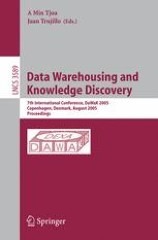
Data warehousing and knowledge discovery ; Vol.3589 ; 7th international conference, DaWak 2005, Copenhagen, Denmark, August 22-26, 2005, Proceedings
For more than a decade, data warehousing and knowledge discovery technologies have been developing into key technologies for decision-making processes in com- nies. Since 1999, due to the relevant role of these technologies in academia and ind- try, the Data Warehousing and Knowledge Discovery (DaWaK) conference series have become an international forum where both practitioners and researchers share their findings, publish their relevant results and dispute in depth research issues and experiences on data warehousing and knowledge discovery systems and applications.

Data Warehousing and Knowledge Discovery ; 9th International Conference, DaWaK 2007, Regensburg, Germany, September 3-7, 2007, Proceedings
Data Warehousing and Knowledge Discovery have been widely accepted as key te- nologies for enterprises and organizations to improve their abilities in data analysis, decision support, and the automatic extraction of knowledge from data. With the exponentially growing amount of information to be included in the decision-making process, the data to be processed become more and more complex in both structure and semantics. Consequently, the process of retrieval and knowledge discovery from this huge amount of heterogeneous complex data constitutes the reality check for research in the area.

Data Warehousing and Knowledge Discovery ; 4th International Conference, DaWaK 2002, Aix-en-Provence, France, September 4-6, 2002. Proceedings
Within the last few years Data Warehousing and Knowledge Discovery technology has established itself as a key technology for enterprises that wish to improve the quality of the results obtained from data analysis, decision support, and the automatic extraction of knowledge from data. The Fourth International Conference on Data Warehousing and Knowledge Discovery (DaWaK 2002) continues a series of successful conferences dedicated to this topic. Its main objective is to bring together researchers and practitioners to discuss research issues and experience in developing and deploying data warehousing and knowledge discovery systems, applications, and solutions.

Data Warehousing and Knowledge Discovery ; 10th International Conference, DaWaK 2008 Turin, Italy, September 2-5, 2008 Proceedings
This book constitutes the refereed proceedings of the 10th International Conference on Data Warehousing and Knowledge Discovery, DaWak 2008, held in Turin, Italy, in September 2008.

Data Warehousing and Data Mining Techniques for Cyber Security
It provide techniques for collecting information from distributed databases and for performing data analysis. The ever expanding, tremendous amount of data collected and stored in large databases has far exceeded our human ability to comprehend--without the proper tools. There is a critical need for data analysis that can automatically analyze data, summarize it and predict future trends. In the modern age of Internet connectivity, concerns about denial of service attacks, computer viruses and worms are extremely important. Data Warehousing and Data Mining Techniques for Cyber Security contributes to the discipline of security informatics. The author discusses topics that intersect cyber security and data mining, while providing techniques for improving cyber security. Since the cost of information processing and internet accessibility is dropping, an increasing number of organizations are becoming vulnerable to cyber attacks. This volume introduces techniques for applications in the area of retail, finance, and bioinformatics, to name a few.

Data Management in Grid and Peer-to-Peer Systems ; 1st International Conference, Globe 2008, Turin, Italy, September 3, 2008. Proceedings
This book constitutes the refereed proceedings of the First International Conference on Data Management in Grid and Peer-to-Peer Systems, Globe 2008, held in Turin, Italy, in September 2008.

Journal on Data Semantics XI
The LNCS Journal on Data Semantics is devoted to the presentation of notable work that, in one way or another, addresses research and development on issues related to data semantics. The scope of the journal ranges from theories supporting the formal definition of semantic content to innovative domain-specific applications of semantic knowledge. The journal addresses researchers and advanced practitioners working on the semantic web, interoperability, mobile information services, data warehousing, knowledge representation and reasoning, conceptual database modeling, ontologies, and artificial intelligence.

Journal on Data Semantics X
Web semantics and semi-structured data , Semantic caching , Data warehousing and semantic data mining , Spatial, temporal, multimedia and multimodal semantics , Semantics in data visualization , Semantic services for mobile users , Supporting tools , Applications of semantic-driven approaches These topics are to be understood as specifically related to semantic issues. Contributions submitted to the journal and dealing with semantics of data will be considered even if they are not from the topics in the list. While the physical appearance of the journal issues is like the books from the we- known Springer LNCS series, the mode of operation is that of a journal. Contributions can be freely submitted by authors and are reviewed by the Editorial Board.

Journal on Data Semantics VIII
Springer's LNCS Journal on Data Semantics aims at providing a highly visible dissemination channel for most remarkable work that in one way or another addresses research and development on issues related to the semantics of data. The target domain ranges from theories supporting the formal definition of semantic content to innovative domain-specific application of semantic knowledge. This publication channel should be of the highest interest to researchers and advanced practitioners working on the Semantic Web, interoperability, mobile information services, data warehousing, knowledge representation and reasoning, conceptual database modeling, ontologies, and artificial intelligence.

Journal on Data Semantics VII
The LNCS Journal on Data Semantics is devoted to the presentation of notable work that, in one way or another, addresses research and development on issues related to data semantics. Based on the highly visible publication platform Lecture Notes in Computer Science, this new journal is widely disseminated and available worldwide. The scope of the journal ranges from theories supporting the formal definition of semantic content to innovative domain-specific applications of semantic knowledge. The journal addresses researchers and advanced practitioners working on the semantic web, interoperability, mobile information services, data warehousing, knowledge representation and reasoning, conceptual database modeling, ontologies, and artificial intelligence.

Journal on Data Semantics VI
Data warehousing and semantic data mining • Spatial, temporal, multimedia and multimodal semantics • Semantics in data visualization • Semantic services for mobile users • Supporting tools • Applications of semantic-driven approaches These topics are to be understood as speci?cally related to semantic issues. Contributions submitted to the journal and dealing with semantics of data will be considered even if they are not within the topics in the list. While the physical appearanceof the journal issues looks like the books from the well-known Springer LNCS series, the mode of operation is that of a jo- nal. Contributions can be freely submitted by authors and are reviewed by the Editorial Board. Contributions may also be invited, and nevertheless carefully reviewed, as in the case for issues that contain extended versions of best papers from major conferences addressing data semantics issues. Special issues, foc- ing on a speci?c topic, are coordinated by guest editors once the proposal for a special issue is accepted by the Editorial Board.

Journal on Data Semantics V
The LNCS Journal on Data Semantics is devoted to the presentation of notable work that, in one way or another, addresses research and development on issues related to data semantics. Based on the highly visible publication platform Lecture Notes in Computer Science, this new journal is widely disseminated and available worldwide. The scope of the journal ranges from theories supporting the formal definition of semantic content to innovative domain-specific applications of semantic knowledge. The journal addresses researchers and advanced practitioners working on the semantic web, interoperability, mobile information services, data warehousing, knowledge representation and reasoning, conceptual database modeling, ontologies, and artificial intelligence.

Journal on Data Semantics III
– semantic caching – data warehousing and semantic data mining – spatial, temporal, multimedia and multimodal semantics – semantics in data visualization – semantic services for mobile users – supporting tools – applications of semantic-driven approaches These topics are to be understood as speci?cally related to semantic issues. Contributions submitted to the journal and dealing with semantics of data will be considered even if they are not within the topics in the list. While the physical appearance of the journal issues looks like the books from the well-known Springer LNCS series, the mode of operation is that of a journal. Contributions can be freely submitted by authors and are reviewed by the Editorial Board. Contributions may also be invited, and nevertheless carefully reviewed, as in the case for issues that contain extended versions of best papers from major conferences addressing data semantics issues. Special issues, focusing on a speci?c topic, are coordinated by guest editors once the proposal for a special issue is accepted by the Editorial Board. Finally, it is also possible that a journal issue be devoted to a single text.
