



الصفحة 1
الصفحة 1

Human-computer interaction – INTERACT 2007 ; 11th IFIP TC 13 International Conference, Rio de Janeiro, Brazil, September 10-14, 2007, Proceedings, Part I
The two volume set LNCS 4662 and LNCS 4663 constitutes the refereed proceedings of the 11th IFIP TC13 International Conference on Human-Computer Interaction, INTERACT 2007, held in Rio de Janeiro, Brazil, in September 2007.

Groupware : design, implementation, and use ; Vol. 3706 ; 11th International workshop, CRIWG 2005, Porto de Galinhas, Brazil, September 25-29, 2005, Proceedings
This book constitutes the refereed proceedings of the 11th International Workshop on Groupware, CRIWG 2005, held in Porto de Galinhas, Brazil in September 2005. The 16 revised full papers and 13 revised short papers presented together with a keynote paper were carefully reviewed and selected from 67 submissions. The papers are organized in topical sections on groupware development, collaborative applications, workflow management, knowledge management, computer supported collaborative learning, group decision support systems, mobile collaborative work, and work modeling in CSCW.

Fieldwork for Design : Theory and Practice
Fieldwork for Design looks at why ethnographic approaches have been turned to in the design of computing devices for the workplace, for the home and elsewhere. It presents a history of ethnography, both as it was practiced before computer science picked it up and since, most especially in the CSCW and HCI domains. It examines, further, the various ethnographic or ‘fieldwork’ frameworks currently popular, explaining and examining what each claims and entails. The focus of the book throughout is on the practical relationship between theory and practice, a relationship that is often misunderstood yet fundamental to successful design.

Enterprise Knowledge Infrastructures
Success of an organization is increasingly dependent on its capability to create an environment to improve the productivity of knowledge work. This book focuses on the concepts, models and technologies that are used to design and implement such an environment. It develops the vision of a modular, yet highly integrated enterprise knowledge infrastructure and presents an ideal architecture replete with current technologies and systems. The most important streams of technological development that are covered in the book are computer-supported cooperative work, document and content management, e-learning, enterprise portals, information life cycle management, knowledge management, mobile computing, and the Semantic Web. It includes learning goals, exercises and case examples that help the reader to easily understand and practice the concepts.
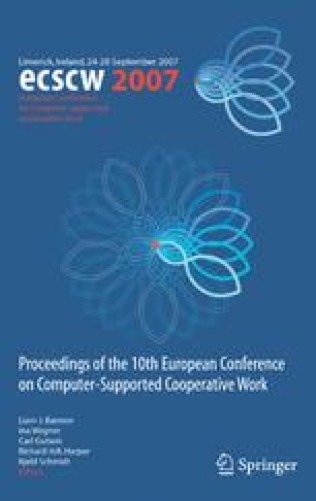
ECSCW 2007 ; Proceedings of the 10th European Conference on Computer-Supported Cooperative Work, Limerick, Ireland, 24-28 September 2007
The volume includes papers addressing novel interaction technologies for CSCW systems, new models and architectures for groupware systems, studies of communication and coordination among mobile actors, studies of cooperative work in complex settings, studies of groupware systems in actual use in real-world settings, and theories and techniques to support the development of cooperative applications. The papers present emerging technologies alongside new methods and approaches to the development of this important class of applications.

ECSCW 2005 ; Proceedings of the ninth European conference on computer-supported cooperative work, 18-22 September 2005, Paris, France
These proceedings contain a collection of papers that reflect the variegated research activities in the field. The volume includes papers addressing novel interaction technologies for CSCW systems, new models and architectures for groupware systems, studies of communication and coordination among mobile actors, studies of cooperative work in complex settings, studies of groupware systems in actual use in real-world settings, and theories and techniques to support the development of cooperative applications. The papers present emerging technologies alongside new methods and approaches to the development of this important class of applications. The work in this volume represents the best of the current research and practice within CSCW. The collection of papers presented here will appeal to researchers and practitioners alike, as they combine an understanding of the nature of work with the possibility offered by new technologies.

Computer Supported Cooperative Work in Design I
The design of complex artifacts and systems requires the cooperation of multidisciplinary design teams using multiple commercial and non-commercial engineering tools such as CAD tools, modeling, simulation and optimization software, engineering databases, and knowledge-based systems. Individuals or individual groups of multidisciplinary design teams usually work in parallel and separately with various engineering tools, which are located on different sites, often for quite a long time. At any moment, individual members may be working on different versions of a design or viewing the design from various perspectives, at different levels of detail. In order to meet these requirements, it is necessary to have effective and efficient collaborative design environments. These environments should not only automate individual tasks, in the manner of traditional computer-aided engineering tools, but also enable individual members to share information, collaborate and coordinate their activities within the context of a design project. CSCW (computer-supported cooperative work) in design is concerned with the development of such environments.
