



الصفحة 1
الصفحة 1

Multiscale Modeling in Epitaxial Growth
Epitaxy is a very active area of theoretical research since several years. It is experimentally well-explored and technologically relevant for thin film growth. Recently powerful numerical techniques in combination with a deep understanding of the physical and chemical phenomena during the growth process offer the possibility to link atomistic effects at the surface to the macroscopic morphology of the film. The goal of this book is to summarize recent developments in this field, with emphasis on multiscale approaches and numerical methods. It covers atomistic, step-flow, and continuum models and provides a compact overview of these approaches. It also serves as an introduction into this highly active interdisciplinary field of research for applied mathematicians, theoretical physicists and computational materials scientists.

Handbook of Materials Modeling
The first reference of its kind in the rapidly emerging field of computational approachs to materials research, this is a compendium of perspective-providing and topical articles written to inform students and non-specialists of the current status and capabilities of modelling and simulation. From the standpoint of methodology, the development follows a multiscale approach with emphasis on electronic-structure, atomistic, and mesoscale methods, as well as mathematical analysis and rate processes. Basic models are treated across traditional disciplines, not only in the discussion of methods but also in chapters on crystal defects, microstructure, fluids, polymers and soft matter. Written by authors who are actively participating in the current development, this collection of 150 articles has the breadth and depth to be a major contributor toward defining the field of computational materials. In addition, there are 40 commentaries by highly respected researchers, presenting various views that should interest the future generations of the community.

Computational Materials Chemistry : Methods and Applications
As a result of the advancements in algorithms and the huge increase in speed of computers over the past decade, electronic structure calculations have evolved into a valuable tool for characterizing surface species and for elucidating the pathways for their formation and reactivity. It is also now possible to calculate, including electric field effects, STM images for surface structures. To date the calculation of such images has been dominated by density functional methods, primarily because the computational cost of - curate wave-function based calculations using either realistic cluster or slab models would be prohibitive. DFT calculations have proven especially valuable for elucidating chemical processes on silicon and other semiconductor surfaces. However, it is also clear that some of the systems to which DFT methods have been applied have large non-dynamical correlation effects, which may not be properly handled by the current generation of Kohn-Sham-based density functionals. For example, our CASSCF calculations on the Si(001)/acetylene system reveal that at some geometries there is extensive 86 configuration mixing. This, in turn, could signal problems for DFT cal- lations on these systems.
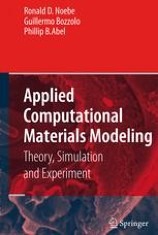
Applied computational materials modeling : Theory, simulation and experiment
this book provides the average person working in the materials field with a more balanced perspective of the role that computational modeling can play in every day research and development efforts. This is done by presenting a series of examples of the successful application of various computational modeling procedures (everything from first principles to quantum approximate to CALPHAD methods) to real life surface and bulk alloy problems.This book should have a large appeal in the materials community, both for experimentalists who would greatly benefit from adding computational methods to their everyday research regimes, as well as for those scientists/engineers familiar with a particular computational method who would like to add complementary techniques to their arsenal of research and development tools
