



الصفحة 1
الصفحة 1

Nuclear Cardiology, The Basics : How to Set Up and Maintain a Laboratory
The purpose of this book is to provide the outline for the "nuts and bolts" establishment and operation of a nuclear cardiology laboratory. In so doing, the authors have attempted to deal with the relevant issues that a laboratory director must address in either setting up the laboratory or maintaining its competitive edge and clinical competence over time. The authors primarily attempted to identify issues related to outpatient imaging facilities. However, where appropriate issues related to inpatients in hospital-based laboratories are also discussed.

Neurodevelopmental Disorders
The book comprises a number of topics related to psychosocial and motor development and is exemplary with regard to its comprehensiveness, as reviews of the topics presented are generally not available in a single publication. It starts with a timely and critical discussion of the genetics of attention deficit hyperactivity disorder by Dr. Buitelaar in which prospects and challenges of this approach are outlined. The next chapter by Drs. Nicolson and Fawcett deals with dyslexia and its relationship to cerebellar function providing a framework that can explain motor, speed, and phonological deficits in a unified approach. Diagnostic and treatment aspects of speech development disorders are the focus of Dr. Zorowka’s contribution in which, among other issues, the necessity of mul- professional cooperation is stressed. Dr. Sigmundsson then focuses on disorders of motor development. 6-10 % of children have motor competence well below the norm, which often persist.

Medical and healthcare interactions
Presenting a series of empirical studies by scholars working with approaches from ethnomethodology and conversation analysis, Medical and Healthcare Interactions studies real-life work and training encounters among medical and healthcare professionals and trainees or between professionals and patients. Using video analysis and detailed description, it considers the methods and procedures through which professionals, trainees, and patients produce actions and interpret those of others, exploring questions of member competence and socialization within situated courses of interaction. Offers fruitful contributions for training and education in the field of healthcare and will appeal to scholars in the human and social sciences with interests in interaction, ethnomethodology, and conversation analysis.

Measuring Professional Competence for the Teaching of Mathematical Modelling : A Test Instrument
This book presents a structural model and an associated test instrument designed to provide a detailed analysis of professional competences for teaching mathematical modelling. The conceptualisation is based on the COACTIV model, which describes aspects, areas and facets of professional competences of teachers. The manual provides an overview of the essential teaching skills in application-related contexts and offers the tools needed to capture these aspects. It discusses the objectives and application areas of the instrument, as well as the development of the test. In addition, it describes the implementation and evaluates the quality and results of the structural equation analysis of the model.

Internal Crowdsourcing in Companies : Theoretical Foundations and Practical Applications
This book examines the implications of internal crowdsourcing (IC) in companies. Presenting an employee-oriented, cross-sector reference model for good IC practice, it discusses the core theoretical foundations, and offers guidelines for process-management and blueprints for the implementation of IC. Furthermore, it examines solutions for employee training and competence development based on crowdsourcing.

Internal communication and management : Theory and praxis communication-centered management
Deals with these topics Fundamentals of corporate management Introduction to communication-based management theory Perspectives of internal communication in the context of agile management Tasks of corporate management Factors of leadership communication, including normative leadership, strategic controlling and innovation management Outlook for future developments in internal communication

Intercultural Language Use and Language Learning
This volume attempts to address an issue that deserves further attention on the part of language acquisition researchers: that of intercultural learners in instructed language contexts. Given the fact that most speech communities where such learning takes place are at least bilingual, and the idea that English is studied for the purposes of communication among people from different cultures, the book focuses on English learners as intercultural speakers. In so doing, the volume brings together three main research areas: those of the study of English as a lingua franca, the development of communicative competence and the use and acquisition of a language beyond a second one in instructed contexts.

Informatics education - supporting computational thinking ; 3rd International Conference on informatics in secondary schools : Evolution and perspectives, ISSEP 2008 Torun Poland, July 1-4, 2008 Proceedings
Informatics Education – Supporting Computational Thinking contains papers presented at the Third International Conference on Informatics in Secondary Schools – Evolution and Perspective, ISSEP 2008, held in July 2008 in Torun, Poland. As with the proceedings of the two previous ISSEP conferences (2005 in Klag- furt, Austria, and 2006 in Vilnius, Lithuania), the papers presented in this volume address issues of informatics education transcending national boundaries and, the- fore, transcending differences in the various national legislation and organization of the educational system. Observing these issues, one might notice a trend. The p- ceedings of the First ISSEP were termed From Computer Literacy to Informatics F- damentals [1]. There, broad room was given to general education in ICT.

Immunosenescence
In this volume not only the mechanisms responsible for immune ageing in humans but consider what might be accomplished to redress the erosion of immune competence with age.

IEA International Computer and Information Literacy Study 2018 Assessment Framework
This book is designed to assess how well students are prepared for study, work and life in a digital world. The study measures international differences in students’ computer and information literacy (CIL): their ability to use computers to investigate, create, participate and communicate at home, at school, in the workplace and in the community. Participating countries also have an option for their students to complete an assessment of computational thinking (CT). The ICILS assessment framework articulates the basic structure of the study, providing a description of the field and the constructs to be measured. This book outlines the design and content of the measurement instruments, sets down the rationale for those designs, and describes how measures generated by those instruments relate to the constructs. Hypothesized relations between constructs provide the foundation for some of the analyses that follow.

High-quality outdoor learning : Evidence-based education Outside the classroom for children, teachers and society
Reviews evidence and case studies on the effects of outdoor learning on teachers and learners. It shows how real-world learning outside the classroom contributes to unlocking the full potential of learners, demonstrating its benefits for academic learning, social competencies, personal and emotional development, psychological well-being, and physical activity and health. In addition, the book highlights how outdoor learning nurtures environmental awareness and helps learners to tackle current sustainability challenges. Its focus on high-quality learning makes it a unique contribution to the implementation of SDG 4. Aimed at lecturers at teacher training universities, teachers, professional educators, coaches, and multipliers who train staff of educational NGOs, as well as decision makers on all levels of education systems, this book is of interest to all those who seek a more in-depth understanding of the future of education.

Higher Education and Graduate Employment in Europe : Results from Graduates Surveys from Twelve Countries
The book indicates a noteworthy variety among economically advanced countries in the competences fostered by Higher Education and the emphasis placed either on laying a broad basis of knowledge or direct preparation for professional tasks. While universities in some countries are strongly involved in ensuring a rapid transition from study to employment, in other countries a long period after graduation is widespread for the search of a suitable career. Graduates from some countries appreciate their study experiences though they criticize a weak preparation for their subsequent assignments, while others less satisfied with higher education in their retrospective view note a satisfying preparation for the world of work. Study often turns out useful to lead to challenging tasks even though remuneration and status remain below expectations.

High performance computing in science and engineering, Garching 2004 ; Transaction of the KONWIHR Result Workshop, October 14-15, 2004, Technical University of Munich, Garching, Germany
This volume of High Performance Computing in Science and Engineering is fully dedicated to the final report of KONWIHR, the Bavarian Competence Network for Technical and Scientific High Performance Computing. It covers projects from basic research in computer science to develop tools for high performance computing as well as applications from biology, chemistry, electrical engineering, geology, mathematics, physics, computational fluid dynamics, materials science and computer science.

Global perspectives on recognising non-formal and Informal Learning : Why recognition matters
This book deals with the relevance of recognition and validation of non-formal and informal learning in education and training, the workplace and society. In an increasing number of countries, it is at the top of the policy and research agenda ranking among the possible ways to redress the glaring lack of relevant academic and vocational qualifications and to promote the development of competences and certification procedures which recognise different types of learning, including formal, non-formal and informal learning. The aim of the book is therefore to present and share experience, expertise and lessons in such a way that enables its effective and immediate use across the full spectrum of country contexts, whether in the developing or developed world. It examines the importance of meeting institutional and political requirements that give genuine value to the recognition of non-formal and informal learning; it shows why recognition is important and clarifies its usefulness and the role it serves in education, working life and voluntary work; it emphasises the importance of the coordination, interests, motivations, trust and acceptance by all stakeholders.

Global Citizenship Education : Critical and International Perspectives
This book takes a critical and international perspective to the mainstreaming of the Global Citizenship Concept and analyses the key issues regarding global citizenship education across the world. In that respect, it addresses a pressing need to provide further conceptual input and to open global citizenship agendas to diversity and indigeneity.

Equity, Equality and Diversity in the Nordic : Model of Education
Does the Nordic model of education still stand by its original principles and safeguard education for all? This Open Access volume is a carefully crafted collection of chapters that investigate the different aspects of equity, equality and diversity across the education systems in the Nordic countries.

Environments for Multi-Agent Systems ; 1st International Workshop, E4MAS, 2004, New York, NY, July 19, 2004, Revised Selected Papers
The modern ?eld of multiagent systems has developed from two main lines of earlier research. Its practitioners generally regard it as a form of arti?cial intelligence (AI). Some of its earliest work was reported in a series of workshops in the US dating from1980,revealinglyentitled,“DistributedArti?cialIntelligence,”andpioneers often quoted a statement attributed to Nils Nilsson that “all AI is distributed. ” The locus of classical AI was what happens in the head of a single agent, and much MAS research re?ects this heritage with its emphasis on detailed modeling of the mental state and processes of individual agents. From this perspective, intelligenceisultimatelythepurviewofasinglemind,thoughitcanbeampli?ed by appropriate interactions with other minds. These interactions are typically mediated by structured protocols of various sorts, modeled on human conver- tional behavior. But the modern ?eld of MAS was not born of a single parent. A few - searchershavepersistentlyadvocatedideasfromthe?eldofarti?ciallife(ALife). These scientists were impressed by the complex adaptive behaviors of commu- ties of animals (often extremely simple animals, such as insects or even micro- ganisms). The computational models on which they drew were often created by biologists who used them not to solve practical engineering problems but to test their hypotheses about the mechanisms used by natural systems. In the ar- ?cial life model, intelligence need not reside in a single agent, but emerges at the level of the community from the nonlinear interactions among agents. - cause the individual agents are often subcognitive, their interactions cannot be modeled by protocols that presume linguistic competence.

English for Business Communication
Key features of this book include: use of English in social media that reflects recent trends in business communication; coverage of the concept of communicative competence; analysis of email communication; introduction to informal English and English for socialisation as well as goodwill messages, such as thank you or appreciation messages, which are a part of everyday interaction in the workplace; examination of persuasive messages and ways to understand such messages.
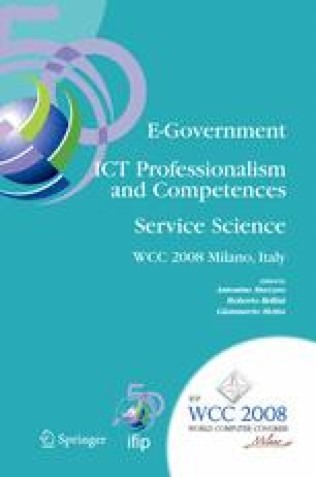
E-Government Ict Professionalism and Competences Service Science ; IFIP 20th World Computer Congress, Industry Oriented Conferences, September 7-10, 2008, Milano, Italy
The IFIP series publishes state-of-the-art results in the sciences and technologies of information and communication. The principal aim of the IFIP series is to encourage education and the dissemination and exchange of information about all aspects of computing.

Effectiveness of University Education in Italy : Employability, Competences, Human Capital
In this volume we present papers on the effectiveness of university education, on employability of graduates, with a discussion on the opportunity to consider the employment rate as the main assessment indicator, on competence analysis for backward assessment purposes and finally on university human capital indicators.
