



الصفحة 1
الصفحة 1

Multiscale Methods : Averaging and Homogenization
This introduction to multiscale methods gives readers a broad overview of the many uses and applications of the methods. The book begins by setting the theoretical foundations of the subject area, and moves on to develop a unified approach to the simplification of a wide range of problems which possess multiple scales, via perturbation expansions; differential equations and stochastic processes are studied in one unified framework. The book concludes with an overview of a range of theoretical tools used to justify the simplified models derived via the perturbation expansions.

Isomorphisms Between H¹ Spaces
Presents a thorough and self-contained presentation of H¹ and its known isomorphic invariants, such as the uniform approximation property, the dimension conjecture, and dichotomies for the complemented subspaces. The necessary background is developed from scratch. This includes a detailed discussion of the Haar system, together with the operators that can be built from it (averaging projections, rearrangement operators, paraproducts, Calderon-Zygmund singular integrals). Complete proofs are given for the classical martingale inequalities of C. Fefferman, Burkholder, and Khinchine-Kahane, and for large deviation inequalities. Complex interpolation, analytic families of operators, and the Calderon product of Banach lattices are treated in the context of H^p spaces. Througout the book, special attention is given to the combinatorial methods developed in the field, particularly J. Bourgain's proof of the dimension conjecture, L. Carleson's biorthogonal system in H¹, T. Figiel's integral representation, W.B. Johnson's factorization of operators, B. Maurey's isomorphism, and P. Jones' proof of the uniform approximation property. An entire chapter is devoted to the study of combinatorics of colored dyadic intervals."
Hamiltonian dynamical systems and applications
This volume is the collected and extended notes from the lectures on Hamiltonian dynamical systems and their applications that were given at the NATO Advanced Study Institute in Montreal in 2007. Many aspects of the modern theory of the subject were covered at this event, including low dimensional problems as well as the theory of Hamiltonian systems in infinite dimensional phase space; these are described in depth in this volume. Applications are also presented to several important areas of research, including problems in classical mechanics, continuum mechanics, and partial differential equations. These lecture notes cover many areas of recent mathematical progress in this field, including the new choreographies of many body orbits, the development of rigorous averaging methods which give hope for realistic long time stability results, the development of KAM theory for partial differential equations in one and in higher dimensions, and the new developments in the long outstanding problem of Arnold diffusion.
Continuous-Time Systems
The book systematically covers major foundations of the systems theory. First, the quantitative and qualitative methods of systems description are presented along with the stability analysis. The representation of linear time-invariant systems in the time domain is provided using the convolution, ordinarily differential equations (ODEs), and state space. In the frequency domain, these systems are analyzed using the Fourier and Laplace transforms. The linear time-varying systems are represented using the general convolution, ODEs, and state space. The nonlinear time-invariant systems are described employing the Taylor and Volterra series expansions, ODEs, state space, and approximate methods such as averaging, equivalent linearization, and describing function. Finally, the representation of nonlinear time-varying systems is given using the Taylor and Volterra series, ODEs, modulation functions method, and state space modelling.
Machine Learning and Knowledge Discovery in Databases ; European Conference, ECML PKDD 2008, Antwerp, Belgium, September 15-19, 2008, Proceedings, Part I
Constitutes the refereed proceedings of the joint conference on Machine Learning and Knowledge Discovery in Databases: ECML PKDD 2008, held in Antwerp, Belgium, in September 2008.The 100 papers presented in two volumes, together with 5 invited talks, were carefully reviewed and selected from 521 submissions. In addition to the regular papers the volume contains 14 abstracts of papers appearing in full version in the Machine Learning Journal and the Knowledge Discovery and Databases Journal of Springer.
Averaging Methods in Nonlinear Dynamical Systems
The authors have presented an extensive revision of the first edition of the Averaging Methods in Nonlinear Dynamical Systems book. There are many changes, corrections and updates in chapters on Basic Material and Asymptotics, Averaging, and Attraction.
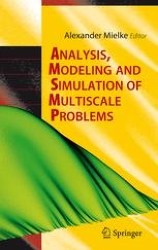
Analysis, Modeling and Simulation of Multiscale Problems
This book reports recent mathematical developments in the Programme "Analysis, Modeling and Simulation of Multiscale Problems", which started as a German research initiative in 2006. Multiscale problems occur in many fields of science, such as microstructures in materials, sharp-interface models, many-particle systems and motions on different spatial and temporal scales in quantum mechanics or in molecular dynamics. The book presents current mathematical foundations of modeling, and proposes efficient numerical treatment.

Aggregation functions : A guide for practitioners
Aggregation of information is of primary importance in the construction of knowledge based systems in various domains, ranging from medicine, economics, and engineering to decision-making processes, artificial intelligence, robotics, and machine learning. This book gives a broad introduction into the topic of aggregation functions, and provides a concise account of the properties and the main classes of such functions, including classical means, medians, ordered weighted averaging functions, Choquet and Sugeno integrals, triangular norms, conorms and copulas, uninorms, nullnorms, and symmetric sums. It also presents some state-of-the-art techniques, many graphical illustrations and new interpolatory aggregation functions. A particular attention is paid to identification and construction of aggregation functions from application specific requirements and empirical data. This book provides scientists, IT specialists and system architects with a self-contained easy-to-use guide, as well as examples of computer code and a software package. It will facilitate construction of decision support, expert, recommender, control and many other intelligent systems.
