



الصفحة 1
الصفحة 1

From Animals to Animats 10 ; 10th International Conference on Simulation of Adaptive Behavior, SAB 2008, Osaka, Japan, July 7-12, 2008. Proceedings
This book constitutes the refereed proceedings of the 10th International Conference on Simulation of Adaptive Behavior, SAB 2008, held in Osaka, Japan in July 2008.The 30 revised full papers and 21 revised poster papers presented were carefully reviewed and selected from 110 submissions. The papers are organized in topical sections on the animat approach to adaptive behaviour, evolution, navigation and internal world models, perception and control, learning and adaptation, cognition, emotion and behaviour, collective and social behaviours, adaptive behaviour in language and communication, and applied adaptive behaviour.

DARPA Grand Challenge : The Great Robot Race
The goal of the new series of Springer Tracts in Advanced Robotics (STAR) is to bring, in a timely fashion, the latest advances and developments in robotics on the basis of their significance and quality. It is our hope that the wider dissemination of research developments will stimulate more exchanges and collaborations among the research community and contribute to further advancement of this rapidly growing field. The volume edited by Martin Buehler, Karl Iagnemma and Sanjiv Singh presents a unique and extensive collection of the scientific results by the teams which took part into the DARPA Grand Challenge in October 2005 in the Nevada desert. This event reached an incredible peak of popularity in the media, the race of the century like someone called it! The Grand Challenge demonstrated the fast growing progress - ward the development of robotics technology, as it showed the feasibility of using mobile robots operating autonomously in real world scenarios.
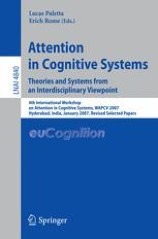
Attention in Cognitive Systems : Theories and Systems from an Interdisciplinary Viewpoint ; 4th International Workshop on Attention in Cognitive Systems, WAPCV 2007 Hyderabad, India, January 8, 2007 Revised Selected Papers
The embodied nature of sensory-motor intelligence requires a continuous and focused interplay between the control of motor activities and the interpretation of feedback from perceptual modalities. Decision making about the selection of information from the incoming sensory stream – in tune with contextual processing on a current task and an agent’s global objectives – becomes a further challenging issue in attentional control. Attention must operate at interfaces between bottom-up driven world int- pretation and top-down driven information selection, thus acting at the core of arti?cial cognitive systems. These insights have already induced changes in AI-related disciplines, such as the design of behavior-based robot control and the computational modeling of animats. Today, the development of enabling technologiessuch as autonomous robotic systems,miniaturizedmobile–evenwearable–sensors,andambientintelligence systems involves the real-time analysis of enormous quantities of data. These data have to be processed in an intelligent way to provide “on time delivery” of the required relevant information. Knowledge has to be applied about what needs to be attended to, and when, and what to do in a meaningful sequence, in correspondence with visual feedback.
