



الصفحة 1
الصفحة 1

Numerical Methods and Applications ; 6th International Conference, NMA 2006, Borovets, Bulgaria, August 20-24, 2006, Revised Papers
This book constitutes the thoroughly refereed post-proceedings of the 6th International Conference on Numerical Methods and Applications, NMA 2006. The papers are organized in topical sections on numerical methods for hyperbolic problems, robust preconditioning solution methods, Monte Carlo and quasi-Monte Carlo for diverse applications, metaheuristics for optimization problems, uncertain/control systems and reliable numerics, interpolation and quadrature processes, large-scale computations in environmental modelling, and contributed talks.
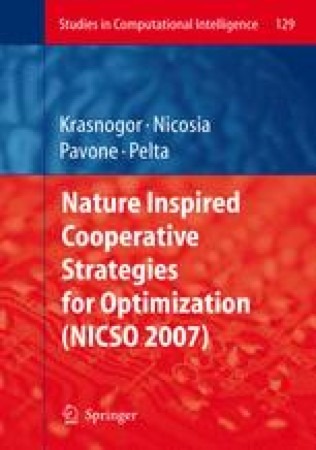
Nature Inspired Cooperative Strategies for Optimization (NICSO 2007)
The aim for NICSO 2007 was to provide a forum were the latest ideas and state of the art research related to cooperative strategies for problem solving arising from Nature could be discussed. The contributions collected in this book were strictly peer reviewed by at least three members of the international programme committee, to whom we are indebted for their support and assistance. The topics covered by the contributions include several well established nature inspired techniques like Genetic Algorithms, Ant Colonies, Artificial Immune Systems, Evolutionary Robotics, Evolvable Systems, Membrane Computing, Quantum Computing, Software Self Assembly, Swarm Intelligence, etc.

Multiobjective Optimization : Interactive and Evolutionary Approaches
Multiobjective optimization deals with solving problems having not only one, but multiple, often conflicting, criteria. Such problems can arise in practically every field of science, engineering and business, and the need for efficient and reliable solution methods is increasing. The task is challenging due to the fact that, instead of a single optimal solution, multiobjective optimization results in a number of solutions with different trade-offs among criteria, also known as Pareto optimal or efficient solutions. Hence, a decision maker is needed to provide additional preference information and to identify the most satisfactory solution. Depending on the paradigm used, such information may be introduced before, during, or after the optimization process. Clearly, research and application in multiobjective optimization involve expertise in optimization as well as in decision support.

Modern asset allocation for wealth management
This book provides a complete taxonomy of modern methods for constructing investment portfolios. It goes beyond the simplest models and heuristics that are commonly used today and brings advances that are otherwise buried in Ph.D.-level mathematics to the financial advisor community. It covers all aspects of creating client portfolios, including choosing asset classes to invest in, selecting securities within asset classes, client risk preference assessment, portfolio construction, and portfolio rebalancing.

Model checking and artificial intelligence ; 4th Workshop, MoChArt IV, Riva del Garda, Italy, August 29, 2006, Revised Selected and Invited Papers
This book constitutes the thoroughly refereed post-proceedings of the 4th Workshop on Model Checking and Artificial Intelligence, MoChArt IV, held in Riva Del Garda, Italy in August 2006, as a satellite event of ECAI0 2006, the 17th biannual European conference on Artificial Intelligence.
Metaheuristics for Scheduling in Industrial and Manufacturing Applications
This book deals with the application of various novel metaheuristics in scheduling. Addressing the various issues of scheduling in industrial and manufacturing applications is the novelty of this edited volume. Important features include the detailed overview of the various novel metaheuristic scheduling approaches, excellent coverage of timely, advanced scheduling topics, state-of-the-art theoretical research and application developments and chapters authored by pioneers in the field.

Metaheuristics for Scheduling in Distributed Computing Environments
This volume presents meta-heuristics approaches for Grid scheduling problems. Due to the complex nature of the problem, meta-heuristics are primary techniques for the design and implementation of efficient Grid schedulers. The volume brings new ideas, analysis, implementations and evaluation of meta-heuristic techniques for Grid scheduling, which make this volume novel in several aspects. The 13 chapters of this volume have identified several important formulations of the problem, which we believe will serve as a reference for the researchers in the Grid computing community.
Metaheuristics for Hard Optimization : Methods and Case Studies
Metaheuristics for Hard Optimization comprises of three parts. The first part is devoted to the detailed presentation of the four most widely known metaheuristics: the simulated annealing method, tabu search, the evolutionary algorithms, and ant colony algorithms. Each one of these metaheuristics is actually a family of methods, of which the essential elements are discussed. In the second part, the book presents some other less widespread metaheuristics, then, extensions of metaheuristics and some ways of research are described . The problem of the choice of a metaheuristic is posed and solution methods are discussed. The last part concentrates on three case studies from telecommunications, air traffic control, and vehicle routing.
Metaheuristics : Progress in Complex Systems Optimization
The aim of METAHEURISTICS: Progress in Complex Systems Optimization is to provide several different kinds of information: a delineation of general metaheuristics methods, a number of state-of-the-art articles from a variety of well-known classical application areas as well as an outlook to modern computational methods in promising new areas. Therefore, this book may equally serve as a textbook in graduate courses for students, as a reference book for people interested in engineering or social sciences, and as a collection of new and promising avenues for researchers working in this field.

Metaheuristics : Progress as Real Problem Solvers
Metaheuristics: Progress as Real Problem Solvers is a peer-reviewed volume of eighteen current, cutting-edge papers by leading researchers in the field. Included are an invited paper by F. Glover and G. Kochenberger, which discusses the concept of Metaheuristic agent processes, and a tutorial paper by M.G.C. Resende and C.C. Ribeiro discussing GRASP with path-relinking. Other papers discuss problem-solving approaches to timetabling, automated planograms, elevators, space allocation, shift design, cutting stock, flexible shop scheduling, colorectal cancer and cartography. A final group of methodology papers clarify various aspects of Metaheuristics from the computational view point

Measure Theory and Probability Theory
The book can be used as a text for a two semester sequence of courses in measure theory and probability theory, with an option to include supplemental material on stochastic processes and special topics.Prerequisites are kept to the minimal level of an understanding of basic real analysis concepts such as limits, continuity, differentiability, Riemann integration, and convergence of sequences and series. A review of this material is included in the appendix. The book starts with an informal introduction that provides some heuristics into the abstract concepts of measure and integration theory, which are then rigorously developed. The first part of the book can be used for a standard real analysis course for both mathematics and statistics Ph.D. students as it provides full coverage of topics such as the construction of Lebesgue-Stieltjes measures on real line and Euclidean spaces, the basic convergence theorems, L^p spaces, signed measures, Radon-Nikodym theorem, Lebesgue's decomposition theorem and the fundamental theorem of Lebesgue integration on R, product spaces and product measures, and Fubini-Tonelli theorems. It also provides an elementary introduction to Banach and Hilbert spaces, convolutions, Fourier series and Fourier and Plancherel transforms.

Interactive Curve Modeling : With Applications to Computer Graphics, Vision and Image Processing
Interactive curve modeling techniques and their applications are extremely useful in a number of academic and industrial settings, and specifically play a significant role in multidisciplinary problem solving, such as in font design, designing objects, CAD/CAM, medical operations, scientific data visualization, virtual reality, character recognition, and object recognition, etc. Various problems such as iris, fingerprint, and signature recognition, can also be intelligently solved and automated using curve techniques.

Intelligent information processing III ; IFIP TC12 International Conference on Intelligent Information Processing (IIP 2006), September 20-23, Adelaide, Australia
The IFIP series publishes state-of-the-art results in the sciences and technologies of information and communication. The principal aim of the IFIP series is to encourage education and the dissemination and exchange of information about all aspects of computing.
Intelligent Decision Making : An AI-Based Approach
This book includes contributions from leading researchers in the field beginning with the foundations of human decision making and the complexity of the human cognitive system. Researchers contrast human and artificial intelligence, survey computational intelligence, present pragmatic systems, and discuss future trends.

Integration of AI and OR Techniques in Constraint Programming for Combinatorial Optimization Problems ; 5th International Conference, CPAIOR 2008 Paris, France, May 20-23, 2008 Proceedings
The 5th International Conference on Integration of AI and OR Techniques in Constraint Programming for Combinatorial Optimization Problems (CPAIOR 2008) was held in Paris, France May 20–23, 2008. The purpose of this conference series is to bring together researchers in the felds of constraint programming, artifcial intelligence, and operations research to explore ways of solving large-scale, practical optimization problems through integration and hybridization of the felds’ diferent techniques. Through the years, this research community is discovering that the felds have much in c- mon, and there has been tremendous richness in the resulting cross-fertilization of felds.
Information Processing with Evolutionary Algorithms : From Industrial Applications to Academic Speculations
The last decade of the 20th century has witnessed a surge of interest in num- ical, computation-intensive approaches to information processing. The lines that draw the boundaries among statistics, optimization, arti cial intelligence and information processing are disappearing, and it is not uncommon to nd well-founded and sophisticated mathematical approaches in application - mains traditionally associated with ad-hoc programming. Heuristics has - come a branch of optimization and statistics. Clustering is applied to analyze soft data and to provide fast indexing in the World Wide Web. Non-trivial matrix algebra is at the heart of the last advances in computer vision. The breakthrough impulse was, apparently, due to the rise of the interest in arti cial neural networks, after its rediscovery in the late 1980s. Disguised as ANN, numerical and statistical methods made an appearance in the - formation processing scene, and others followed. A key component in many intelligent computational processing is the search for an optimal value of some function. Sometimes, this function is not evident and it must be made explicit in order to formulate the problem as an optimization problem. The search - ten takes place in high-dimensional spaces that can be either discrete, or c- tinuous or mixed. The shape of the high-dimensional surface that corresponds to the optimized function is usually very complex. Evolutionary algorithms are increasingly being applied to information processing applications that require any kind of optimization.

Hybrid metaheuristics ; Vol. 4030 ; 3rd International Workshop, HM 2006, Gran Canaria, Spain, October 13-14, 2006, Proceedings
The selection of papers for HM 2006 consolidated some of the mainstream issues that have emerged from the past editions. Firstly, there are prominent examples of e?ective hybrid techniques whose design and implementation were motivated by challenging real-world applications. We believe this is particularly important for two reasons: on the one hand, researchers are conscious that the primary goal of developing algorithms is to solve relevant real-life problems; on the other hand, the path towarde?cient solving methods for practical problems is a source of new outstanding ideas and theories. A second important issue is that the research community on metaheur- tics has become increasingly interested in and open to techniques and methods known from arti?cial intelligence (AI) and operations research (OR). So far, the most representative examples of such integration have been the use of AI/OR techniques as subordinates of metaheuristic methods. As a historical and - ymological note, this is in perfect accordance with the original meaning of a metaheuristic as a “general strategy controlling a subordinate heuristic. ” The awareness of the need for a sound experimental methodology is a third keypoint.

Hybrid metaheuristics ; Vol. 3636 ; 2nd International Workshop, HM 2005, Barcelona, Spain, August 29-30, 2005. Proceedings
Constitutes the refereed proceedings of the Second International Workshop on Hybrid Metaheuristics, HM 2005, held in Barcelona, Spain, in August 2005. In this book, the papers addresses topics such as: low-level hybridization, high-level hybridization, portfolio techniques, expert systems, co-operative search, taxonomy, terminology, and more.

Hybrid metaheuristics ; 5th International Workshop, HM 2008, Málaga, Spain, October 8-9, 2008. Proceedings
This book constitutes the refereed proceedings of the 5th International Workshop on Hybrid Metaheuristics, HM 2008, held in Malaga, Spain, in October 2008.The 14 revised full papers presented were carefully reviewed and selected from 33 submissions. The papers discuss specific aspects of combinations of metaheuristics and other solving techniques for tackling particular relevant constrained optimization problems, such as fiber optic networks, time tabling and freight train scheduling problems.

Hybrid metaheuristics ; 4th International Workshop,HM 2007, Dortmund, Germany, October 8-9, 2007, Proceedings
This book constitutes the refereed proceedings of the 4th International Workshop on Hybrid Metaheuristics, HM 2007, held in Dortmund, Germany. The 14 revised full papers discuss specific aspects of hybridization of metaheuristics, hybrid metaheuristics design, development and testing.
