



الصفحة 95
الصفحة 95

Assembly Language for x86 Processors ; 7th ed.
Focuses on its primary goal, to teach students how to write and debug programs at the machine level. It will never replace a complete book on computer architecture, but it does give students the first-hand experience of writing software in an environment that teaches them how a computer works. Our premise is that students retain knowledge better when theory is combined with experience. In an engineering course, students construct prototypes; in a computer architecture course, students should write machine-level programs.
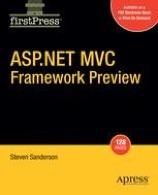
ASP.NET MVC Framework Preview
The ASP.NET MVC framework is the latest evolution of Microsoft's ASP.NET web platform. It introduces a radical high–productivity programming model, promotes cleaner code architecture, supports test–driven development, and provides powerful extensibility, combined with all the benefits of ASP.NET 3.5. ASP.NET MVC Framework Preview is a first look at this technology's main features, designed to give you a head start getting to grips with this powerful new technology.
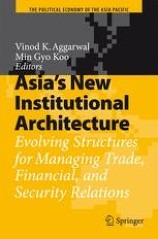
Asias New Institutional Architecture : Evolving Structures for Managing Trade, Financial, and Security Relations
This book investigates the origins and evolution of Asia’s new institutional architecture in trade, finance, and security from both a theoretical and empirical perspective. The traditional institutional equilibrium in Asia has come under heavy strain in the "post triple shocks period" - the post-Cold War, the post-financial crisis of 1997-98, and the post-9-11 attacks. The new dynamics of rivalry and cooperation among states at both the intraregional and transregional levels is now shaping a new institutional architecture. Political and business leaders from Northeast and Southeast Asia interact with each other more frequently. South Asia’s participation in the rest of Asia in recent years is truly impressive. As we show, the future institutional trajectory of Asia is still open, but we believe that the book provides a timely examination of key shifts in the region. In doing so, our hope is to provide policymakers and analysts with an institutional road map for the future.

Asian century … on a knife-edge : A 360 degree analysis of Asia's recent economic development
This book delves into the widely held belief that the 21st century will be the "Asian Century" by examining the Asia's rapid economic development in the post-war era and the challenges it faces in forging ahead of world leaders in the West. The impact of the current turbulent global political climate on Asia is critically analyzed, employing a holistic and multidisciplinary approach, combining economic, social, political and geopolitical perspectives. Written in an accessible style, the book offers students, business, government, and civil society players powerful insights on Asia.

Arts of Allusion : Object, Ornament, and Architecture in Medieval Islam
The art of the object reached unparalleled heights in the medieval Islamic world, yet the deep intellectual dimensions of ceramics, metalwares, and other plastic arts in this milieu have not always been acknowledged. Arts of Allusion reveals the object as a crucial site where premodern craftsmen of the eastern Mediterranean and Persianate realms engaged their creations in fertile dialogue with poetry, literature, painting, and, perhaps most strikingly, architecture. Through close studies of objects from the ninth to the thirteenth centuries, this book reveals that allusions to architecture abound across media in the portable arts of the medieval Islamic world.

Artistic cartography and design explorations towards the pluriverse
Explores the pluriverse of art and design through epistemological and methodological considerations. What kinds of sustainable ways are there for knowledge transfer, supporting plural agendas, finding novel ways for unsettling conversations, unlearning and learning and challenging power structures with marginalised groups and contexts through art and design? The main themes of the book are art and design methods, epistemologies and practices that provide critical, interdisciplinary, pluriversal and decolonial considerations. The book challenges the domination of the white logic of art and design and shifts away from the Anglo-European one-world system towards the pluriverse.

Artificiality and sustainability in entrepreneurship : Exploring the unforeseen, and paving the way to a sustainable future
Explores the past, present, and future of artificiality and sustainability in entrepreneurship – the unforeseen consequences and ways to advance to a sustainable future. In particular, it connects artificiality, sustainability and entrepreneurship, intertwining artificial with the specific phenomenon of those novel digital technologies that provoke continuous and significant change in our lives and business. Unlike digital entrepreneurship research, which focuses on digital technology development and management, this book covers processes and mechanisms of sustainable adaptability of entrepreneurs, the business logic of start-ups, and the collaborative behaviours under the mass digital transformation, including the prevalence of artificial intelligence. Some of the questions that this book answers are as follows: How has entrepreneurship reacted to such challenges previously? What lessons have been learned and need to be carried forward? How can entrepreneurship and the artefacts of entrepreneurship respond to current challenges? What should be the mindset of the entrepreneur to assure sustainable adaptation? How to embrace and embed the new business logic?
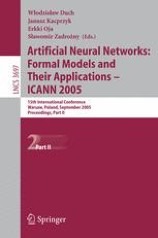
Artificial neural networks : Formal Models and Their Applications – ICANN 2005 ; 15th International Conference, Warsaw, Poland, September 11-15, 2005, Proceedings, Part II
The second volume contains 162 contributions related to Formal Models and their Applications and deals with new neural network models, supervised learning algorithms, ensemble-based learning, unsupervised learning, recurent neural networks, reinforcement learning, bayesian approaches to learning, learning theory, artificial neural networks for system modeling, decision making, optimalization and control, knowledge extraction from neural networks, temporal data analysis, prediction and forecasting, support vector machines and kernel-based methods, soft computing methods for data representation, analysis and processing, data fusion for industrial, medical and environmental applications, non-linear predictive models for speech processing, intelligent multimedia and semantics, applications to natural language processing, various applications, computational intelligence in games, and issues in hardware implementation.
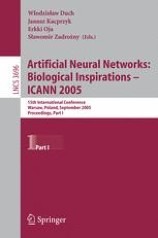
Artificial neural networks : Biological Inspirations – ICANN 2005 ; 15th International Conference, Warsaw, Poland, September 11-15, 2005, Proceedings, Part I
The two volume set LNCS 3696 and LNCS 3697 constitutes the refereed proceedings of the 15th International Conference on Artificial Neural Networks, ICANN 2005, held in Warsaw, Poland in September 2005. The over 600 papers submitted to ICANN 2005 were thoroughly reviewed and carefully selected for presentation. The first volume includes 106 contributions related to Biological Inspirations; topics addressed are modeling the brain and cognitive functions, development of cognitive powers in embodied systems spiking neural networks, associative memory models, models of biological functions, projects in the area of neuroIT, evolutionary and other biological inspirations, self-organizing maps and their applications, computer vision, face recognition and detection, sound and speech recognition, bioinformatics, biomedical applications, and information- theoretic concepts in biomedical data analysis.

Artificial Mind System : Kernel Memory Approach
This book is written from an engineer's perspective of the mind. "Artificial Mind System" exposes the reader to a broad spectrum of interesting areas in general brain science and mind-oriented studies. In this research monograph a picture of the holistic model of an artificial mind system and its behaviour is drawn, as concretely as possible, within a unified context, which could eventually lead to practical realisation in terms of hardware or software. With a view that "the mind is a system always evolving", ideas inspired by many branches of studies related to brain science are integrated within the text, i.e. artificial intelligence, cognitive science / psychology, connectionism, consciousness studies, general neuroscience, linguistics, pattern recognition / data clustering, robotics, and signal processing.
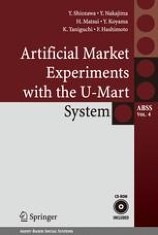
Artificial Market Experiments with the U-Mart System
Economics went through great development in the 20th century. This development, which was based mainly on mathematical methods, is not an appropriate method of analyzing markets that change every hour and every day. In a stock market, prices constantly change depending on speculation. U-Mart, a manmade market, has been proposed in order to study such instantly moving markets. Although the U-Mart system is internationally acclaimed for being at the forefront of market research, its use is by no means limited to a small number of researchers on the fringe. The whole system, including its source code, is open and is distributed without charge, testifying to a philosophy of creating and providing a common testbed for research into financial markets.

Artificial life models in software
Artificial Life Models in Software presents software tools, environments and realities dealing with creation, imitation and analysis of artefactual, virtual and living forms, written by those who personally design and produce software, hardware and art installations in artificial life, simulated complex systems and virtual worlds. This timely volume offers a nearly exhaustive overview and original analysis of major non-profit artificial life software packages. The carefully selected topics include: · simulation of real and imaginary life forms and their evolution · self-organization · emergent behaviours · swarm intelligence · evolutionary robotics · agent-based simulations · adaptive, complex and biologically inspired ecosystems · creative computer art There has long been a need within the academic and research community for an informal introduction and guidance to modern software tools for modelling and simulation of life-like phenomena – Artificial Life Models in Software fills this gap and provides invaluable information to both professional and amateur readers, offering detailed reviews of contemporary software for artificial life.

Artificial Intelligent Techniques for Wireless Communication and Networking
Wireless communication and networking based on AI concepts and techniques are explored in this book, specifically focusing on the current research in the field by highlighting empirical results along with theoretical concepts. The possibility of applying AI mechanisms towards security aspects in the communication domain is elaborated; also explored is the application side of integrated technologies that enhance AI-based innovations, insights, intelligent predictions, cost optimization, inventory management, identification processes, classification mechanisms, cooperative spectrum sensing techniques, ad-hoc network architecture, and protocol and simulation-based environments.

Artificial intelligence techniques in hydrology and water resources management
The sustainable management of water cycles is crucial in the context of climate change and global warming. It involves managing global, regional, and local water cycles, as well as urban, agricultural, and industrial water cycles, to conserve water resources and their relationships with energy, food, microclimates, biodiversity, ecosystem functioning, and anthropogenic activities. Hydrological modeling is indispensable for achieving this goal, as it is essential for water resources management and the mitigation of natural disasters. In recent decades, the application of artificial intelligence (AI) techniques in hydrology and water resources management has led to notable advances. In the face of hydro-geo-meteorological uncertainty, AI approaches have proven to be powerful tools for accurately modeling complex, nonlinear hydrological processes and effectively utilizing various digital and imaging data sources, such as ground gauges, remote sensing tools, and in situ Internet of Things (IoT) devices.

Artificial intelligence in theory and practice ; IFIP 19th World Computer Congress, TC 12: IFIP AI 2006 Stream, August 21-24, 2006, Santiago, Chile
The IFIP series publishes state-of-the-art results in the sciences and technologies of information and communication. The scope of the series includes: foundations of computer science; software theory and practice; education; computer applications in technology; communication systems; systems modeling and optimization; information systems; computers and society; computer systems technology; security and protection in information processing systems; artificial intelligence; and human-computer interaction. Proceedings and post-proceedings of referred international conferences in computer science and interdisciplinary fields are featured.

Artificial intelligence in HCI ; 1st International conference, AI-HCI 2020, Held as Part of the 22nd HCI International Conference, HCII 2020, Copenhagen, Denmark, July 19–24, 2020, Proceedings
This book constitutes the refereed proceedings of the First International Conference on Artificial Intelligence in HCI, AI-HCI 2020, held as part of the 22nd International Conference on Human-Computer Interaction, HCII 2020, in July 2020. The conference was planned to be held in Copenhagen, Denmark, but had to change to a virtual conference mode due to the COVID-19 pandemic.

Artificial intelligence hardware design : Challenges and solutions
Learn foundational and advanced topics in Neural Processing Unit design with real-world examples from leading voices in the field. A thorough introduction to neural networks and neural network development history, as well as Convolutional Neural Network (CNN) models Explorations of various parallel architectures, including the Intel CPU, Nvidia GPU, Google TPU, and Microsoft NPU, emphasizing hardware and software integration for performance improvement Discussions of streaming graph for massive parallel computation with the Blaize GSP and Graphcore IPU An examination of how to optimize convolution with UCLA Deep Convolutional Neural Network accelerator filter decomposition

Artificial intelligence based cancer nanomedicine : Diagnostics, therapeutics and bioethics
Nanomedicine is evolving with novel drug formulations devised for multifunctional approaches towards diagnostics ad therapeutics. Nanomedicine-based drug therapy is normally explored at a fixed dose. The drug action is time-dependent, dose-dependent and patient-specific. To overcome challenges of nanomedicine testing, artificial intelligence (AI) serves as a helping tool for optimizing the drug and dose parameters. Real time conversions between these two features enables upgradation of patient data acquisition and improved design of nanomaterials. In this scenario, AI-based pattern analysis and algorithms models can greatly improve accuracy of diagnostics and therapeutics.
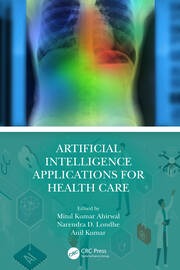
Artificial Intelligence Applications for Health Care
Covers topics on health care and artificial intelligence. Data sets related to biomedical signals (ECG, EEG, EMG) and images (X-rays, MRI, CT) are explored, analyzed, and processed through different computation intelligence methods. Applications of computational intelligence techniques like artificial and deep neural networks, swarm optimization, expert systems, decision support systems, clustering, and classification techniques on medial datasets are explained. Survey of medical signals, medial images, and computation intelligence methods are also provided.

Artificial intelligence applications and innovations ; 3rd IFIP Conference on Artificial Intelligence Applications and Innovations (AIAI), 2006, June 7-9, 2006, Athens, Greece
The IFIP series publishes state-of-the-art results in the sciences and technologies of information and communication. The scope of the series includes: foundations of computer science; software theory and practice; education; computer applications in technology; communication systems; systems modeling and optimization; information systems; computers and society; computer systems technology; security and protection in information processing systems; artificial intelligence; and human-computer interaction. Proceedings and post-proceedings of referred international conferences in computer science and interdisciplinary fields are featured. These results often precede journal publication and represent the most current research.
