



الصفحة 93
الصفحة 93
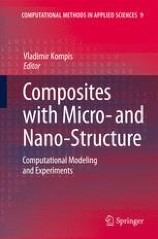
Composites with micro- and nano-structure : Computational modeling and experiments
The book contains atomistic and continuum numerical methods and experimental validation for composite materials reinforced with particles or fibres, porous materials, homogenization and other important topics for research in this field.
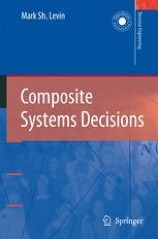
Composite Systems Decisions
Composite decisions consist of interconnected parts or subdecisions and correspond to a composite (composable, modular, decomposable) system. Composite Systems Decisions describes an educational approach that is based on systems engineering and considered modular design of composite decisions. Divided into four parts, this book contains descriptions of basic systems approaches and examines basic ‘technological’ problems for composite systems, including: modular hierarchical design; multistage design; multistage planning; redesign/improvement/adaptation; evaluation; and, combinatorial evolution/development.

Component-Based Software Testing with UML
Component-based software development regards software construction in terms of conventional engineering disciplines where the assembly of systems from readily-available prefabricated parts is the norm. Because both component-based systems themselves and the stakeholders in component-based development projects are different from traditional software systems, component-based testing also needs to deviate from traditional software testing approaches. Gross first describes the specific challenges related to component-based testing like the lack of internal knowledge of a component or the usage of a component in diverse contexts. He argues that only built-in contract testing, a test organization for component-based applications founded on building test artifacts directly into components, can prevent catastrophic failures like the one that caused the now famous ARIANE 5 crash in 1996. This book is the first comprehensive treatment of the intricacies of testing component-based software systems. With its strong modeling background, it appeals to researchers and graduate students specializing in component-based software engineering. Professionals architecting and developing component-based systems will profit from the UML-based methodology and the implementation hints based on the XUnit and JUnit frameworks.
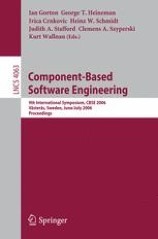
Component-based software engineering ; Vol. 4063 ; 9th International Symposium, CBSE 2006, Västeras, Sweden, June 29 - July 1, 2006, Proceedings
CBSE is concerned with the development of software-intensive systems from reusable parts (components), the development of reusable parts, and system maintenance and improvement by means of component replacement and customization. CBSE 2006 was the ninth in a series of events that promote a science and technology foundation for achieving predictable quality in software systems through the use of software component technology and its associated software engineering practices.
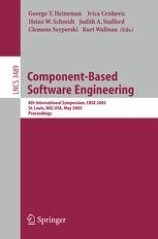
Component-based software engineering ; Vol. 3489 ; 8th International Symposium, CBSE 2005, St. Louis, MO, USA, May 14-15, 2005
this book present the proceedings of the 2005 Symposium on Component-Based Software Engineering (CBSE). CBSE is concerned with the development of software-intensive systems from reusable parts (components), the development of reusable parts, and system maintenance and improvement by means of component replacement and c- tomization. CBSE 2005, “Software Components at Work,” was the eighth in a series of events that promote a science and technology foundation for achieving predictable quality in software systems through the use of software component technology and its associated software engineering practices.
Component models and systems for grid applications ; Proceedings of the Workshop on Component Models and Systems for Grid Applications held June 26, 2004 in Saint Malo, France.
This first volume of the CoreGRID series addresses such vital issues as the architecture of the Grid, the way software will influence the development of the Grid, and the practical applications of Grid technologies for individuals and businesses alike. Part I of the book, Application-Oriented Designs, focuses on development methodology and how it may contribute to a more component-based use of the Grid. Middleware Architecture, the second part, examines portable Grid engines, hierarchical infrastructures, interoperability, as well as workflow modeling environments. The final part of the book, Communication Frameworks, looks at dynamic self-adaptation, collective operations, and higher-order components. With Component Models and Systems for Grid Applications, editors Vladimir Getov and Thilo Kielmann offer the computing professional and the computing researcher the most informative, up-to-date, and forward-looking thoughts on the fast-growing field of Grid studies.

Complexity in chemistry, biology, and ecology
This book, written by an international team of experts, introduces the reader to various aspects of complexity theory and its applications. It illustrates the latest trends in science to go beyond the mechanistic Newtonian view of the world by shifting the focus to self-organization, adaptation, and emergent phenomena. The authors discuss these properties of complex systems in biology, ecology and chemistry along with the structure and interconnectedness of the "layers" of complexity. The qualitative description is complemented by a discussion of methods for complexity quantification. Networks are covered in detail as a universal language of the complex world.
Complex systems concurrent engineering : Collaboration, technology innovation and sustainability
Concurrent engineering is well-established as an approach to engineer product parts. However, the concept has much broader application. Complex Systems Concurrent Engineering: Collaboration, Technology Innovation and Sustainability demonstrates how concurrent engineering can be used to benefit the development of complex systems, to produce results that sustain balanced stakeholder satisfaction over time. Gathered from the 14th ISPE International Conference on Concurrent Engineering, the collected papers cover all aspects of the sustainable and integrated development of complex systems, such as airplanes, satellites, space vehicles, automobiles and ships.

Complex Medical Engineering
In the twenty-first century, applications in medicine and engineering must acquire greater safety and flexibility if they are to yield better products at higher efficiency. To this end, complex science and technology must be integrated in medicine and engineering. Complex medical engineering (CME) is a new field that merges medical science and technology, and includes biomedical robotics and biomechatronics, complex virtual technology in medicine, information and communication technology in medicine, complex technology in rehabilitation, cognitive neuroscience and technology, and complex bioinformatics. Experts from academia, industry, and government research laboratories who have pioneered CME ideas and technologies describe its concept and research approach and discuss related hardware and software, science and technology, and medicine and engineering. This book will be invaluable to scientists, researchers, and graduates in the emerging field of CME.
Complex Engineered Systems : Science Meets Technology
This volume examines the difficulties that arise in creating highly complex engineered systems and new approaches that are being adopted. Topics addressed range from the formal representation and classification of distributed networked systems to revolutionary engineering practices inspired by biological evolution. By bringing together the latest research in Complex Engineered Systems, this book sheds light on the current state and future course of this emerging field.
Complex decision making : Theory and practice
The increasingly complex environment of today's world, characterized by technological innovation and global communication, generates myriads of possible and actual interactions while limited physical and intellectual resources severely impinge on decision makers, be it in the public or private domains. At the core of the decision-making process is the need for quality information that allows the decision maker to better assess the impact of decisions in terms of outcomes, nonlinear feedback processes and time delays on the performance of the complex system invoked.

Compiling ESTEREL
Esterel is based on the simple idea of providing a software language that has a synchronous model of time. That is, the execution of the program is divided into discrete instants, and statements are either guaranteed to execute in a single instant, or take multiple instants as requested by the programmer. Suitable for programming safety-critical real-time systems, Esterel and its model of computation have found use in industrial applications such as avionics, integrated circuit design, and other safety-critical environments. While Compiling Esterel does not assume prior knowledge of the Esterel language, readers will appreciate having prior knowledge of programming language semantics and compiler technology, along with some familiarity with synchronous digital hardware design.

Competitiveness in the Tourism Sector : A Comprehensive Approach from Economic and Management Points
International tourism is expected to be a major vehicle of economic development in industrializing countries in the 21st century, especially for Asia. To generate long-term growth, countries with tourism-based economies must develop strategies for employing their comparative advantages to achieve competitive advantages. However, competitiveness in the tourist industry is multi-dimensional and complex. This study evaluates the competitiveness of the Taiwanese tourism sector by a multi-dimensional framework. The theoretical model proposes that the competitiveness of tourist destinations should be composed of Ricardian comparative advantages (like the conditions of natural endowments and the degree of technological change); Porterian competitive advantages; tourism management, i.e., providing high quality education and job training, public goods, support services and reduced transaction costs to enhance comparative and competitive advantages; and environmental conditions.

Competition, innovation, and antitrust : A theory of market leaders and Its policy implications
Competition, Innovation, and Antitrust develops a theory of market leadership in the presence of endogenous entry of firms and applies it to models of competition in the market and for the market.
Competence of Top Management Teams and Success of New Technology-Based Firms : A Theoretical and Empirical Analysis Concerning Competencies of Entrepreneurial Teams and the Development of Their Ventures
In his book, Jan Brinckmann develops a comprehensive competence concept for new technology-based firms. It is grounded in competence-related literature combining insights from entrepreneurship and management research. The competence concept comprises three domains: general entrepreneurial competencies, social competencies, and functional competencies in technology, marketing, and financial management. A measurement model is developed to specify the contents of each sub-domain and to facilitate self-assessment of these competencies. In an empirical study, 212 executives of German NTBFs assessed their team’s competencies. This data is analyzed using structural equation modelling to identify the most relevant competencies for new venture success.

Compendium of civil Engineering education strategies : Case studies and examples
Compiles proven strategies and information on civil engineering education and the skills necessary for successful practice of civil engineering such as critical thinking, design thinking, leadership, and communication skills. It also addresses other relevant topics including professional ethics, global perspectives, assessment, recruitment, retention, and more.
Community-oriented policing and technological innovations
Presents new approaches and innovative challenges to address bringing technology into community-oriented policing efforts. “Community-oriented policing” is an approach that encourages police to develop and maintain personal relationships with citizens and community organizations. By developing these partnerships, the goal is to enhance trust and legitimacy of police by the community (and vice versa), and focus on engaging the community crime prevention and detection efforts for sustainable, long-term crime reduction. The contributions to this volume emphasize how technological innovations can advance community-oriented policing goals.
Community and Identity in Contemporary Technosciences
This book provides new thinking on scientific identity formation. It thoroughly interrogates the concepts of community and identity, including both historical and contemporaneous analyses of several scientific fields.

Communities and Technologies 2005 ; Proceedings of the Second Communities and Technologies Conference, Milano 2005
This book includes 23 papers dealing with the impact of modern information and communication technologies that support a wide variety of communities: local communities, virtual communities, and communities of practice, such as knowledge communities and scientific communities. The volume is the result of the second multidisciplinary "Communities and Technologies Conference", a major event in this emerging research field. The various chapters discuss how communities are affected by technologies, and how understanding of the way that communities function can be used in improving information systems design. This state of the art overview will be of interest to computer and information scientists, social scientists and practitioners alike.

Communications and Networking : An Introduction
Communications and Networking: An Introduction provides a clear and easy to follow treatment of the subject, written specifically for undergraduates who have no previous experience in the field. The author takes a step by step approach, with examples and exercises designed to give the reader increased confidence in using and understanding communications systems. Topics covered include communications technologies, networking models and standards, local area and wide area networks, network protocols, TCP/IP-based networks and network management.
