



الصفحة 9
الصفحة 9
Fuzzy Database Modeling of Imprecise and Uncertain Engineering Information
This book presents recent advances for imprecise and uncertain engineering information from the point of view of fuzzy database modeling. The topics include fuzzy conceptual data modeling of engineering information, conversion of the fuzzy conceptual models, and database implementation of the fuzzy conceptual data models. Some major data and database models for engineering information modeling are investigated. The main novel aspect of this book is that the book focuses on imprecise and uncertain industrial information modeling viewed from databases and fuzzy database technologies viewed from industrial applications. This may be useful for people involved in theory research, design implementation, and application development of intelligent engineering databases.

Fuzzy Chaotic Systems : Modeling, Control, and Applications
"Fuzzy Chaotic Systems" provides original heuristic research achievements and insightful ideas on the interactions or intrinsic relationships between fuzzy logic and chaos theory. It presents the fundamental concepts of fuzzy logic and fuzzy control, chaos theory and chaos control, as well as thedefinition of chaos on the metric space of fuzzy sets. This monograph discusses and illustrates fuzzy modeling and fuzzy control of chaotic systems, synchronization, anti-control of chaos, intelligent digital redesign, spatiotemporal chaos and synchronization in complex fuzzy systems; as well as a practical application example of fuzzy-chaos-based cryptography. Like other very good books, this book may raise more questions than it can provide answers. It therefore generates a great potential to attract more attention to combine fuzzy systems with chaos theory and contains important seeds for future scientific research and engineering applications.

Fundamentals of Artificial Intelligence
Fundamentals of Artificial Intelligence introduces the foundations of present day AI and provides coverage to recent developments in AI such as Constraint Satisfaction Problems, Adversarial Search and Game Theory, Statistical Learning Theory, Automated Planning, Intelligent Agents, Information Retrieval, Natural Language & Speech Processing, and Machine Vision. The book features a wealth of examples and illustrations, and practical approaches along with the theoretical concepts. It covers all major areas of AI in the domain of recent developments. The book is intended primarily for students who major in computer science at undergraduate and graduate level but will also be of interest as a foundation to researchers in the area of AI.

Frontiers in Computing Technologies for Manufacturing Applications
Frontiers in Computing Technologies for Manufacturing Applications presents an overview of the state-of-the-art intelligent computing in manufacturing. Modeling, data processing, algorithms and computational analysis of difficult problems found in advanced manufacturing are discussed. It is the first book to bring together combinatorial optimization, information systems and fault diagnosis and monitoring in a consistent manner. Techniques are presented in order to aid decision makers needing to consider multiple, conflicting objectives in their decision processes. In particular, the use of metaheuristic optimization techniques for multi-objective problems is discussed. Readers will learn about computational technologies that can improve the performance of manufacturing systems ranging from manufacturing equipment to supply chains.

Frontiers in civil and hydraulic engineering ; Vol.2 : Proceedings of the 8th International Conference on Architectural, Civil and Hydraulic Engineering (ICACHE 2022), Guangzhou, China, 12–14 August 2022
Focuses on the research of architecture and hydraulic engineering in civil engineering. The proceedings feature the most cutting-edge research directions and achievements related to civil and hydraulic engineering. Subjects in the proceedings including: Engineering Structure Intelligent Building Structural Seismic Resistance Monitoring and Testing Hydraulic Engineering Engineering Facility The works of this proceedings can promote development of civil and hydraulic engineering, resource sharing, flexibility and high efficiency.

Frontiers in civil and hydraulic engineering ; Vol.1 : Proceedings of the 8th International Conference on architectural, civil and hydraulic engineering (ICACHE 2022), Guangzhou, China, 12–14 August 2022
Focuses on the research of architecture and hydraulic engineering in civil engineering. The proceedings feature the most cutting-edge research directions and achievements related to civil and hydraulic engineering. Subjects in the proceedings including: Engineering Structure Intelligent Building Structural Seismic Resistance Monitoring and Testing Hydraulic Engineering Engineering Facility The works of this proceedings can promote development of civil and hydraulic engineering, resource sharing, flexibility and high efficiency.

From integrated publication and information systems to information and knowledge environments : Essays dedicated to Erich J. Neuhold on the Occasion of His 65th Birthday
This book constitutes a commemorative volume devoted to Erich J. Neuhold on the occasion of his 65th birthday. The 32 invited reviewed papers presented are written by students and colleagues of Erich Neuhold throughout all periods of his scientific career. The papers are organized in the following topical sections: Database management enabling information systems Semantic Web drivers for advanced information management Securing dynamic media content integration From digital libraries to intelligent knowledge environments Visualization – key to external cognition in virtual information environments From human-computer interaction to human-artefact interaction Domains for virtual information and knowledge environments.
Foundations of Intelligent Systems ; Vol. 4203 ; 16th International Symposium, ISMIS 2006, Bari, Italy, September 27-29, 2006, Proceedings
This book constitutes the refereed proceedings of the 16th International Symposium on Methodologies for Intelligent Systems, ISMIS 2006. The book presents 81 revised papers together with 3 invited papers. Topical sections include active media human-computer interaction, computational intelligence, intelligent agent technology, intelligent information retrieval, intelligent information systems, knowledge representation and integration, knowledge discovery and data mining, logic for AI and logic programming, machine learning, text mining, and Web intelligence.

Foundations of Intelligent Systems ; Vol. 3488 ; 15th International Symposium ISMIS 2005, Saratoga Springs, NY, USA, May 25-28, 2005, Proceedings
This volume contains the papers selected for presentation at the 15th International S- posiumonMethodologiesforIntelligentSystems, ISMIS2005, heldinSaratogaSprings, NewYork,25-28May,2005. ThesymposiumwasorganizedbySUNYatAlbany. Itwas sponsored by the Army Research Of?ce and by several units of the University at Albany including its Division for Research, College of Arts and Sciences, Department of C- puter Science, and Institute for Informatics, Logics, and Security Studies (formerly the Institute for Programming and Logics). The Program Committee selected the following major areas for ISMIS 2005: intelligent information systems, knowledge discovery and data mining, knowledge - formation and integration, knowledge representation, logic for arti?cial intelligence, soft computing, Web intelligence, Web services, and papers dealing with applications of intelligent systems in complex/novel domains. The contributed papers were selected from almost 200 full draft papers by the Program Committee members.
Foundations of Intelligent Systems ; 17th International Symposium, ISMIS 2008 Toronto, Canada, May 20-23, 2008 Proceedings
This book constitutes the refereed proceedings of the 17th International Symposium on Methodologies for Intelligent Systems, ISMIS 2008, held in Toronto, Canada, in May 2008.The 68 revised papers presented together with 3 plenary talks were carefully reviewed and selected from over 100 submissions. The papers are organized in topical sections on knowledge discovery and data mining: foundations, advances, mining changes and actional patterns; logic for artificial intelligence, autonomic and evolutionary computation, soft computing, databases and data warehouses, digital library, intelligent information retrieval.
Foundations of Intelligent Systems ; 13th International Symposium, ISMIS 2002, Lyon, France, June 27-29, 2002. Proceedings
This volume contains the papers selected for presentation at the 13th International Symposium on Methodologies for Intelligent Systems ISMIS 2002, held in Lyon, France, 27-29 June, 2002. The symposium was organized by the UniversitØ ClaudThe program committee selected the following major areas for ISMIS 2002: Intelligent Multimedia, Intelligent Information Retrieval, Intelligent Information Systems, Knowledge Representation and Integration, Learning and Knowledge Discovery, Logic for Artificial Intelligence, Methodologies (modeling, design, validation, performance evaluation), and Soft Computing.

Foundations of fuzzy logic and soft computing ; 12th International Fuzzy Systems Association World Congress, IFSA 2007, Cancun, Mexico, Junw 18-21, 2007, Proceedings
This book comprises a selection of papers from IFSA 2007 on new methods and theories that contribute to the foundations of fuzzy logic and soft computing. methodologies. Soft computing consists of several computing paradigms which can be used to produce powerful intelligent systems for solving real-world problems.
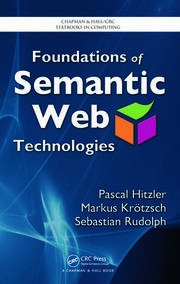
Foundation of semantic web technologies
Concentrates on Semantic Web technologies standardized by the World Wide Web Consortium: RDF and SPARQL enable data exchange and querying, RDFS and OWL provide expressive ontology modeling, and RIF supports rule-based modeling. The text also describes methods for specifying, querying, and reasoning with ontological information. In addition, it explores topics that are clearly beyond foundations, such as tools, applications, and engineering aspects.
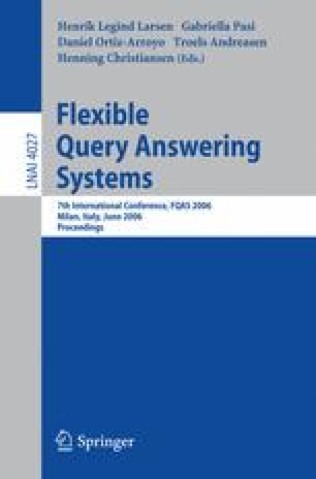
Flexible Query Answering Systems ; 7th International Conference, FQAS 2006, Milan, Italy, June 7-10, 2006
This book constitutes the refereed proceeding of the 7th International Conference on Flexible Query Answering Systems, FQAS 2006, held in Milan, Italy in June 2006. The 60 revised full papers presented were carefully reviewed and selected from numerous submissions. The papers are organized in topical sections on flexibility in database management and quering, vagueness and uncertainty in XML quering and retrieval, information retrieval and filtering, multimedia information access, user modeling and personalization, knowledge and data extraction, intelligent information extraction from text, and knowledge representation and reasoning.

Expert Clouds and Applications ; Proceedings of ICOECA 2021
Features original papers from International Conference on Expert Clouds and Applications (ICOECA 2021), organized by GITAM School of Technology, Bangalore, India during February 18–19, 2021. It covers new research insights on artificial intelligence, big data, cloud computing, sustainability, and knowledge-based expert systems. The book discusses innovative research from all aspects including theoretical, practical, and experimental domains that pertain to the expert systems, sustainable clouds, and artificial intelligence technologies.

Experimental vibration analysis for civil structures : Testing, sensing, monitoring, and control
Covers a wide range of topics in the areas of vibration testing, instrumentation, and analysis of civil engineering and critical infrastructure. It explains how recent research, development, and applications in experimental vibration analysis of civil engineering structures have progressed significantly due to advancements in the fields of sensor and testing technologies, instrumentation, data acquisition systems, computer technology, computational modeling and simulation of large and complex civil infrastructure systems. The book also examines how cutting-edge artificial intelligence and data analytics can be applied to infrastructure systems.

Evolving Connectionist Systems : The Knowledge Engineering Approach
Evolving Connectionist Systems is aimed at all those interested in developing and using intelligent computational models and systems to solve challenging real world problems in computer science, engineering, bioinformatics and neuroinformatics. The book challenges scientists and practitioners with open questions about future creation of new information models inspired by Nature. This edition includes new methods for adaptive, knowledge-based learning, such as online incremental feature selection, spiking neural networks, transductive neuro-fuzzy inference, adaptive data and model integration, cellular automata and artificial life systems, particle swarm optimisation, ensembles of evolving systems, and quantum inspired neural networks. New applications to gene and protein interaction modelling, brain data analysis and brain model creation, computational neuro-genetic modelling, adaptive speech, image and multimodal recognition, language modelling, adaptive robotics, modelling dynamic financial and socio-economic systems, and ecological modelling, are covered. An important new feature of the book is the attempt to connect different structural and functional levels of a complex, intelligent system, looking for inspiration from functional relationships in natural systems, such as the genetic and the brain activity.

Evolution of the Web in Artificial Intelligence Environments
The material in this book is designed to be drawn from different Web application areas so as to provide an overview of important contributions in the development of the Web applications. These are mainly in the areas of Web personalisation, semantic Web and Web services.

Evolution of Teaching and Learning Paradigms in Intelligent Environment
This book is a fascinating window on the evolution of teaching and learning paradigms in intelligent environments. The three Australian authors include a number of chapters on issues of real relevance to today's teaching practice, including an introduction to the evolution of teaching and learning paradigms

E-Service Intelligence : Methodologies, Technologies and Applications
Business organizations and governments are nowadays developing and providing internet based electronic services (e-services) featuring various intelligent functions. E-Service Intelligence integrates intelligent techniques into e-service systems for realizing intelligent internet information searching, presentation, provision, recommendation, online system design, implementation, and assessment to internet users. This book offers a thorough introduction and systematic overview of the new field and covers the state-of-the-art of the research and development in E-Service Intelligence ranging from e-services and/or intelligent techniques to web information presentation, search, and mining, to personalization, privacy, and trust in e-services, to e-service evaluation, optimization and knowledge discovery, and to intelligent e-service system developments.
