



الصفحة 9
الصفحة 9

Handbook of nanoencapsulation : Preparation, characterization, delivery, and safety of nutraceutical nanocomposites
Nutraceutical encapsulation envelopes protection of products from oxidative damage, controlled delivery of nanoencapsulated nutraceuticals and improved nutraceutical bioavailability as well as biological action. It is a promising technique to ensure the stabilization of such labile compounds and to protect the core ingredients from premature reactions and interactions In a comprehensive manner, the Handbook of Nanoencapsulation: Preparation, Characterization, Delivery and Safety of Nutraceutical Nanocomposites presents various nanosystems/nanocarriers, physical and chemical techniques used in encapsulation of various nutraceuticals, and the targeted delivery of various significant nutraceuticals.

Handbook of molecular force spectroscopy
Modern materials science and biophysics are increasingly focused on studying and controlling intermolecular interactions on the single-molecule level. Molecular force spectroscopy was developed in the past decade as the result of several unprecedented advances in the capabilities of modern scientific instrumentation, and defines a number of techniques that use mechanical force measurements to study interactions between single molecules and molecular assemblies in chemical and biological systems. Examples of these techniques, which typically target a specific range of experimental systems and geometries, include atomic force microscopy, optical tweezers, surface forces apparatus, and magnetic tweezers.

Handbook of modern sensors. physics, designs, and applications
Presents a comprehensive and up-to-date account of the theory (physical principles), design, and practical implementations of various sensors for scientific, industrial, and consumer applications. This latest edition focuses on the sensing technologies driven by the expanding use of sensors in mobile devices. These new miniature sensors will be described, with an emphasis on smart sensors which have embedded processing systems. The chapter on chemical sensors has also been expanded to present the latest developments.

Handbook of Hydroxyacetophenones : Preparation and Physical Properties
This Handbook is the reference on hydroxyacetophenones. It is a powerful synthesis tool for the researcher or industrial producers. Nowhere else are so many compounds covered or the physical properties and relevant syntheses provided. It provides a wide choice of hydroxyketones required to achieve syntheses based upon this range of intermediates. In this Handbook the diverse ways of obtaining over 3000 hydroxyacetophenones are described and their physico-chemical properties and spectroscopic data references are indicated. The Handbook is presented in dictionary style, with a logical classification of the ketones, making the information easily available for consultation.

Handbook of Bioterrorism and Disaster Medicine
This comprehensive volume, written by experts in the field, is the essential portable handbook on bioterrorism and disaster medicine. The volume covers all pertinent topics with meticulous organization and includes an abundance of invaluable web-based resources. Written as both a practical and clinical guide to various types of disasters, it includes planning and response procedures to help mitigate the impact of disasters on affected individuals and communities. Designed to be used in the field, all the essential aspects are included: public health, bioterror agents, chemical warfare, radioactive agents, manmade disasters, natural disasters, humanitarian disasters, infectious and tropical diseases, and basics of emergency medicine. Handbook of Bioterrorism and Disaster Medicine is the ideal tool for researchers, first responders, medical students, physicians, and other healthcare providers who work in the field.

Halogen bonding : Fundamentals and applications
The articles in this volume specifically address halogen bonding, and two aspects of it … . The contributions to this volume are reasonably up-to-date … . each chapter begins with a detailed table of contents and most of them also provide a list defining abbreviations. In summary, this is a very useful book that contains a great deal of information.

Growing Food : A guide to food production
This specialist handbook is intended as a quick and easy reference guide for individuals and organisations that are involved with the production of food, from both agriculture and horticulture. It is designed to be used as a reference book that answers basic questions about how food is produced from plants, and aims to demystify the subject of growing food as far as possible. The focus is firmly on the technical aspects of food crops; animal husbandry, agrochemicals and genetic engineering are only briefly mentioned. The book is divided into three sections: 1. Principles and Practices used in Agriculture and Horticulture; 2. Description and Characteristics of the Main Food Crops; 3. Naming and Classification of Plants, Seed Purchase Procedures, Conversion Tables and Statistics, Planning and Assessing Agricultural Projects.

Group 13 Chemistry III : Industrial Applications
The present issue of Structure and Bonding is dedicated to applied group 13 chemistry, particularly for the elements boron and aluminum, and to a lesser degree gallium and indium. Although boron is a trace element (0.01 g kg 1) in the earth's crust, it has been concentrated in a few locations by geochemical processes and is relatively easy to mine as borax. Aluminum, on the other hand, is the most abundant metal in the earth's crust (82 g kg 1) and dispersed widely throughout the globe. In the chapter Schubert explains the close relationship between the basic properties of the boron compounds and their associated uses. The remaining four chapters focus, to some degree, on aluminum. Since a great deal of literature exists in this area, these chapters are more focused on areas of emerging utility, and contain a great deal of fundamental information. Uhl's contribution in Chapter 2 provides basic synthesis and structural information for aluminum and gallium hydrazides. These types of compounds are being explored as potential molecular precursors to metal nitrides such as the important blue green laser material gallium nitride.
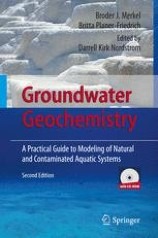
Groundwater Geochemistry : A Practical Guide to Modeling of Natural and Contaminated Aquatic Systems
Numerical groundwater flow, transport, and geochemical models are important tools besides classical deterministic and analytical approaches. Solving complex linear or non-linear systems of equations, commonly with hundreds of unknown parameters, is a routine task for a PC. Modeling hydrogeochemical processes requires a detailed and accurate water analysis, as well as thermodynamic and kinetic data as input. Thermodynamic data, such as complex formation constants and solubility-products, are often provided as databases within the respective programs. However, the description of surface-controlled reactions (sorption, cation exchange, surface complexation) and kinetically controlled reactions requires additional input data. Unlike groundwater flow and transport models, thermodynamic models, in principal, do not need any calibration.

Groundwater Geochemistry : A Practical Guide to Modeling of Natural and Contaminated Aquatic Systems
Offers beginners and advanced modellers alike a minimum theoretical background and a focus on the practical solution of geochemical modeling with PHREEQC. This book covers the possibility to use PITZER equation and the CD music concept within the version of PHREEQC.

Green techniques for organic synthesis and medicinal chemistry
Presents comprehensive coverage of green chemistry techniques for organic and medicinal chemistry applications, summarizing the available new technologies, analyzing each technique’s features and green chemistry characteristics, and providing examples to demonstrate applications for green organic synthesis and medicinal chemistry.

Green Chemical Reactions
Green Chemistry is an inventive science based on fundamental research towards the development of new sustainable chemical processes. There is a great need to create a new type of chemistry focused on a new production system, in order to prepare the younger generation to get a greener future. The globalization pushes the chemistry community to adopt ethical issues. In this prospect Green Chemistry can achieve the approval of the society by teaching students to be confident in science and at the same time by convincing people that it is possible to attain technological development with respect and care for the environment we live in. This is why it is of foremost importance that education and fundamental research remain strictly connected, so that democracy and development can grow and progress side by side.

Granite genesis : in-situ melting and crustal evolution
In this book we suggest an alternative model for the origin of granite in terms of in-situ meltingintracrustal convection that physically determines the process from partial melting of mid-upper crustal rocks to formation of a convecting magma layer. We illustrate the model using the geological, geochemical and geophysical studies from Australia, North and South America, Europe and China, and conclude that heat convection within a crustal partial melting layer is essential for formation of granite magma and that without convection, partial melting of rocks produces migmatites rather than granites. Granite is layer-like within the crust, and shape and size of granite bodies reflect the geometric relationship between an irregular upper surface of the crystallised magma layer and erosion surface. Repeated melting of the crust generates downward-younging granite sequences. Chemical and isotopic compositions of granites indicate differentiation within the magma rather than different deep sources.

Good laboratory practice : The why and the how
The GLP regulations have developed from rules on how to exactly document the planning, conduct and reporting of toxicity studies to a quality system for the management of a multitude of study types, from the simple determination of a physical/chemical parameter to the most complex field studies or ecotoxicology studies. At the same time the term “Good Laboratory Practice” has become somewhat of a slogan with the aim to characterise any reliably conducted laboratory work.

Glycoscience : Chemistry and Chemical Biology I-III
Glycostructures play a pivotal and crucial role in a myriad of organisms and important systems in biology, physiology, medicine, bioengineering and technology. Within recent years tools have been developed to promote the understanding of their highly complex functions and the associated chemistry and chemical biology, however, many facts still remain undiscovered.

Glycopeptides and Glycoproteins : Synthesis, Structure, and Application
Their structure, biosynthesis, and mode of action are summarized in the fth chapter. The last chapter covers current methods for the determination of high-resolution structures of glycopeptides and glycoproteins mainly based onNMRspectroscopy, X-raycrystallography,and molecular modeling.This series presents critical reviews of the present position and future trends in modern chemical research Short and concise reports on chemistry.

Glycerophospholipids in brain : Phospholipases A2 in Neurological Disorders
This unique volume will be invaluable not only to those interested in biochemical properties of phospholipases A2, but also their involvement in neurological disorders. Students will benefit from it as a supplement for a range of neuroscience courses. Clinicians will find it invaluable as well for understanding molecular aspects of neurodegeneration in acute neural trauma (stroke) and neurodegenerative diseases (Alzheimer disease) that are mediated by phospholipases A2.

Global optimization ; Vol. 85 : Scientific and engineering case studies
Optimization models based on a nonlinear systems description often possess multiple local optima. The objective of global optimization (GO) is to find the best possible solution of multiextremal problems. Global Optimization: Selected Case Studies illustrates the applicability of GO modeling techniques and solution strategies to real-world problems.The contributed chapters cover a broad range of applications from agroecosystem management, assembly line design, bioinformatics, biophysics, black box systems optimization, cellular mobile network design, chemical process optimization, chemical product design, composite structure design, computational modeling of atomic and molecular structures, controller design for induction motors, electrical engineering design, feeding strategies in animal husbandry, the inverse position problem in kinematics, laser design, learning in neural nets, mechanical engineering design, numerical solution of equations, radiotherapy planning, robot design, and satellite data analysis. The solution strategies discussed encompass a range of practically viable methods, including both theoretically rigorous and heuristic approaches.

Glass-Ionomers in Dentistry
Covers all aspects of glass-ionomer cements, from the development of these materials in the early 1970s through to the current state of the art. Their physical, chemical, biological, and clinical properties are described as well as how their formulation and usage have evolved over time.

Geology and Ecosystems
This book includes an analysis of the relationship between the different geological, hydrochemical, hydrogeological and engineering-geological processes and the processes within surface ecosystems. The analysis of specific interactions between the lithosphere and biosphere provides an integrated concept of the role of the geological environment in the evolution of the biosphere. The practical significance of the book is reflected by the analysis of modern engineering activity associated with the mining of minerals, excessive groundwater withdrawal, disposal of industrial and domestic wastes (including radioactive wastes) and their impacts on all components of the environment. Geology and Ecosystems includes a scientific approach to the complex monitoring of the environment under different natural and anthropogenic conditions, including the monitoring of permafrost regions. An important part of the book is the analysis of the "water factor" impact on ecosystems and sustainable development. Influences of intensive groundwater extraction on river flow, vegetation and land subsidence are also considered.
