



الصفحة 9
الصفحة 9

From Cells to Proteins : Imaging Nature across Dimensions ; Proceedings of the NATO Advanced Study Institute, held in Pisa, Italy, 12-23 September 2004
This book offers updated information on how much information we are able to obtain in the exploration of the inner details of biological specimens in their native structure and composition. And deals with the implementation of laser beam and stage scanning systems incorporating confocal optics or multiphoton microscopy; the advent of new electro-optical detectors with great sensitivity, linearity, and dynamic range; the possibility of 2D fast image enhancement, reconstruction, restoration, analysis and 3D display, and the application of luminescence techniques.

Fringe 2005 ; The 5th International Workshop on Automatic Processing of Finge Patterns
In 1993 new prin- ples of optical shape measurement, setup calibration, phase unwr- ping and nondestructive testing were the focus of discussion, while in 1997 new approaches in multi-sensor metrology, active measu- ment strategies and hybrid processing technologies played a central role.

Free Energy and Self-Interacting Particles
This book examines a system of parabolic-elliptic partial differential eq- tions proposed in mathematical biology, statistical mechanics, and chemical kinetics. In the context of biology, this system of equations describes the chemotactic feature of cellular slime molds and also the capillary formation of blood vessels in angiogenesis. There are several methods to derive this system. One is the biased random walk of the individual, and another is the reinforced random walk of one particle modelled on the cellular automaton. In the context of statistical mechanics or chemical kinetics, this system of equations describes the motion of a mean field of many particles, interacting under the gravitational inner force or the chemical reaction
Fourth IFIP International Conference on Theoretical Computer Science - TCS 2006 ; IFIP 19th World Computer Congress, TC-1, Foundations of Computer Science, August 23-24, 2006, Santiago, Chile
The IFIP series publishes state-of-the-art results in the sciences and technologies of information and communication. The scope of the series includes: foundations of computer science; software theory and practice; education; computer applications in technology; communication systems; systems modeling and optimization; information systems; computers and society; computer systems technology; security and protection in information processing systems; artificial intelligence; and human-computer interaction. Proceedings and post-proceedings of referred international conferences in computer science and interdisciplinary fields are featured. These results often precede journal publication and represent the most current research. The principal aim of the IFIP series is to encourage education and the dissemination and exchange of information about all aspects of computing.

Foundations of Trusted Autonomy
This book establishes the foundations needed to realize the ultimate goals for artificial intelligence, such as autonomy and trustworthiness. Aimed at scientists, researchers, technologists, practitioners, and students, it brings together contributions offering the basics, the challenges and the state-of-the-art on trusted autonomous systems in a single volume. The book is structured in three parts, with chapters written by eminent researchers and outstanding practitioners and users in the field. The first part covers foundational artificial intelligence technologies, while the second part covers philosophical, practical and technological perspectives on trust. Lastly, the third part presents advanced topics necessary to create future trusted autonomous systems. The book augments theory with real-world applications including cyber security, defence and space.

Foundations of software science and computational structures ; Vol.3441 : 8th International Conference, FOSSACS 2005, Held as part of the joint European conferences on theory and practice of software, ETAPS 2005
ETAPS 2005 was the eighth instance of the European Joint Conferences on Theory and Practice of Software. ETAPS is an annual federated conference that was est- lished in 1998 by combining a number of existing and new conferences. This year it comprised ?ve conferences (CC, ESOP, FASE, FOSSACS, TACAS), 17 satellite wo- shops (AVIS, BYTECODE, CEES, CLASE, CMSB, COCV, FAC, FESCA, FINCO, GCW-DSE, GLPL, LDTA, QAPL, SC, SLAP, TGC, UITP), seven invited lectures (not including those that were speci?c to the satellite events), and several tutorials. We - ceived over 550 submissions to the ?ve conferences this year, giving acceptance rates below 30% for each one. Congratulations to all the authors who made it to the ?nal program! I hope that most of the other authors still found a way of participating in this exciting event and I hope you will continue submitting. The events that comprise ETAPS address various aspects of the system devel- ment process, including speci?cation, design, implementation, analysis and impro- ment. The languages, methodologies and tools which support these activities are all well within its scope.

Foundations of software science and computational structures ; 10th International Conference, FOSSACS 2007, Held as Part of the Joint European Conferences on Theory and Practice of Software, ETAPS 2007, Braga, Portugal, March 24-April 1, 2007, Proceedings
This book constitutes the refereed proceedings of the 10th International Conference on Foundations of Software Science and Computation Structures, FOSSACS 2007, held in Braga, Portugal in March/April 2007 as part of ETAPS 2007. The papers cover a broad spectrum on theories and methods to support analysis, synthesis, transformation and verification of programs and software systems.
Foundations of software science and computation structures ; Vol. 3921 ; 9th International conference, FOSSACS 2006, Held as part of the joint European conferences on theory and practice of software, ETAPS 2006, Vienna, Austria, March 25-31, 2006, proceedings
This book constitutes the refereed proceedings of the 9th International Conference on Foundations of Software Science and Computation Structures, FOSSACS 2006, held in Vienna, Austria in March 2006 as part of ETAPS. The 28 revised full papers presented together with 1 invited paper were carefully reviewed and selected from 107 submissions. The papers are organized in topical sections on mobile processes, software science, distributed computation, categorical models, real time and hybrid systems, process calculi, automata and logic, domains, lambda calculus, types, and security.
Foundations of software science and computation structures ; 24th International conference, FOSSACS 2021, Held as Part of the European joint conferences on theory and practice of software, ETAPS 2021, Luxembourg City, Luxembourg, March 27 – April 1, 2021, proceedings
This book constitutes the proceedings of the 24th International Conference on Foundations of Software Science and Computational Structures, FOSSACS 2021, which was held during March 27 until April 1, 2021, as part of the European Joint Conferences on Theory and Practice of Software, ETAPS 2021. The conference was planned to take place in Luxembourg and changed to an online format due to the COVID-19 pandemic.

Foundations of software science and computation structures ; 23rd International conference, FOSSACS 2020, Held as part of the European joint conferences on theory and practice of software, ETAPS 2020, Dublin, Ireland, April 25–30, 2020, proceedings
This book constitutes the proceedings of the 23rd International Conference on Foundations of Software Science and Computational Structures, FOSSACS 2020, which took place in Dublin, Ireland, in April 2020, and was held as Part of the European Joint Conferences on Theory and Practice of Software, ETAPS 2020.
Foundations of software science and computation structures ; 11th International conference, FOSSACS 2008, Held as part of the joint European conferences on theory and practice of software, ETAPS 2008, Budapest, Hungary, March 29 - April 6, 2008. proceedings
The fve main conferences received 571 submissions, 147 of which were accepted, giving an overall acceptance rate of less than 26%, with each conference below 27%.Congratulations there foretoall the authorswhomadeittothe fnalprogramme! I hope that most of the other authors will still have found a way of participating in this exciting event, and that you will all continue submitting to ETAPS and contributing to make of it the best conference in the area. The events that comprise ETAPS address various aspects of the system velopment process, including specifcation, design, implementation, analysis and improvement

Foundations of Agile Python Development
You've long been enamored with the Python language, and have mastered its many nuances. Yet something seems to be missing—a productivity boost that you know is possible but you're not sure how to go about it. This was the sentiment of so many developers before discovering Agile programming paradigm, which embraces concepts such as automation, effective code management, and test–driven development. Foundations of Agile Python Development is the first book to apply these sought–after principles to Python developers, introducing both the tools and techniques built and supported by the Python community. Authored by Jeff Younker, a well–known member of Python's agile community who is perhaps best known for his creation of a popular Python testing framework
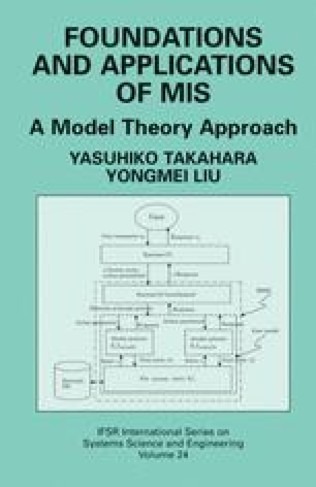
Foundations and applications of MIS : A model theory approach
Foundations and Applications of MIS presents a unique systems theory approach to management information system (MIS) development. The development is driven by the need to eliminate ambiguity in specification, design and construction of the application software. Further, the authors show that the considerable effort being expanded nowadays on validation, verification and testing, as required in current software engineering practices, will be reduced. The approach also reinforces the belief that MIS development is independent of software development. The work presents an approach that provides a theoretical foundation for MIS development from the systems theoretic viewpoint along with practical applications ranging from a transaction processing system to a solver system. Both formal systems theory and automatic system generation based on the authors' newly extended Prolog offer a significant increase in the efficiency of specification, design and production of the application software, as well as an increase in the functional reliability of the software produced. The book assumes a working knowledge of elementary set theory, logic, and familiarity with some systems concepts, such as the automaton model.
Foundation PHP5 for Flash
This latest, completely rewritten, edition again brings together three of the web's hottest technologies—Flash, the server-side language PHP, and the MySQL database system. We've brought things back up to date, using ActionScript 2.0, PHP 5.0, and MySQL 4.1, the book has been designed to be version-neutral. In other words, you can be confident that you're working with the latest standards, but that your applications won't break if deployed on an older server. The book also provides a brief introduction to an alternative database system, SQLite, which is now automatically bundled with PHP 5 and requires no installation.
Formal techniques for networked and distributed systems - FORTE 2005 ; 25th IFIP WG 6.1 International Conference, Taipei, Taiwan, October 2-5, 2005, Proceedings
FORTE (Formal Techniques for Networked and Distributed Systems) 2005 was sp- sored by Working Group 6.1, Technical Committee 6 (TC6) of the International Fed- ation for InformationProcessing (IFIP).The conferenceseries started in 1981underthe name PSTV (ProtocolSpeci?cation, Testing, and Veri?cation).In 1988,a second series under the name FORTE was started. Both series merged to FORTE/PSTV in 1996. The conference name was changed to FORTE in 2001. During its 24-year history, many important contributions have been reported in the conference series. The last ?ve me- ings of FORTE were held in Pisa (Italy), Cheju Island (Korea), Houston (USA), Berlin (Germany), and Madrid (Spain). The 25th FORTE was held from Sunday to Wednesday, October 2–5, 2005 on the beautiful campus of the National Taiwan University (NTU), Taipei, Taiwan, ROC.
Formal Models of Communicating Systems : Languages, Automata, and Monadic Second-Order Logic
This book studies the relationship between automata and monadic second-order logic, focusing on classes of automata that describe the concurrent behavior of distributed systems.
Formal Modelling in Electronic Commerce
Advances in automation for electronic commerce require improved understanding and formalization of the objects, processes, and policies of commerce itself. These include business objects such as bills of lading and contracts; processes such as workflows and trade procedures; and policies covering such problems as contract or procedure validation and strategic behaviour. This book is about theory, formalization, and proof-of-concept implementation of these and related matters. In addition to presenting state-of-the-art results, the book places this work in the context of nearly twenty years of developments in formal modelling for electronic commerce. A comprehensive bibliography and index are provided.
Formal Modeling and Analysis of Timed Systems ; Vol.4202 ; 4th International Conference, FORMATS 2006, Paris, France, September 25-27, 2006, Proceedings
The aim of FORMATS is to promote the study of fundamental and practical aspects of timed systems, and to bring together researchers from di?erent d- ciplines that share interests in modelling and analysis of timed systems. In this volume, there are articles on: – Foundations and Semantics: contributions to the theoretical foundations of timed systems and timed formal languages as well as comparison between di?erentmodelsusedbydi?erentcommunities(timedautomata,timedPetri nets, timed MSCs, hybrid automata, timed process algebra, timed temporal logics, timed abstract state machines, as well as probabilistic models). – Methods and Tools: techniques, algorithms, data structures, and software toolsforanalyzingtimedsystemsandresolvingtemporalconstraints(mod- checking, simulation, robustness analysis, scheduling, etc).
Formal Modeling and Analysis of Timed Systems ; Vol. 3829 ; 3rd International Conference, FORMATS 2005, Uppsala, Sweden, September 26-28, 2005, Proceedings
This book constitutes the thoroughly refereed post-proceedings of the Third International Conference on Formal Modeling and Analysis of Timed Systems, FORMATS 2005, held in Uppsala, Sweden in September 2005 in conjunction with ARTIST2 summer school on Component Modelling, Testing and Verification, and Static analysis of embedded systems. The 19 revised full papers presented together with the abstracts of 3 invited talks were carefully selected from 43 submissions. The papers cover work on semantics and modeling of timed systems, formalisms for modeling and verification including timed automata, hybrid automata, and timed petri nets, games for verification and synthesis, model-checking, case studies and issues related to implementation, security and performance analysis.

Formal Modeling and Analysis of Timed Systems ; 6th International Conference, FORMATS 2008, Saint Malo, France, September 15-17, 2008. Proceedings
This book constitutes the refereed proceedings of the 6th International Conference on Formal Modeling and Analysis of Timed Systems, FORMATS 2008, held in Saint Malo, France, September 2008.The 17 revised full papers presented together with 3 invited talks were carefully reviewed and selected from 37 submissions. The papers are organized in topical sections on extensions of timed automata and semantics; timed games and logic; case studies; model-checking of probabilistic systems; verification and test; timed petri nets.
