



الصفحة 8
الصفحة 8

Plasma Physics : Confinement, Transport and Collective Effects
""Plasma Physics: Confinement, Transport and Collective Effects"" provides an overview of modern plasma research with special focus on confinement and related issues. Beginning with a broad introduction, the book leads graduate students and researchers - also those from related fields - to an understanding of the state-of-the-art in modern plasma physics. Furthermore, it presents a methodological cross section ranging from plasma applications and plasma diagnostics to numerical simulations, the latter providing an increasingly important link between theory and experiment. Effective references.

Photonic Crystals : Physics and Technology
The aim of the work is give an overview of the activity in the field of Photonic Crystal developed in the frame of COST P11 action . The main objective of the COST P11 action was to unify and coordinate national efforts aimed at studying linear and nonlinear optical interactions with Photonic Crystals (PCs), without neglecting an important aspect related to the material research as idea and methods of realizations of 3D PC, together with the development and implementation of measurement techniques for the experimental evaluation of their potential applications in different area, as for example telecommunication with novel optical fibers, lasers, nonlinear multi-functionality, display devices , opto-electronics, sensors.

Performance-based seismic design of concrete structures and infrastructures
Provides contributions on Earthquake Engineering and on Performance-Based design of concrete structures. This book includes topics such as advanced methods for the seismic assessment and vulnerability of structures, strength-based and deformation-based design, and Numerical Models for the Seismic Assessment of Concrete Structures.

Pattern Recognition, Tracking and Vertex Reconstruction in Particle Detectors
A comprehensive review of the methods and algorithms that are used in the reconstruction of events recorded by past, running and planned experiments at particle accelerators such as the LHC, SuperKEKB and FAIR.

Partial Differential Equations in Action : From Modelling to Theory
This book is designed as an advanced undergraduate or a first-year graduate course for students from various disciplines like applied mathematics, physics, engineering. The main purpose is on the one hand to train the students to appreciate the interplay between theory and modelling in problems arising in the applied sciences; on the other hand to give them a solid theoretical background for numerical methods, such as finite elements. Accordingly, this textbook is divided into two parts. The first one has a rather elementary character with the goal of developing and studying basic problems from the macro-areas of diffusion, propagation and transport, waves and vibrations. Ideas and connections with concrete aspects are emphasized whenever possible, in order to provide intuition and feeling for the subject. For this part, a knowledge of advanced calculus and ordinary differential equations is required.

Partial Differential Equations : Modeling and Numerical Simulation
For more than 250 years partial differential equations have been clearly the most important tool available to mankind in order to understand a large variety of phenomena, natural at first and then those originating from human activity and technological development. Mechanics, physics and their engineering applications were the first to benefit from the impact of partial differential equations on modeling and design, but a little less than a century ago the Schrödinger equation was the key opening the door to the application of partial differential equations to quantum chemistry, for small atomic and molecular systems at first, but then for systems of fast growing complexity.

Parallel processing and applied mathematics ; 7th International Conference, PPAM 2007, Gdansk, Poland, September 9-12, 2007 Revised Selected Papers
Constitutes the thoroughly refereed post-conference proceedings of the 7th International Conference on Parallel Processing and Applied Mathematics, PPAM 2007, held in Gdansk, Poland, in September 2007.The 63 revised full papers of the main conference presented together with 85 revised workshop papers were carefully reviewed and selected from over 250 initial submissions. The papers are organized in topical sections on parallel/distributed architectures and mobile computing, numerical algorithms and parallel numerics, parallel and distributed non-numerical algorithms, environments and tools for as well as applications of parallel/distributed/grid computing, evolutionary computing, meta-heuristics and neural networks.

Parallel Processing and Applied Mathematics ; 6th International Conference, PPAM 2005, Poznan, Poland, September 11-14, 2005, Revised Selected Papers
Constitutes the refereed post-proceedings of the 6th International Conference on Parallel Processing and Applied Mathematics, PPAM 2005. This book presents the papers organized in topical sections on parallel and distributed architectures, parallel and distributed non-numerical algorithms, performance analysis, and prediction and optimization.

Parallel Processing and Applied Mathematics ; 4th International Conference, PPAM 2001 Naleczow, Poland, September 9-12, 2001 Revised Papers
Constitutes the thoroughly refereed post-proceedings of the 4th International Conference on Parallel Processing and Applied Mathematics, PPAM 2002, held in Naleczow, Poland, in September 2001. The 101 papers presented were carefully reviewed and improved during two rounds of reviewing and revision. The book offers topical sections on distributed and grid architectures, scheduling and load balancing, performance analysis and prediction, parallel non-numerical algorithms, parallel programming, tools and environments, parallel numerical algorithms, applications, and evolutionary computing and neural networks.

Orthogonal Polynomials and Special Functions : Computation and Applications
Containes seven chapters about the current state of orthogonal polynomials and special functions and gives a view on open problems and future directions. The topics are: computational methods and software for quadrature and approximation, equilibrium problems in logarithmic potential theory, discrete orthogonal polynomials and convergence of Krylov subspace methods in numerical linear algebra, orthogonal rational functions and matrix orthogonal rational functions, orthogonal polynomials in several variables (Jack polynomials) and separation of variables, a classification of finite families of orthogonal polynomials in Askey’s scheme using Leonard pairs, and non-linear special functions associated with the Painlevé equations.

Ordinary Differential Equations with Applications to Mechanics
The present book has its source in the authors’ wish to create a bridge between the mathematical and the technical disciplines, which need a good knowledge of a strong mathematical tool. The necessity of such an interdisciplinary work drove the authors to publish a first book to this aim with Editura Tehnica, Bucharest, Romania.The present book is a new, English edition of the volume published in 1999. It contains many improvements concerning the theoretical (mathematical) information, as well as new topics, using enlarged and updated references. Only ordinary differential equations and their solutions in an analytical frame were considered, leaving aside their numerical approach.

Optimization Theory and Methods : Nonlinear Programming
It systematically describes optimization theory and several powerful methods, including recent results. For most methods, the authors discuss an idea’s motivation, study the derivation, establish the global and local convergence, describe algorithmic steps, and discuss the numerical performance. The book deals with both theory and algorithms of optimization concurrently.

Optimisation in Computational Fluid Dynamics
The numerical optimization of practical applications is an issue of growing importance in research and industry. It allows both the exploration of non-trivial configurations differing widely from all known solutions and the step-by-step improvement of existing designs.The purpose of this book is to introduce the state of the art concerning this issue, referred to in the book as CFD-based Optimization (CFD-O). Many complementary applications are presented, so that interested researchers and engineers will get a clear view of the present possibilities for all problems where the numerical optimization process relies on evaluations obtained through Computational Fluid Dynamics.

Optimisation appliquée = Optimization applied
Presents the fundamental concepts of classical optimization and linear programming. In addition to a prologue and epilogue, the book includes a section on mathematical theory, covering matrix calculus and systems of linear equations and inequalities. It then deals with classical optimization, both constrained and unconstrained, linear programming, the simplex method, and the revised simplex method. The final chapters are devoted to duality, post-optimization and sensitivity analysis, as well as transportation problems. Emphasis is placed on explaining the methods presented and their applications. Numerous numerical examples drawn from various economic and social situations are provided.

Optics : Learning by Computing, with Examples Using Mathcad, Matlab, Mathematica, and Maple
It uses scripts from Maple, MathCad, Mathematica, and MATLAB provide a simulated laboratory where students can learn by exploration and discovery instead of passive absorption. The text covers all the standard topics of a traditional optics course, including: geometrical optics and aberration, interference and diffraction, coherence, Maxwell's equations, wave guides and propagating modes, blackbody radiation, atomic emission and lasers, optical properties of materials, Fourier transforms and FT spectroscopy, image formation, and holography. It contains step by step derivations of all basic formulas in geometrical, wave and Fourier optics.

Optical Properties of Photonic Crystals
This is the first comprehensive textbook on the optical properties of photonic crystals. It deals not only with the properties of the radiation modes inside the crystals but also with their peculiar optical response to external fields. A general theory of linear and nonlinear optical response is developed in a clear and detailed fashion using the Green's function method. The symmetry of the eigenmodes is treated systematically using group theory to show how it affects the optical properties of photonic crystals. Important recent developments such as the enhancement of stimulated emission, second harmonic generation, quadrature-phase squeezing, and low-threshold lasing are also treated in detail and made understandable. Numerical methods are also emphasized. Thus this book provides both an introduction for graduate and undergraduate students and also key information for researchers in this field. This second edition has been updated and includes a new chapter on superfluorescence.

Open-Channel Flow
In Open-Channel Flow, Second Edition, author Hanif Chaudhry draws upon years of practical experience and incorporates numerous examples and real life applications to provide the reader with:Numerous applications of efficient solution techniques, computational procedures, and numerical methods suitable for computer analyses; Comprehensive coverage of steady and unsteady flow techniques; New and updated chapters on sediment transport, uniform flow, two dimensional flow techniques and other topics; Updated and new problem sets and exercises.

Numerical Treatment of Partial Differential Equations
In 1988 we started work on the frst German edition of our book, which appeared in 1992. Our aim was to give students a textbook that contained the basic concepts and ideas behind most numerical methods for partial di?er- tial equations. The success of this frst edition and the second edition in 1994 encouraged us, ten years later, to write an almost completely new version, taking into account comments from colleagues and students and drawing on the enormous progress made in the numerical analysis of partial di?erential equations in recent times. The present English version slightly improves the third German edition of 2005: we have corrected some minor errors and added additional material and references.

Numerical Techniques for Chemical and Biological Engineers Using MATLAB® : A Simple Bifurcation Approach
This book addresses the bifurcation characteristics of chemical and biological processes as the general case and treats systems with a unique steady state as special cases. It uses a system approach which is the most efficient for knowledge organization and transfer. The book develops mathematical models for many commercial processes utilizing the mass-, momentum-, and heat-balance equations coupled to the rates of the processes that take place within the boundaries of the system. The models are solved numerically through MATLAB codes with emphasis on the design and optimization of the chemical and biological industrial equipment and plants.
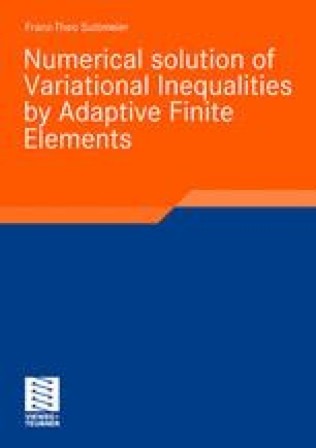
Numerical solution of Variational Inequalities by Adaptive Finite Elements
Franz-Theo Suttmeier describes a general approach to a posteriori error estimation and adaptive mesh design for finite element models where the solution is subjected to inequality constraints. This is an extension to variational inequalities of the so-called Dual-Weighted-Residual method (DWR method) which is based on a variational formulation of the problem and uses global duality arguments for deriving weighted a posteriori error estimates with respect to arbitrary functionals of the error. In these estimates local residuals of the computed solution are multiplied by sensitivity factors which are obtained from a numerically computed dual solution. The resulting local error indicators are used in a feed-back process for generating economical meshes which are tailored according to the particular goal of the computation.
