



الصفحة 8
الصفحة 8

Multiobjective Problem Solving from Nature : From Concepts to Applications
he book focuses on how MOEAs and related techniques can be used to solve problems, particularly in the disciplines of science and engineering. Contributions by leading researchers show how the concepts of multiobjective optimization can be used to reformulate and resolve problems in broad areas such as constrained optimization, coevolution, classification, inverse modelling and design. The book is distinguished from other texts on MOEAs in that it is not primarily about the algorithms, nor specific applications, but about the concepts and processes involved in solving problems using a multiobjective approach. Each chapter contributes to the central, deep concepts and themes of the book: evaluating the utility of the multiobjective approach; discussing alternative problem formulations; showing how problem formulation affects the search process; and examining solution selection and decision making.
Multi-Objective Machine Learning
This monograph presents a selected collection of research work on multi-objective approach to machine learning, including multi-objective feature selection, multi-objective model selection in training multi-layer perceptrons, radial-basis-function networks, support vector machines, decision trees, and intelligent systems.

Multimodal Concepts for Integration of Cytotoxic Drugs
The first part of this book summarizes the rationale and the preclinical data for combined treatment with ionizing radiation and pharmaceutical agents. Individual chapters focus on different forms of combined treatment, with due consideration being given to a range of drugs and to emerging combinations with small molecules and antibodies, derived from recent advances in molecular oncology. The second part of the book comprises a series of disease-specific chapters in which the clinical results of combined modality treatment are presented. In addition, the topics of acute and late toxicity, supportive treatment and tolerance in elderly patients are reviewed.
Multimedia technology and enhanced learning ; 2nd EAI International conference, ICMTEL 2020, Leicester, UK, April 10-11, 2020, Proceedings, Part II
This two-volume book constitutes the refereed proceedings of the Second International Conference on Multimedia Technology and Enhanced Learning, ICMTEL 2020, held in Leicester, United Kingdom, in April 2020. Due to the COVID-19 pandemic all papers were presented in YouTubeLive. The 83 revised full papers have been selected from 158 submissions. They describe new learning technologies which range from smart school, smart class and smart learning at home and which have been developed from new technologies such as machine learning, multimedia and Internet of Things.

Multimedia Technology and Enhanced Learning ; 2nd EAI International Conference, ICMTEL 2020, Leicester, UK, April 10-11, 2020, Proceedings, Part I
This two-volume book constitutes the refereed proceedings of the Second International Conference on Multimedia Technology and Enhanced Learning, ICMTEL 2020, held in Leicester, United Kingdom, in April 2020. Due to the COVID-19 pandemic all papers were presented in YouTubeLive. The 83 revised full papers have been selected from 158 submissions. They describe new learning technologies which range from smart school, smart class and smart learning at home and which have been developed from new technologies such as machine learning, multimedia and Internet of Things.
Multimedia Forensics
Media forensics has never been more relevant to societal life. Not only media content represents an ever-increasing share of the data traveling on the net and the preferred communications means for most users, it has also become integral part of most innovative applications in the digital information ecosystem that serves various sectors of society, from the entertainment, to journalism, to politics. Undoubtedly, the advances in deep learning and computational imaging contributed significantly to this outcome. The underlying technologies that drive this trend, however, also pose a profound challenge in establishing trust in what we see, hear, and read, and make media content the preferred target of malicious attacks.

Multimedia Database Retrieval : A Human-Centered Approach
Multimedia Database Retrieval: A Human-Centered Approach presents the latest development in user-centered methods and the state-of-the-art in visual media retrieval. It includes discussion on perceptually inspired non-linear paradigm in user-controlled interactive retrieval (UCIR) systems. It also features a coherent approach which focuses on specific topics within content/concept-based retrievals via audio-visual information modeling of multimedia. Highlights include: * Exploring an adaptive machine that can learn from its environment * Optimizing the learning system by incorporating self-organizing adaptation into the retrieval process * Demonstrating state-of-the-art applications within small, medium, and large databases
Multimedia computing systems and virtual reality
Presents recent advancements in multimedia systems as they relate to various application areas such as healthcare services and agriculture-related industries. The authors also discuss human-machine interface design, graphics modelling, rendering/animation, image/graphics techniques/systems and visualization. They then go on to explore multimedia content adaptation for interoperable delivery. Finally, the book covers cultural heritage, philosophical/ethical/societal/international issues, standards-related virtual technology and multimedia uses. This book is intended for computer engineers and computer scientists developing applications for multimedia and virtual reality and professionals working in object design and visualization, transformation, modelling and animation of the real world.
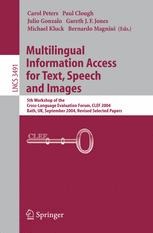
Multilingual Information Access for Text, Speech and Images ; 5th Workshop of the Cross-Language Evaluation Forum, CLEF 2004, Bath, UK, September 15-17, 2004, Revised Selected Papers
The ?fth campaign of the Cross-Language Evaluation Forum (CLEF) for Eu- pean languages was held from January to September 2004. Participation in the CLEF campaigns has increased each year and CLEF 2004 was no exception: 55 groups submitted results for one or more of the di?erent tracks compared with 42 groups in the previous year. CLEF 2004 also marked a breaking point with respect to previous campaigns. The focus was no longer mainly concentrated on multilingual document retrieval as in previous years but was diversi?ed to include di?erent kinds of text retrieval across languages (e. g. , exact answers in the question-answering track) and retrieval on di?erent kinds of media (i. e. , not just plain text but collections containing image and speech as well). In ad- tion, increasing attention was given to issues that regard system usability and user satisfaction with tasks to measure the e?ectiveness of interactive systems or system components being included in both the cross-language question - swering and image retrieval tasks with the collaboration of the coordinators of the interactive track. The campaign culminated in a two-and-a-half-day workshop held in Bath, UK, 15–17 September, immediately following the 8th European Conference on Digital Libraries. The workshop was attended by nearly 100 researchers and s- tem developers.

Multifunctional systems for combined delivery, biosensing and diagnostics
Multifunctional Systems for Combined Delivery, Biosensing, and Diagnostics explores how multifunctional nanocarriers are being used in combined delivery and diagnostics in contemporary medicine. Particular attention is given to efforts to i) reduce the side effects of therapeutic agents, ii) increase the pharmacological effect, and iii) improve aqueous solubility and chemical stability of different therapeutic agents. The chapters focus on applications of nanostructured materials and nanocarriers, highlighting how these can be used effectively in both diagnosis and delivery.

Multifunctional Pharmaceutical Nanocarriers
Various pharmaceutical nanocarriers, such as nanospheres,nanocapsules, liposomes, micelles, cell ghosts, lipoproteins and some others are widely used for experimental (and already clinical) delivery of therapeutic and diagnostic agents. The use of nanoparticulate pharmaceutical carriers to enhance the in vivo efficiency of many drugs well established itself over the past decade both in pharmaceutical research and clinical setting.

Multidisciplinary Scheduling : Theory and Applications ; 1st International Conference, MISTA '03 Nottingham, UK, 13-15 August 2003. Selected Papers
MULTIDISCIPLINARY SCHEDULING: Theory and Applications is a volume of nineteen reviewed papers that were selected from the sixty-seven papers presented during the First Multidisciplinary International Conference of Scheduling: Theory and Applications (MISTA). This is the initial volume of MISTA—the primary forum on interdisciplinary research on scheduling. Each paper in the volume has been rigorously reviewed and carefully copyedited to ensure the volume's readability. The book contains leading edge papers on the fundamentals of scheduling, multi-criteria objective scheduling, personnel scheduling, scheduling in space, scheduling the Internet, machine scheduling, bin packing, educational timetabling, sports scheduling, transport scheduling, aircraft scheduling, and heuristic and meta-heuristic scheduling

Multicriteria Scheduling : Theory, Models and Algorithms
Scheduling and multicriteria optimisation theory have been subject, separately, to numerous studies. Since the last twenty years, multicriteria scheduling problems have been subject to a growing interest. However, a gap between multicriteria scheduling approaches and multicriteria optimisation field exits. This book is an attempt to collect the elementary of multicriteria optimisation theory and the basic models and algorithms of multicriteria scheduling. It is composed of numerous illustrations, algorithms and examples which may help the reader in understanding the presented concepts. This book covers general concepts such as Pareto optimality, complexity theory, and general method for multicriteria optimisation, as well as dedicated scheduling problems and algorithms: just-in-time scheduling, flexibility and robustness, single machine problems, parallel machine problems, shop problems, etc.

Multicomponent reactions towards heterocycles : Concepts and applications
Heterocycles are a central component in natural product chemistry, pharmaceuticals, agrochemicals, and material science. New synthetic methodologies integrating the sequencing of multicomponent reactions (MCRs) are today being used for the rapid synthesis of diversified heterocycles in just one step. Multicomponent Reactions towards Heterocycles presents an up-to-date summary MCR chemistry with a focus on the conjugation between modern synthetic methodologies and MCRs.

Multi-Agent Programming : Languages, Platforms and Applications
Part I describes four approaches that are based on computational logic or process algebra--Jason, 3APL, IMPACT, and CLAIM/SyMPA. These programming languages have formal semantics and use heavy machinery based on formal methods, but also provide working platforms for the development of multi-agent systems. Part II presents agent languages and platforms that extend or are based on Java--JADE, Jadex, and JACKTM. Although these have no formal semantics, the languages are well documented and the platforms provide a variety of tools that have been extensively used in practice. Part III provides two significant industry specific applications--The DEFACTO System for coordinating human-agent teams for the future of disaster response, and the ARTIMIS rational dialogue agent technology. The book also features seven appendices, summarising each of the agent programming languages, hence facilitating comparison of the approaches. In particular, Appendix A describes the criteria used for comparing the agent languages and platforms.
Mucins : Methods and protocols
Explores the latest advancements in mucin research. The chapters in this book are organized into 8 parts and cover a wide range of topics such as mucin extraction, isolation, physicochemical property analysis, and experimental methods. The chapters also discuss the origins of mucins in jellyfish, feces, saliva and salivary glands, bronchi, stomach, and cervical tract; organic synthesis of peptides glycosylated at specific sites; analysis of mucin gene expression and methylation-specific electrophoresis of genes; imaging of mucin networks by AFM; and experimental methods using supported molecular matrix electrophoresis. Written in the highly successful Methods in Molecular Biology series format, chapters include introductions to their respective topics, lists of the necessary materials and reagents, step-by-step, readily reproducible laboratory protocols, and tips on troubleshooting and avoiding known pitfalls.

Move : Architecture in Motion - Dynamic Components and Elements
Dynamic components and adaptive elements are becoming increasingly important in contemporary architecture, and not just because of their visual effect. If architects and engineers are engaging more and more with the issue of movement – whether in the form of sun-tracking solar cells, lowerable walls, or intelligently programmed elevators – it’s because they are busy exploring responses to three challenges: How can we control and reduce the energy requirement of buildings? How can we expand the range of possible uses? And how can we represent, illustrate, accommodate, and control dynamic movements in buildings?

Mosby's 2024 nursing drug reference
Makes it easy to find the most vital information on the drugs you administer most frequently. More than 5,000 drugs are profiled — including more than 25 new entries for drugs recently approved by the FDA. And no other drug guide places a higher emphasis on patient safety, with Black Box Warnings for dangerous adverse reactions, High Alerts for drugs with the greatest risk, and a focus on both common and life-threatening side effects. From nursing pharmacology expert Linda Skidmore-Roth, this perennial bestseller proves there is a difference in drug guides.

Mosby’s dental drug reference
Profiles the most commonly used drugs in dentistry, with emphasis on dental-specific considerations. More than 800 drug monographs make it easy to find information such as dosages, indications, contraindications, interactions, precautions, side effects, and serious reactions.

Monographs in contact allergy ; Vol.4 : Systemic drugs
Presents : Identification section; Occupational allergic contact dermatitis; and Cutaneous adverse drug reactions from systemic drugs caused by type IV (delayed-type) hypersensitivity, as shown by positive patch tests (e.g. maculopapular eruption, acute generalized exanthematous pustulosis [AGEP], symmetrical drug-related intertriginous and flexural exanthema [SDRIFE], fixed drug eruption, drug reaction with eosinophilia and systemic symptoms [DRESS], and photosensitivity). Separate chapters present an overview of the spectrum of allergic cutaneous drug reactions, diagnostic tests, immediate contact reactions (contact urticaria), and systemic drugs that have acquired delayed-type hypersensitivity only by cross-reactivity.
