



الصفحة 8
الصفحة 8

Fuzzy Logic Applications in Engineering Science
Fuzzy logic is a relatively new concept in science applications. Hitherto, fuzzy logic has been a conceptual process applied in the field of risk management. Its potential applicability is much wider than that, however, and its particular suitability for expanding our understanding of processes and information in science and engineering in our post-modern world is only just beginning to be appreciated.

Fundamentals of computation theory ; 16th International Symposium, FCT 2007, Budapest, Hungary, August 27-30, 2007, Proceedings
This book constitutes the refereed proceedings of the 16th International Symposium Fundamentals of Computation Theory. The papers address all current topics in computation theory.

Fundamentals of computation theory ; 15th International symposium, FCT 2005, Lübeck, Gemany, August 17-20, 2005, Proceedings
This book constitutes the refereed proceedings of the 15th International Symposium Fundamentals of Computation Theory, FCT 2005, held in L]beck, Germany in August 2005. The 46 revised full papers presented together with 3 invited papers were carefully reviewed and selected from 105 submissions. The papers are organized in topical sections on circuits, automata, complexity, approximability, computational and structural complexity, graphs and complexity, computational game theory, visual cryptography and computational geometry, query complexity, distributed systems, automata and formal languages, semantics, approximation algorithms, average case complexity, algorithms, graph algorithms, and pattern matching.

Fun with algorithms ; 4th International conference, FUN 2007, Castiglioncello, Italy, June 3-5, 2007, Proceedings
This book constitutes the refereed proceedings of the 4th International Conference on Fun with Algorithms, FUN 2007, held in Castiglioncello, Italy in June 2007.

Fuchsian Reduction : Applications to Geometry, Cosmology, and Mathematical Physics
Fuchsian reduction is a method for representing solutions of nonlinear PDEs near singularities. The technique has multiple applications including soliton theory, Einstein's equations and cosmology, stellar models, laser collapse, conformal geometry and combustion. Developed in the 1990s for semilinear wave equations, Fuchsian reduction research has grown in response to those problems in pure and applied mathematics where numerical computations fail.

Frontiers in Number Theory, Physics, and Geometry II : On Conformal Field Theories, Discrete Groups and Renormalization
The present book collects most of the courses and seminars delivered at the meetingentitled"FrontiersinNumberTheory, PhysicsandGeometry", which took place at the Centrede PhysiquedesHouches in theFrenchAlps, March9- 21,2003. Itisdividedintotwovolumes. VolumeIcontainsthecontributionson three broad topics: Random matrices, Zeta functions and Dynamical systems. The present volume contains sixteen contribution sonthreethemes:Conformal?eld theories for strings and branes, Discrete groups and automorphic forms and?nally, Hopf algebras and renormalization. The relation between Mathematics and Physics has a long history.

Frontiers in Number Theory, Physics, and Geometry I : On Random Matrices, Zeta Functions, and Dynamical Systems
This book presents pedagogical contributions on selected topics relating Number Theory, Theoretical Physics and Geometry. The parts are composed of long self-contained pedagogical lectures followed by shorter contributions on specific subjects organized by theme. Most courses and short contributions go up to the recent developments in the fields; some of them follow their author?s original viewpoints. There are contributions on Random Matrix Theory, Quantum Chaos, Non-commutative Geometry, Zeta functions, and Dynamical Systems. The chapters of this book are extended versions of lectures given at a meeting entitled Number Theory, Physics and Geometry, held at Les Houches in March 2003, which gathered mathematicians and physicists.

Frontiers in Algorithmics ; 2nd Annual International Workshop, FAW 2008, Changsha, China, June 19-21, 2008, Proceeedings
This book constitutes the refereed proceedings of the Second International Frontiers of Algorithmics Workshop, FAW 2008, held in Changsha, China, in June 2008.The 33 revised full papers presented together with the abstracts of 3 invited talks were carefully reviewed and selected from 80 submissions. The papers were selected for 9 special focus tracks in the areas of biomedical informatics, discrete structures, geometric information processing and communication, games and incentive analysis.
From Gestalt Theory to Image Analysis : A Probabilistic Approach
This book introduces the reader to a recent theory in Computer Vision yielding elementary techniques to analyse digital images. These techniques are inspired from and are a mathematical formalization of the Gestalt theory. Gestalt theory, which had never been formalized is a rigorous realm of vision psychology developped between 1923 and 1975. From the mathematical viewpoint the closest field to it is stochastic geometry, involving basic probability and statistics, in the context of image analysis.

From Geometry to quantum mechanics : In Honor of Hideki Omori
This volume is composed of invited expository articles by well-known mathematicians in differential geometry and mathematical physics that have been arranged in celebration of Hideki Omori's recent retirement from Tokyo University of Science and in honor of his fundamental contributions to these areas.The papers focus on recent trends and future directions in symplectic and Poisson geometry, global analysis, infinite-dimensional Lie group theory, quantizations and noncommutative geometry, as well as applications of partial differential equations and variational methods to geometry.

Frobenius Splitting Methods in Geometry and Representation Theory
The theory of Frobenius splittings has made a significant impact in the study of the geometry of flag varieties and representation theory. This work, unique in book literature, systematically develops the theory and covers all its major developments.

Fracture Mechanics : Inverse Problems and Solutions
This book presents, in a unified manner, a variety of topics in Continuum and Fracture Mechanics: energy methods, conservation laws, mathematical methods to solve two-dimensional and three-dimensional crack problems.

Fractals in Biology and Medicine : Beyond Planting Trees
This volume it highlights the potential that fractal geometry offers for elucidating and explaining the complex make-up of cells, tissues and biological organisms either in normal or in pathological conditions, including the structural changes that occur in tumours. It helps develop the concepts, questions and methods required in research on fractal biology and natural phenomena and to evidence the pitfalls of a too simplistic application of these principles in investigating topical subjects of biology and medicine. It discusses present and future applications of fractal geometry, bringing together cellular and molecular biology, engineering, mathematics, physics, medicine and other disciplines and allowing an interdisciplinary vision.
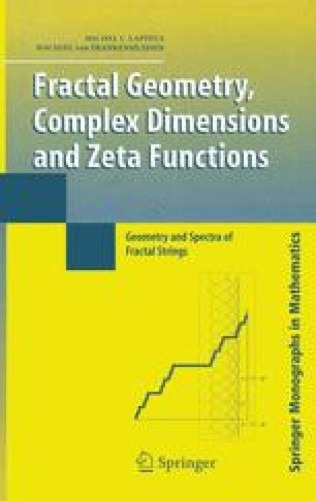
Fractal Geometry, Complex Dimensions and Zeta Functions : Geometry and Spectra of Fractal Strings
Number theory, spectral geometry, and fractal geometry are interlinked in this in-depth study of the vibrations of fractal strings, that is, one-dimensional drums with fractal boundary. Key Features The Riemann hypothesis is given a natural geometric reformulation in the context of vibrating fractal strings Complex dimensions of a fractal string, defined as the poles of an associated zeta function, are studied in detail, then used to understand the oscillations intrinsic to the corresponding fractal geometries and frequency spectra Explicit formulas are extended to apply to the geometric, spectral, and dynamical zeta functions associated with a fractal Examples of such explicit formulas include a Prime Orbit Theorem with error term for self-similar flows, and a geometric tube formula The method of Diophantine approximation is used to study self-similar strings and flows Analytical and geometric methods are used to obtain new results about the vertical distribution of zeros of number-theoretic and other zeta functions Throughout new results are examined. The final chapter gives a new definition of fractality as the presence of nonreal complex dimensions with positive real parts, and discusses several open problems and extensions.

Foundations of information and knowledge systems ; 5th International Symposium, FoIKS 2008, Pisa, Italy, February 11-15, 2008. Proceedings
This book constitutes the refereed proceedings of the 5th International Symposium on Foundations of Information and Knowledge Systems, FoIKS 2008 held in Pisa, Italy, in February 2008. The 13 revised full papers presented together with 9 revised short papers and 3 invited lectures were carefully selected during two rounds of reviewing and improvement from from 79 submissions. The papers deal with any foundational aspect of information and knowledge systems, including submissions from researchers working in fields such as discrete mathematics, logic and algebra, model theory, information theory, complexity theory, algorithmics and computation, geometry, analysis, statistics and optimisation who are interested in applying their ideas, theories and methods to research on information and knowledge systems.

Foundations of Hyperbolic Manifolds
The book is divided into three parts. The first part is concerned with hyperbolic geometry and discrete groups. The main results are the characterization of hyperbolic reflection groups and Euclidean crystallographic groups. The second part is devoted to the theory of hyperbolic manifolds. The main results are Mostow’s rigidity theorem and the determination of the global geometry of hyperbolic manifolds of finite volume. The third part integrates the first two parts in a development of the theory of hyperbolic orbifolds. The main result is Poincare«s fundamental polyhedron theorem.

Foundation Mathematics for Computer Science : A Visual Approach
In this second edition of Foundation Mathematics for Computer Science, John Vince has reviewed and edited the original book and written new chapters on combinatorics, probability, modular arithmetic and complex numbers. These subjects complement the existing chapters on number systems, algebra, logic, trigonometry, coordinate systems, determinants, vectors, matrices, geometric matrix transforms, differential and integral calculus. During this journey, the author touches upon more esoteric topics such as quaternions, octonions, Grassmann algebra, Barrycentric coordinates, transfinite sets and prime numbers.
Foliations and Geometric Structures
Offers basic material on distributions and foliations. This book introduces and builds the tools needed for studying the geometry of foliated manifolds. Its main theme is to investigate the interrelations between foliations of a manifold on the one hand, and the many geometric structures that the manifold may admit on the other hand.

Fluctuations, Information, Gravity and the Quantum Potential
A main theme of the book outlines the role of the quantum potential in quantum mechanics and general relativity and one of its origins via fluctuations formulated in terms of Fisher information. Another theme is the description of various approaches to Bohmian mechanics and their role in quantum mechanics and general relativity. Along the way various approaches to, for instance, the Dirac equation, the Einstein equations, the Klein-Gordon equation, the Maxwell equations and the Schr?dinger equations are described. Statistics and geometry are intertwined in various ways and, among other matters, the aether, cosmology, entropy, fractals, quantum Kaehler geometry, the vacuum and the zero point field are discussed. There is also some speculative material and some original work along with material extracted from over 1000 references and the work is current up to April 2005.

Flow and transport processes with complex obstructions : Applications to cities, vegetative canopies and industry
The NATO Advanced Study Institute “Flow and Transport Processes in Complex - structed Geometries: from cities and vegetative canopies to engineering problems” was held in Kyiv, Ukraine in the period of May 4 - 15, 2004. This book based on the papers presented there provides an overview of this new area in ?uid mechanics and its app- cations that have developed over the past three decades. The subject, whose origins lie both in theory and in practice, is now rapidly developing in many directions. The focus of applied ?uid mechanics research has steadily been shifting from - gineering to environmental applications.
