



الصفحة 6
الصفحة 6

Microcontrollers in Practice
Stressing common characteristics and real applications of the most used microcontrollers, this practical guide provides readers with hands-on knowledge of how to implement three families of microcontrollers (HC11, AVR, and 8051). Unlike the rest of the ocean of literature on individual chips, Microcontrollers in Practice supplieS side-by-side comparisons and an overview that treats the systems as resources available for implementation. Packed with hundred of practical examples and exercises to foster mastery of concepts and details, the guide also includes several extended projects. By treating the less expensive 8-bit and RISC microcontrollers, this information-dense manual equips students and home-experimenters with the know-how to put these devices into operation.

Microbiologically Influenced Corrosion : An Engineering Insight
Microbiologically-influenced corrosion (MIC) is one of the greatest mysteries of corrosion science and engineering, due to the complexities resulting from the involvement of living things such as bacteria. Bacteria are not only able to affect our health, but are also capable of impacting upon everyday life through a wide range of industrial sectors and the economy. Microbiologically Influenced Corrosion: An Engineering Insight introduces a new approach to the basics of MIC and explains how to recognise, understand, mitigate and/or prevent this type of corrosion. Topics explored include stress corrosion cracking and microbial corrosion, the pros and cons of biocides, the involvement of magnetic bacteria in microbial corrosion, and a new interpretation of cathodic protection based on recent research in microbial environments.

Microbial Processing of Metal Sulfides
The application of microbiological methods to the extraction of metals from minerals has definitely gained a prominent role and is supported by the several bioleaching and biooxidation processes operating in different sites over the world. In recent years new techniques and new results about proteomic and bioinformatics are bringing a new perspective on the microbial processes.This book focuses on the basic aspects of the process with special emphasis on recent contributions regarding the chemical and microbial aspects of the bioleaching process and the use of microorganisms in the treatment of complex ores and concentrates.

Micro and Nano Mechanical Testing of Materials and Devices
Nanoscale and nanostructured materials have exhibited different physical properties from the corresponding macroscopic coarse-grained materials due to the size confinement. As a result, there is a need for new techniques to probe the mechanical behavior of advanced materials on the small scales. Micro and Nano Mechanical Testing of Materials and Devices presents the latest advances in the techniques of mechanical testing on the micro- and nanoscales, which are necessary for characterizing the mechanical properties of low-dimensional materials and structures.
Micro- and Macro-Properties of Solids : Thermal, Mechanical and Dielectric Properties
Each of the eight chapters treats an important aspect of solid state physics, comprising a complete review of the particular field. Typically, a chapter starts with basic information about a property of a solid and the related experimental techniques. This is followed by a global overview which brings together all important contributions by different research workers in the field. This overview is comprehensive and covers essential literature over the past 60 years. Each chapter concludes with a detailed discussion of the contributions made by the chapter authors and their associates, in some cases spanning the last 45 years. In addition, Micro- and Macro-Properties of Solids provides data on new materials such as rare-earth metals, semiconductors, ferroelectrics, mixed-valence compounds, superionic conductors, optical and optoelectronic materials and biomaterials.
Methods of Measuring Moisture in Building Materials and Structures : State-of-the-Art Report of the RILEM Technical Committee 248-MMB
Provides the most recent overview of methods for measuring moisture Covers major applications in civil engineering Gives both the scientific background of methods and examples of their application
Metathesis Polymerization
Clearly illustrated and demonstrated by the entire series of Advances in Polymer Science., the area of polymer science is a rapidly developing and growing field, strongly influencing other areas of chemistry. Among other polymerization techniques, those based on metathesis polymerization have experienced significant progress. With a rapidly developing armory of initiators on hand, one is now capable of polymerizing various types of functional monomers by metathesis-based techniques.The latest developments in all these areas of metathesis-based polymerizations are summarized in this book. It is designed to attract equally students and advanced scientists working in the areas of polymer science, physical, and organometallic chemistry by providing both extensive background information and up-to-date interdisciplinary knowledge. Special consideration has been given to the literature sections in order to facilitate further reading.

Metathesis Chemistry : From Nanostructure Design to Synthesis of Advanced Materials
Recently, an important scientific event in metathesis chemistry, the NATO-Advanced Study Institute New Frontiers in Metathesis Chemistry: From Nanostructure Design to Sustainable Technologies for . Synthesis of Advanced Materials was organized in Antalya, Turkey (September 4-16, 2006). Prominent scientists, young researchers and students, convened for two weeks to debate on the newest trends in olefin metathesis and identify future perspectives in this fascinating field of synthetic organic, organometallic and polymer chemistry with diverse potential applications in materials science and technology. Following the fruitful practice of the previous NATO ASI meetings, selected contributions comprising plenary lectures, short communications and posters are compiled in this special volume dedicated to this outstanding international scientific meeting.
Metallopolymer Nanocomposites
Highly dispersed nanoscale particles in polymer matrices are currently attracting great interest in many fields of chemistry, physics and materials science. This book presents and analyzes the essential data on nanoscale metal clusters dispersed in, or chemically bonded with polymers. Special attention is paid to the in situ synthesis of the nanocomposites, their chemical interactions, and the size and distribution of the particles in the polymer matrix. Numerous novel nanocomposites are described with regard to their mechanical, electrophysical, optical, magnetic, catalytic and biological properties. Their applications, present and future, are outlined. The book is addressed both to researchers who actively use these materials and to students entering this multidisciplinary field.

Metallocenes in Regio- and Stereoselective Synthesis
Metallocene is a well known sandwich complex with two cyclopentadienyl ligands such as ferrocene. Recently, such metallocene compounds have been found to be very characteristic and they have become very important, not only in the area of organic synthesis, but also in polymerization in industry. Metal complexes with one cyclopentadienyl ligand have also become popular as half sandwich complexes. The number of researchers in the field of metallocenes has increased rapidly. However, the origin of the characteristic reactivity of metallocenes is not fully understood. In this volume, the chemistry of metal complexes with at least one cyclopentadienyl ligand is comprehensively covered by leading experts. Reactions discussed here are (i) natural product synthesis, (ii) catalytic asymmetric synthesis, (iii) cyclization reactions, (iv)catalytic reactions, (iv) polymerization reactions and (v) carbon-carbon bond cleavage reactions. The reader will have access to useful information about the current state of metallocene chemistry.

Metal-Catalysed Reactions of Hydrocarbons
This unique book, drawing on the author’s lifetime experience, critically evaluates the extensive literature on the field of Metal-Catalysed Reactions of Hydrocarbons. Emphasis is placed on reaction mechanisms involving hydrogenation, hydrogenolysis, skeletal and positional isomerisation, and exchange reactions. The motivation for fundamental research in heterogeneous catalysis is to identify the physicochemical characteristics of active centres for the reaction being studied, to learn how these may be modified or manipulated to improve the desired behavior of the catalyst, and to recognize and control those aspects of the catalyst's structure that limit its overall performance. By restricting the subject of the book to hydrocarbons, Bond has progressively developed the subject matter to include areas of importance both to researchers and to those working in the industry.

Metal Matrix Composites
Metal matrix composites (MMCs) have become real engineering materials. MMCs have gone from "niche" materials to several high performance applications in aerospace, electronic packaging, automotive, and recreational products. This text focuses on the synergistic relationships among processing, microstructure, and properties of metal matrix composites. An introductory chapter is followed by a chapter each on reinforcements and common matrix materials. A chapter on the very important topic of processing of MMC is then presented. This is followed by a chapter on interfaces in MMCs, their characterization and techniques to obtain interfacial properties. Next there are chapters on monotonic mechanical and physical properties; followed by cyclic fatigue, creep, and wear resistance. We conclude with a chapter on applications of MMCs. The book is well-suited for upper level undergraduate students, graduate students, and as general source of reference on the subject for the professionals in the field.
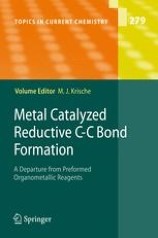
Metal Catalyzed Reductive C-C Bond Formation : A Departure from Preformed Organometallic Reagents
The prototypical catalytic reductive C–C bond formations, the Fischer-Tropsch reaction [1] and alkene hydroformylation [2], were discovered in 1922 and 1938, respectively [3,4]. These processes, which involve reductive coupling to carbon monoxide, have long been applied to the industrial manufacture of commodity chemicals [5]. Notably, alkene hydroformylation, also known as the oxo-synthesis, has emerged as the largest volume application of homogeneous metal catalysis, accounting for the production of over 7 million metrictons of aldehyde annually. Despite the impact of these prototypical reductive C–C bond formations, this field of research lay fallow for several decades.

Metal Catalyzed Cascade Reactions
Transition metal-catalyzed cascade reactions are an elegant approach to complex molecular scaffolds. Besides their esthetics and increase in structural complexity, they have also become mechanistic challenges for the combination of organometallic elementary steps. As a consequence, cascade reactions have revolutionized synthetic strategies and conceptual thinking. The authors highlight cyclization via carbopalladation and acylpalladation and Heck-pericyclic sequences. They discuss p-allyl palladium-based cascade reactions, Michael-type additions as an entry to transition-metal-promoted cyclizative transformations, and sequential or consecutive palladium-catalyzed processes, and show Pauson-Khand cascades, metal-catalyzed cyclizations of acyclic precursors, as well as cascade and sequential ruthenium-catalyzed transformations. Therefore, the reader finds overview of an exciting and highly dynamic field of a new and innovative methodological concept

Metal Catalysed Reactions in Ionic Liquids
Metal Catalysed Reactions in Ionic Liquids is the first non-edited book on the subject of metal catalysed reactions in ionic liquids and covers the literature from its origins until early 2005.The book begins with a general introduction to the field of biphasic/multiphasic catalysis and describes the synthesis, functionalisation and fundamental properties of ionic liquids relevant to catalysis.This book is an invaluable resource for all those working in catalysis, green chemistry, and advanced synthetic methods,

MEMS/NEMS : (1) Handbook Techniques and Applications Design Methods, (2) Fabrication Techniques, (3) Manufacturing Methods, (4) Sensors and Actuators, (5) Medical Applications and MOEMS
Micro-Electro Mechanical Systems (MEMS) is the integration of mechanical elements, sensors, actuators, and electronics on a common silicon substrate. While the electronics are fabricated using integrated circuit (IC) process sequences (e.g., CMOS, Bipolar, or BICMOS processes),the micromechanical components are fabricated using compatible micromachining processes that selectively etch away parts of the silicon wafer or add new structural layers to form the mechanical and electromechanical devices. MEMS promises to revolutionize nearly every product category by bringing together silicon-based microelectronics with micromachining technology, thereby, making possible the realization of complete systems-on-a-chip.

Medicinal Chemistry and Pharmacological Potential of Fullerenes and Carbon Nanotubes
Medicinal Chemistry and Pharmacological Potential of Fullerenes and Carbon Nanotubes features important insights into the applications of fullerenes and carbon nanotubes. It discusses the fullerene and nanotubes derivatives which are effective against viruses, cells, and bacteria and those which are able to interact and inhibit certain enzymes. Also covered in this book are the formation of complex structures between biologically active molecules and carbon materials. Furthermore, the application of fullerenes in certain medical therapies is explored, including the very recent discovery of new bio-compatible media which could be used as carriers in the delivery of fullerenes in vivo. An additional topic of this text is the formation of hybrids between nanotubes and biological molecules and their use as chemical sensors.

Medical Applications of Colloids
This volume collects chapters dealing with significant topics in colloids and surfaces relevant to medical applications. The book will be of interest to scientists and practitioners in areas as diverse as medical diagnostics, drug formulations, X-ray photoelectron spectroscopy of biomaterials, and particle transport in human airways.

Mechanochemistry in Nanoscience and Minerals Engineering
Mechanochemistry as a branch of solid state chemistry enquires into processes which proceed in solids due to the application of mechanical energy. This provides a thorough, up to date overview of mechanochemistry of solids and minerals. Applications of mechanochemistry in nanoscience with special impact on nanogeoscience are described. Selected advanced identification methods, most frequently applied in nanoscience, are described as well as the advantage of mechanochemical approach in minerals engineering. Examples of industrial applications are given. Mechanochemical technology is being applied in many industrial fields: powder metallurgy (synthesis of nanometals, alloys and nanocompounds), building industry (activation of cements), chemical industry (solid waste treatment, catalyst synthesis, coal ashes utilization), minerals engineering (ore enrichment, enhancement of processes of extractive metallurgy), agriculture industry (solubility increase of fertilizers), and pharmaceutical industry (improvement of solubility and bioavailability of drugs).

Mechanics of Composite Materials with MATLAB
This textbook makes use of the popular computer program MATLAB as the major computer tool to study Mechanics of Composite Materials. It is written specifically for students in Engineering and Materials Science examining step-by-step solutions of composite material mechanics problems using MATLAB.
