



الصفحة 57
الصفحة 57

Computational Fluid Dynamics for Wind Engineering
Covers topics such as: Fluid mechanics, turbulence in fluid mechanics, turbulence modelling, and mathematical modelling of wind engineering problems The finite difference method for CFD, solutions to the incompressible Navier-Stokes equations, visualization, and animation in CFD, and the application of CFD to building and bridge aerodynamics How to compare CFD analysis with wind tunnel measurements, field measurements, and the ASCE-7 pressure coefficients Wind effects and strain on large structures

Computational Fluid Dynamics 2004 ; Proceedings of the Third International Conference on Computational Fluid Dynamics, ICCFD3, Toronto, 12-16 July 2004
The International Conference on Computational Fluid Dynamics (ICCFD) is the merger of the International Conference on Numerical Methods in Fluid Dynamics (ICNMFD) and the International Symposium on Computational Fluid Dynamics (ISCFD). It is held every two years and brings together physicists, mathematicians and engineers to review and share recent advances in mathematical and computational techniques for modeling fluid dynamics. The proceedings of the 2004 conference held in Toronto, Canada, contain a selection of refereed contributions and are meant to serve as a source of reference for all those interested in the state of the art in computational fluid dynamics.

Computational Ergodic Theory
Ergodic theory is hard to study because it is based on measure theory, which is a technically difficult subject to master for ordinary students, especially for physics majors. Many of the examples are introduced from a different perspective than in other books and theoretical ideas can be gradually absorbed while doing computer experiments. Theoretically less prepared students can appreciate the deep theorems by doing various simulations. The computer experiments are simple but they have close ties with theoretical implications. The last chapter explains the relation between entropy and data compression, which belongs to information theory and not to ergodic theory.

Computational Electronic Circuits : Simulation and Analysis with MATLAB®
This textbook teaches in one, coherent presentation the three distinct topics of analysis of electronic circuits, mathematical numerical algorithms and coding in a software such as MATLAB®. By combining the capabilities of circuit simulators and mathematical software, the author teaches key concepts of circuit analysis and algorithms, using a modern approach. The DC, Transient, AC, Noise and behavioral analyses are implemented in MATLAB to study the complete characteristics of a variety of electronic circuits, such as amplifiers, rectifiers, hysteresis circuits, harmonic traps and passes, polyphaser filters, directional couplers, electro-static discharge and piezoelectric crystals. This book teaches basic and advanced circuit analysis, by incorporating algorithms and simulations that teach readers how to develop their own simulators and fully characterize and design electronic circuits.

Computational Electromagnetics
Computational Electromagnetics is a young and growing discipline, expanding as a result of the steadily increasing demand for software for the design and analysis of electrical devices. This book introduces three of the most popular numerical methods for simulating electromagnetic fields: the finite difference method, the finite element method and the method of moments. In particular it focuses on how these methods are used to obtain valid approximations to the solutions of Maxwell's equations, using, for example, "staggered grids" and "edge elements." The main goal of the book is to make the reader aware of different sources of errors in numerical computations, and also to provide the tools for assessing the accuracy of numerical methods and their solutions. To reach this goal, convergence analysis, extrapolation, von Neumann stability analysis, and dispersion analysis are introduced and used frequently throughout the book. Another major goal of the book is to provide students with enough practical understanding of the methods so they are able to write simple programs on their own. To achieve this, the book contains several MATLAB programs and detailed description of practical issues such as assembly of finite element matrices and handling of unstructured meshes.

Computational Commutative : Algebra 2
The main part of this book is a breathtaking passeggiata through the computational domains of graded rings and modules and their Hilbert functions. Besides Gröbner bases, we encounter Hilbert bases, border bases, SAGBI bases, and even SuperG bases. The tutorials traverse areas ranging from algebraic geometry and combinatorics to photogrammetry, magic squares, coding theory, statistics, and automatic theorem proving. Whereas in the first volume gardening and chess playing were not treated, in this volume they are. This is a book for learning, teaching, reading, and most of all, enjoying the topic at hand. The theories it describes can be applied to anything from children's toys to oil production. If you buy it, probably one spot on your desk will be lost forever!

Computational Chemistry and Molecular Modeling : Principles and Applications
The gap between introductory level textbooks and highly specialized monographs is filled by this modern textbook. It provides in one comprehensive volume the in-depth theoretical background for molecular modeling and detailed descriptions of the applications in chemistry and related fields like drug design, molecular sciences, biomedical, polymer and materials engineering. Special chapters on basic mathematics and the use of respective software tools are included.

Comfort and Perception in Architecture
This book discusses the design of comfortable buildings and shows that design perception and, as a result, comfort should be an intentional feature of architectural design. Modern buildings are often sealed boxes without operable windows or daylighting design. However, contemporary designers increasingly find themselves faced with the task of creating spaces that are comfortable in terms of thermal and visual aspects.

Combustion : Physical and Chemical Fundamentals, Modeling and Simulation, Experiments, Pollutant Formation
The actual fourth edition presents a completely restructured book: Mathematical Formulae and derivations as well as the space-consuming reaction mechanisms have been replaced from the text to appendix. A new chapter discusses the impact of combustion processes on the earth’s atmosphere, the chapter on auto-ignition is extended to combustion in Otto- and Diesel-engines, and the chapters on heterogeneous combustion and on soot formation appear heavily revised.

Combinatorics of Coxeter Groups
Coxeter groups are of central importance in several areas of algebra, geometry, and combinatorics. This clear and rigorous exposition focuses on the combinatorial aspects of Coxeter groups, such as reduced expressions, partial order of group elements, enumeration, associated graphs and combinatorial cell complexes, and connections with combinatorial representation theory. While Coxeter groups have already been exposited from algebraic and geometric perspectives, this text is the first one to focus mainly on the combinatorial aspects of Coxeter groups. The first part of the book provides a self-contained introduction to combinatorial Coxeter group theory. The emphasis here is on the combinatorics of reduced decompositions, Bruhat order, weak order, and some aspects of root systems. The second part deals with more advanced topics, such as Kazhdan-Lusztig polynomials and representations, enumeration, and combinatorial descriptions of the classical finite and affine Weyl groups. A wide variety of exercises, ranging from easy to quite difficult are also included.

Combinatorics and Graph Theory
This book covers a wide variety of topics in combinatorics and graph theory. It includes results and problems that cross subdisciplines, emphasizing relationships between different areas of mathematics. In addition, recent results appear in the text, illustrating the fact that mathematics is a living discipline.

Combinatorial Stochastic Processes : Ecole d'Eté de Probabilités de Saint-Flour XXXII - 2002
This volume contains the course “Combinatorial stochastic processes” of Professor Pitman. We cordially thank the author for his performance in Saint-Flour and for these notesThere is particular focus on the theory of random combinatorial structures such as partitions, permutations, trees, forests, and mappings, and connections between the asymptotic theory of enumeration of such structures and the theory of stochastic processes like Brownian motion and Poisson processes.

Combinatorial pattern matching ; Vol.4009) ; 17th Annual Symposium, CPM 2006, Barcelona, Spain, July 5-7, 2006, Proceedings
The book presents 33 revised full papers together with 3 invited talks, organized in topical sections on data structures, indexing data structures, probabilistic and algebraic techniques, applications in molecular biology, string matching, data compression, and dynamic programming

Combinatorial pattern matching ; 18th Annual Symposium, CPM 2007, London, Canada, July 9-11, 2007, Proceedings
This book presented original research contri- tions on computational pattern matching and analysis, data compression and compressed text processing, sufix arrays and trees, and computational biology. Combinatorial Pattern Matching addresses issues of searching and matching strings and more complicated patterns such as trees, regular expressions, graphs, point sets, and arrays.The goal is to derive non-trivial combinatorial properties of such structures and to exploit these properties in order to either achieve superior performance for the corresponding computational problems or pinpoint conditions under which searches cannot be performed eficiently.
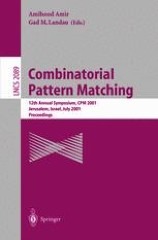
Combinatorial pattern matching ; 12th Annual Symposium, CPM 2001 Jerusalem, Israel, July 1-4, 2001 Proceedings
This book constitutes the refereed proceedings of the 12th Annual Symposium on Combinatorial Pattern Matching, CPM 2001, held in Jerusalem, Israel, in July 2001. The 21 revised papers presented together with one invited paper were carefully reviewed and selected from 35 submissions. The papers are devoted to current theoretical and algorithmic issues of searching and matching strings and more complicated patterns such as trees, regular expressions, graphs, point sets, and arrays as well as to advanced applications of CPM in areas such as the Internet, computational biology, multimedia systems, information retrieval, data compression, coding, computer vision, and pattern recognition.

Combinatorial optimization and applications ; 2nd International Conference, COCOA 2008, St. John’s, NL, Canada, August 21-24, 2008. Proceedings
This book constitutes the refereed proceedings of the Second International Conference on Combinatorial Optimization and Applications, COCOA 2008, held in St. John's, Canada, in August 2008.

Combinatorial optimization and applications ; 1st International Conference, COCOA 2007, Xi'an, China, August 14-16, 2007, Proceedings
This book presented feature original research in the areas of combinatorial optimization - both theoretical issues and and applications motivated by real-world problems thus showing convincingly the usefulness and efficiency of the algorithms discussed in a practical setting.

Combinatorial optimization and applications ; 14th International Conference, COCOA 2020, Dallas, TX, USA, December 11–13, 2020, Proceedings
This volume constitutes the proceedings of the 14th International Conference on Combinatorial Optimization and Applications, COCOA 2020, held in Dallas, TX, USA, in December 2020. The 55 full papers presented in this volume were carefully reviewed and selected from 104 submissions. The papers are grouped into the following topics: Approximation Algorithms; Scheduling; Network Optimization; Complexity and Logic; Search, Facility and Graphs; Geometric Problem; Sensors, Vehicles and Graphs; and Graph Problems.

Combinatorial Optimization : Theory and Algorithms
Puts special emphasis on theoretical results and algorithms with provably good performance, in contrast to heuristics. It has arisen as the basis of several courses on combinatorial optimization and more special topics at graduate level. Since the complete book contains enough material for at least four semesters (4 hours a week), one usually selects material in a suitable way. The book contains complete but concise proofs, also for many deep results, some of which did not appear in a book before. Many very recent topics are covered as well, and many references are provided. Thus this book represents the state of the art of combinatorial optimization. This third edition contains a new chapter on facility location problems, an area which has been extremely active in the past few years. Furthermore there are several new sections and further material on various topics. New exercises and updates in the bibliography were added.

Combinatorial Optimization : Theory and Algorithms
Places special emphasis on theoretical results and algorithms with provably good performance, in contrast to heuristics. It has arisen as the basis of several courses on combinatorial optimization and more special topics at graduate level. It contains complete but concise proofs, also for many deep results, some of which did not appear in a textbook before. Many very recent topics are covered as well, and many references are provided. Thus this book represents the state of the art of combinatorial optimization.
