



الصفحة 56
الصفحة 56

Enterprise ontology : Theory and methodology
Such a theory and a matching methodology, which has passed the test of practical experience, constitute the contents of this book. The enterprise ontology, as developed by Dietz, is the starting point for profoundly understanding the organization of an enterprise and subsequently for analyzing, (re)designing, and (re)engineering it. The approach covers numerous issues in an integrated way: business processes, in- and outsourcing, information systems, management control, staffing etc.

Enterprise interoperability III : New challenges and industrial approaches
This book provides knowledge for cost savings and business improvement as well as new technical solutions. Composed of over 50 papers, Enterprise Interoperability III ranges from academic research through case studies to industrial and administrative experience of interoperability.

Enterprise interoperability II : New challenges and approaches
Interoperability: the ability of a system or a product to work with other systems or products without special effort from the user is a key issue in manufacturing and industrial enterprise generally. It is fundamental to the production of goods and services quickly and at low cost at the same time as maintaining levels of quality and customisation. Interoperability is achieved if internal and external collaborators can interact on at least three levels: data, applications and business enterprise (through the architecture of an enterprise model and making allowance for the semantics of both partners). Not only a problem of software and IT technologies, it implies support for communication and transactions between different organisations that must be based on shared business references. Today, a new and important consideration must be taken into account – economic business evaluation and the definition of dissemination policy.

Enterprise interoperability : New challenges and approaches
Interoperability: the ability of a system or a product to work with other systems or products without special effort from the user is a key issue in manufacturing and industrial enterprise generally. It is fundamental to the production of goods and services quickly and at low cost at the same time as maintaining levels of quality and customisation. Interoperability is achieved if internal and external collaborators can interact on at least three levels: data, applications and business enterprise (through the architecture of an enterprise model and making allowance for the semantics of both partners). Not only a problem of software and IT technologies, it implies support for communication and transactions between different organisations that must be based on shared business references. Today, a new and important consideration must be taken into account – economic business evaluation and the definition of dissemination policy.

Enterprise Information Systems VII
The purpose of the 7th International Conference on Enterprise Information Systems (ICEIS) was to bring together researchers, engineers and practitioners interested in the advances and business applications of information systems. Five simultaneous tracks have been held, covering different aspects of Enterprise Information Systems Applications, including Enterprise Database Technology, Systems Integration, Artificial Intelligence, Decision Support Systems, Information Systems Analysis and Specification, Internet Computing, Electronic Commerce and Human Factors.
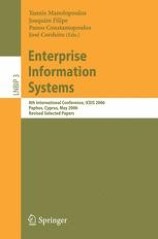
Enterprise Information Systems ; 8th International Conference, ICEIS 2006, Paphos, Cyprus, May 23-27, 2006, Revised Selected Papers
This book contains the carefully selected best papers of the 8th International Conference on Enterprise Information Sysetms, ICEIS 2006, held in Paphos, Cyprus, in May 2006.The 4 invited papers and 27 revised and selected papers presented in this volume cover different aspects related to enterprise computing. They were selected from 63 accepted papers (out of more than 400 submissions). The contributions are grouped in sections on databases and information systems integration.

Enterprise architecture at work : Modelling, communication and analysis
n enterprise architecture tries to describe and control an organisation’s structure, processes, applications, systems and techniques in an integrated way. The unambiguous specification and description of components and their relationships in such an architecture requires a coherent architecture modelling language.Since an architecture model is useful not only for providing insight into the current or future situation but can also be used to evaluate the transition from ‘as-is’ to ‘to-be’, the authors also describe analysis methods for assessing both the qualitative impact of changes to an architecture and the quantitative aspects of architectures, such as performance and cost issues. The modelling language and the other techniques presented have been proven in practice in many real-life case studies. So this book is an ideal companion for enterprise IT or business architects in industry as well as for computer or management science students studying the field of enterprise architecture.

Enterprise Applications and Services in the Finance Industry ; 3rd International Workshop, FinanceCom 2007, Montreal, Canada, December 8, 2007. Revised Papers
This book constitutes the proceedings of the 4th International Workshop on Enterprise Applications and Services in the Finance Industry, FinanceCom2008, held in Paris, France, on December 13, 2008. The workshop spans multiple disciplines, including technical, economic, sociological and behavioral sciences. The guiding theme of this workshop was concerned with innovations in the financial services industry, driven by either new business models or changed regulations.

Entering Emerging Markets : Motorola's Blueprint for Going Global
The book describes the strategies and processes of a multi-national US corporation applied in entering emerging markets around the globe. It details the structured approach, innovative ways and concerted efforts involved. Executives learned how to gain foothold in unknown territory and how to deal with complexity and diversity.

Enhancing Smallholder Farmers' Access to Seed of Improved Legume Varieties Through Multi-stakeholder Platforms : Learning from the TLIII project Experiences in sub-Saharan Africa and South Asia
This book shares the experiences of Tropical Legumes III (TLIII) project in facilitating access to seed of improved legume varieties to smallholder farmers through innovation platforms. It highlights practices and guiding principles implemented in eight developing countries of sub-Saharan Africa and South Asia. This book details key processes that respective teams employed to create an innovation space that delivers seed, other inputs, knowledge and financial services to agricultural communities and most importantly, the underserved farmers in remote areas of the drylands

Enhanced Methods in Computer Security, Biometric and Artificial Intelligence Systems
"Methods of Artificial Intelligence and Intelligent Agents" contains 13 contributions analyzing such areas of AI as fuzzy set theory, predicate logic, neural networks, clustering, data mining and others. It also presents applications of AI as possible solutions for problems like firm bankruptcy, soil erosion, flight control and others. "Information Technology Security" covers three important areas of security engineering in information systems: software security, public key infrastructure and the design of new cryptographic protocols and algorithms. "Biometric Systems" comprises 11 contributions dealing with face picture analysis and recognition systems. This chapter focuses on known methods of biometric problem solution as well as the design of new models.

Enhanced Living Environments : Algorithms, Architectures, Platforms, and Systems
Ambient Assisted Living (AAL) is an area of research based on Information and Communication Technologies (ICT), medical research, and sociological research. AAL is based on the notion that technology and science can provide improvements in the quality of life for people in their homes, and that it can reduce the financial burden on the budgets of the healthcare providers. The concept of Enhanced Living Environments (ELE) refers to the AAL area that is more related with ICT. Effective ELE solutions require appropriate ICT algorithms, architectures, platforms, and systems, having in view the advance of science in this area and the development of new and innovative solutions. The aim of this book is to become a state-of-the-art reference, discussing progress made, as well as prompting future directions on theories, practices, standards, and strategies related to the ELE area.

English proofreader
Using Natural Language Processing via Deep Learning, we will attempt to implement a context-sensitive spelling error correction system focused on casual text messaging. For example, usual autocorrect systems will not correct a sentence like “An apple is better than a banana” as this is a syntactically correct sentence. However, a correction should be made here to the word “then” and the sentence should be, “An apple is better than a banana.” These types of mistakes are common in people texting and can be found for example in people learning English as a second language. Natural Language Processing can be summarized as combining the utilization of computation to understand the concepts of natural language and speech.

Engineering Stochastic Local Search Algorithms. Designing, Implementing and Analyzing Effective Heuristics ; International Workshop, SLS 2007, Brussels, Belgium, September 6-8, 2007, Proceedings
Stochastic local search (SLS) algorithms enjoy great popularity as powerful and versatile tools for tackling computationally hard decision and optimization pr- lems from many areas of computer science, operations research, and engineering. However, in recent years it has become evident that at the core of this development task there is a highly complex engineering process, which combines various aspects of algorithm design with empirical analysis techniques and problem-specific background, and which relies heavily on knowledge from a number of disciplines and areas, including computer science, operations research, artificial intelligence, and statistics. This development process needs to be - sisted by a sound methodology that addresses the issues arising in the various phases of algorithm design, implementation, tuning, and experimental eval- tion.

Engineering Societies in the Agents World VII ; 7th International Workshop, ESAW 2006 Dublin, Ireland, September 6-8, 2006 Revised Selected and Invited Papers
It cover main themes: Engineering multi-agent systems, Methodologies for analysis, design, development and verification of agent societies, Interaction and coordination in agent societies, Autonomic agent societies, Trust in agent societies For

Engineering Optics
Engineering Optics is a book for students who want to apply their knowledge of optics to engineering problems, as well as for engineering students who want to acquire the basic principles of optics. It covers such important topics as optical signal processing, holography, tomography, holographic radars, fiber optical communication, electro- and acousto-optic devices, and integrated optics (including optical bistability). As a basis for understanding these topics, the first few chapters give easy-to-follow explanations of diffraction theory, Fourier transforms, and geometrical optics. Practical examples, such as the video disk, the Fresnel zone plate, and many more, appear throughout the text, together with numerous solved exercises. There is an entirely new section in this updated edition on 3-D imaging.

Engineering Design : A Systematic Approach
Engineering Design (3rd edition) describes a systematic approach to engineering design. The authors argue that such an approach, applied flexibly and adapted to a particular task, is essential for successful product development. The design process is first broken down into phases and then into distinct steps, each with its own working methods. The third edition of this internationally-recognised text is enhanced with new perspectives and the latest thinking. These include extended treatment of product planning; new sections on organisation structures, simultaneous engineering, leadership and team behaviour; and updated chapters on quality methods and estimating costs. New examples have been added and existing ones extended, with additions on design to minimise wear, design for recycling, mechanical connections, mechatronics, and adaptronics.

Engineering and Managing Software Requirements
This book provides an exploration of key issues in requirements engineering, the book is organized in three parts. Part 1 presents surveys of state-of-the art requirements engineering process research along with critical assessments of existing models, frameworks and techniques. Part 2 addresses key areas in requirements engineering, such as market-driven requirements engineering, goal modeling, requirements ambiguity, and others. Part 3 concludes the book with articles that present empirical evidence and experiences from practices in industrial projects. Its broader perspective gives this book its distinct appeal and makes it of interest to both researchers and practitioners, not only in software engineering but also in other disciplines such as business process engineering and management science.

Engineered Bamboo Structures
Bamboo is in the spotlight as a potential building material in the current pursuit of a CO2-neutral society, due to its rapid maturation and excellent mechanical properties. Despite the growing interest in bamboo in academia and society, there is a lack of systematic understanding of the fabrication, design and construction processes using bamboo as a modern industrial material. Describes a new category of structural systems constructed with engineered bamboo. It gives a definition of engineered bamboo (glubam) in an analogy with steel structures and wood structures. Structural systems and components have been designed using glubam; then industrialized production processes of glubam are described.

Energy minimization methods in computer vision and pattern recognition ; 6th International Conference, EMMCVPR 2007, Ezhou, China, August 27-29, 2007, Proceedings
Contains critical issues of representation, learning, and inference. Important new themes include pr- abilistic grammars, image parsing, and the use of datasets with ground-truth to act as benchmarks for evaluating algorithms and as a way to train learning algorithms. Other themes include the development of efficient inference algorithms using advanced techniques from statistics, computer science, and applied mathematics. This book makes no distinction between oral and poster papers. It also contiants sections on al- rithms, applications, image parsing, image processing, motion, shape, and thr- dimensional processing.
