



الصفحة 5
الصفحة 5

From Nucleons to Nucleus : Concepts of Microscopic Nuclear Theory
From Nucleons to Nucleus deals with single-particle and collective features of spherical nuclei. Each nuclear model is introduced and derived in detail. The formalism is then applied to light and medium-heavy nuclei in worked-out examples, and finally the acquired skills are strengthened by a wide selection of exercises, many relating the models to experimental data.

From microphysics to macrophysics : Methods and applications of statistical physics; Vol.1
Volume 1 discusses in detail the probabilistic description of quantum or classical systems, the Boltzmann-Gibbs distributions, the conservation laws, and the interpretation of entropy as missing information. Thermodynamics and electromagnetism in matter are dealt with, as well as applications to gases, both dilute and condensed, and to phase transitions.

Foundations of security analysis and design III : FOSAD 2004/2005 tutorial lectures
The increasing relevance of security to real-life applications, such as electronic commerce and Internet banking, is attested by the fast-growing number of - search groups, events, conferences, and summer schools that address the study of foundations for the analysis and the design of security aspects. The “Int- national School on Foundations of Security Analysis and Design” (FOSAD, see http://www.sti.uniurb.it/events/fosad/)has been one of the foremost events - tablishedwiththegoalofdisseminatingknowledgeinthiscriticalarea,especially for young researchers approaching the ?eld and graduate students coming from less-favoured and non-leading countries. The FOSAD school is held annually at the Residential Centre of Bertinoro (http://www.ceub.it/), in the fascinating setting of a former convent and ep- copal fortress that has been transformed into a modern conference facility with computing services and Internet access. Since the ?rst school, in 2000, FOSAD hasattractedmorethan250participantsand50lecturersfromallovertheworld.
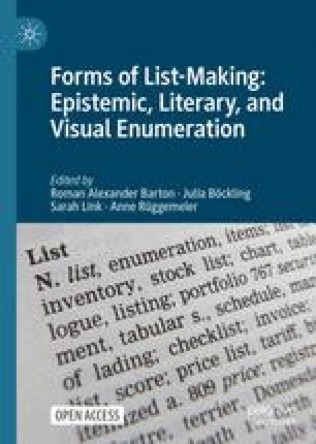
Forms of List-Making : Epistemic, Literary, and Visual Enumeration
This book attempts to show that an examination of the list’s formal features has the potential to produce genuine insights into the production of knowledge, the poetics of literature and the composition of visual art. Following a conceptual introduction, the twelve single-authored chapters place the list in a variety of well-researched contexts, including ancient Roman historiography, medieval painting, Enlightenment periodicals, nineteenth-century botanical geography, American Beat poetry and contemporary photobooks.
Formative research in social marketing : Innovative methods to gain consumer insights
Brings together the state of the art and current debates in the field of formative research, and examines many of the innovative methods largely overlooked in the available literature. This book will help social marketing to move beyond surveys and focus groups.The book addresses the needs of social marketing academics and practitioners alike by providing a robust and critical academic discussion of cutting-edge research methods, while demonstrating at the same time how each respective method can help us arrive at a deeper understanding of the issues that social marketing interventions are seeking to remedy. Each chapter includes a scholarly discussion of key formative research methods.

Flux Pinning in Superconductors
Covers the flux pinning mechanisms and properties and the electromagnetic phenomena caused by the flux pinning common for metallic, high-Tc and MgB2 superconductors. The condensation energy interaction known for normal precipitates or grain boundaries and the kinetic energy interaction proposed for artificial Nb pins in Nb-Ti, etc., are introduced for the pinning mechanism.

Flavours and Fragrances : Chemistry, Bioprocessing and Sustainability
This book is an introduction to the fascinating world of aroma chemicals, essential oils, fragrances and flavour compositions for the food, cosmetics and pharmaceutical industry. The present state-of-the-art technology, the future use of resources and biotechnological approaches for the production of the respective chemical compounds are described. A large section is devoted to the description of the renewable resources of flavours: spice plants, fruits from moderate to tropical climates, vegetables, fermented and heated plants. Analytical methods, such as gas chromatography coupled to human or electronic noses or to a mass spectrometer, are outlined and consumer trends, legal and safety aspects are described. Novel renewable resources come from biotechnology.

Fisica solare = Solar physics
An introduction to Solar Physics, intended to illustrate to those who intend to approach this discipline (students, PhDs, researchers) the physical mechanisms underlying the complex phenomena observed on our closest star. It does not claim to be exhaustive (suffice it to say that solar physics spans a wide range of disciplines, such as nuclear physics, thermodynamics, electrodynamics, atomic and molecular physics, spectroscopy across all bands of the electromagnetic spectrum, magnetohydrodynamics, plasma physics, the development of new instrumentation, optics, etc.). Rather, a number of topics of fundamental relevance to the current study of the Sun have been selected (especially with regard to ground-based observations with large telescopes), and an attempt has been made to provide a general overview of these topics, including their historical evolution, without going into excessive detail. Since Solar Physics can rightfully be considered the "Rosetta Stone" of all Astrophysics, the volume can also be considered a valid introduction to this subject.

Finite Element Mathematics
Is a comprehensive guide that explores the versatility and affordability of the finite element method (FEM) as a powerful tool for solving engineering problems across various industries. This book provides a practical introduction to FEM analysis, covering applications in mechanical engineering, civil engineering, electrical engineering, and physics. It presents a balanced blend of theory and applications, catering to both beginners and those seeking to enhance their FEM skills.
Finding the limits of the limes : Modelling demography, economy and transport on the edge of the Roman Empire
This book demonstrates the application of simulation modelling and network analysis techniques. The book shows the added value of state-of-the-art computer modelling techniques and bridges computational and conventional approaches. Topics that will be of particular interest to archaeologists are the question of (forced) surplus production, the demographic and economic effects of the Roman occupation on the local population, and the structuring of transport networks and settlement patterns. For modellers, issues of sensitivity analysis and validation of modelling results are specifically addressed. This book will appeal to students and researchers working in the computational humanities and social sciences, in particular, archaeology and ancient history.

Field Theory ; 2nd ed.
This book presents the basic theory of fields, starting more or less from the beginning. It is suitable for a graduate course in field theory, or independent study.There are new exercises, a new chapter on Galois theory from an historical perspective, and additional topics sprinkled throughout the text, including a proof of the Fundamental Theorem of Algebra, a discussion of casus irreducibilis, Berlekamp's algorithm for factoring polynomials over Zp and natural and accessory irrationalities.
Field Models in Electricity and Magnetism
Covering the development of field computation in the past forty years, Field Models in Electricity and Magnetism intends to be a concise, comprehensive and up-to-date introduction to field models in electricity and magnetism, ranging from basic theory to numerical applications. The approach assumed throughout the whole book is to solve field problems directly from partial differential equations in terms of vector quantities. Theoretical issues are illustrated by practical examples. In particular, a single example is solved by different methods so that, by comparison of results, limitations and advantages of the various methods are made clear.

Ferro- and Antiferroelectricity : Order/Disorder versus Displacive
Solid-state systems are frequently classi?ed according to their physical, str- tural or chemical properties. Such schemes are extremely helpful since pr- erties related to any such classi?cation are typically known and facilitate id- tifying solids with special material classes. The best-known examples of these schemes are conductivity or resistivity measurements by means of which m- als are easily distinguishable from insulators. However, frequently clear-cut decisions between material classes are not possible, since anisotropy, chemical composition, binding forces and local effects wash out distinct properties and lead to competition or coexistence. Such unresolved situations are especially typical for transition metal oxides that exhibit a variety of ground-state properties in a fascinating way.

Fashion marketing in emerging economies ; Vol.1 : Brand, consumer and sustainability perspectives
Chapters explore core topics such as brand management, sustainability, digital marketing, analytics and data science. Covering a wide range of emerging markets, chapters provide case studies from China, India, Ethiopia, Romania, Turkey, Brazil and Nigeria, among others.

Farmacognosia applicata : Controllo di qualità delle droghe vegetali
Il processo di identificazione è per una droga vegetale di enorme importanza ai fini dell'efficacia e sicurezza della stessa. Infatti la risposta terapeutica e gli effetti indesiderati sono fortemente condizionati dall'identificazione della droga e dalla presenza di contaminanti botanici. Il testo si compone di due parti; la prima sintetizza gli aspetti diagnostici che indirizzano verso il riconoscimento della droga vegetale, mentre la seconda descrive gli aspetti macro- e microscopici della droga ed i saggi chimici e farmacologici che consentono con certezza l’identificazione della stessa. Infine, l’ultima parte riporta alcuni esempi di cromatogrammi e di tracciati di organi isolati.

Extreme Nonlinear Optics : An Introduction
Following the birth of the laser in 1960, the field of "nonlinear optics" rapidly emerged. Today, laser intensities and pulse durations are readily available, for which the concepts and approximations of traditional nonlinear optics no longer apply. In this regime of "extreme nonlinear optics," a large variety of novel and unusual effects arise, for example frequency doubling in inversion symmetric materials or high-harmonic generation in gases, which can lead to attosecond electromagnetic pulses or pulse trains. Other examples of "extreme nonlinear optics" cover diverse areas such as solid-state physics, atomic physics, relativistic free electrons in a vacuum and even the vacuum itself. This book starts with an introduction to the field based primarily on extensions of two famous textbook examples, namely the Lorentz oscillator model and the Drude model. Here the level of sophistication should be accessible to any undergraduate physics student. Many graphical illustrations and examples are given. The following chapters gradually guide the student towards the current "state of the art" and provide a comprehensive overview of the field. Every chapter is accompanied by exercises to deepen the reader's understanding of important topics, with detailed solutions at the end of the book.

Exit-architecture design between war and peace : With a foreword by Heiner Mühlmann and a project by Exit Ltd.
A oeFirst we shape things, then they shape usa, was Churchilla (TM)s view. What kind of architecture can be said to shape? Who does it shape? And by what means does it shape? The authora (TM)s answers to these questions are a surprise. Through war and proximity to stress. After a tour da (TM)horizon through Roman temples, Washingtona (TM)s corridors of power and Meccaa (TM)s anti-panic architecture it becomes clear that architecture is anything but in the background. Instead it is situated in the hot spot of transmission dynamics and is capable of altering cultures, empires and even religions.

Executing magic in the modern era : Criminal bodies and the Gallows in popular medicine
This book explores the magical and medical history of executions from the eighteenth to the early twentieth century by looking at the afterlife potency of criminal corpses, the healing activities of the executioner, and the magic of the gallows site. The use of corpses in medicine and magic has been recorded back into antiquity. The lacerated bodies of Roman gladiators were used as a source of curative blood, for instance. In early modern Europe, a great trade opened up in ancient Egyptian mummies and the fat of executed criminals, plundered as medicinal cure-alls. However, this is the first book to consider the demand for the blood of the executed, the desire for human fat, the resort to the hanged man’s hand, and the trade in hanging rope in the modern era. It ends by look at the spiritual afterlife of dead criminals.

Event-Triggered and Time-Triggered Control Paradigms
Event-Triggered and Time-Triggered Control Paradigms presents a valuable survey about existing architectures for safety-critical applications and discusses the issues that must be considered when moving from a federated to an integrated architecture. The book focuses on one key topic--the amalgamation of the event-triggered and the time-triggered control paradigm into a coherent integrated architecture. The architecture provides for the integration of independent distributed application subsystems by introducing multi-criticality nodes and virtual networks of known temporal properties.

European Tort Law 2006
The European Tort Law Yearbook provides a comprehensive overview of the latest developments in tort law in Europe. It contains reports on most EU Member States, including the new Member States the Czech Republic, Estonia, Hungary, Latvia, Lithuania, Poland, Slovakia and Slovenia. Furthermore, the Yearbook provides contributions from Norway and Switzerland, an overview of the developments in the field of EU law as well as a paper on Romanian tort law. In conclusion, a comparative summary reviews the essential aspects of all reports.
