



الصفحة 5
الصفحة 5

Sustainable Mobility for Island Destinations
Presents the findings of the CIVITAS DESTINATIONS project regarding the link between mobility and tourism in urban areas and the complications tourist destinations face in becoming more sustainable. It integrates the tourist mobility needs and the associated fluctuation impacts in the design of mobility solutions in order to enforce the accessibility, attractiveness, efficiency and sustainability of transport services and infrastructure for both residents and tourists in island cities such as Rethymno, Crete, and Valetta, Malta.

Sustainable Light Concrete Structures
Presents new technologies for easy and economical construction of light concrete structures saving materials and CO2. The new super-light technology allows a designer to place forces, where it is optimal, and save material everywhere else. The book also supports this “Direct Engineering” principle with a number of new details and structural principles. The new pearl-chain technology makes it possible to design optimal shapes such as arches, vaults, cupolas, floating tunnels, and shells etc. from inexpensive, and mass-produced components. The new super-light deck-elements presented in the book are now produced in six factories in Denmark, Finland, and USA, and the number is increasing. The book will be of interest for all structural engineers, who would like to save materials, CO2 and optimize their structures, for students learning about the new technologies, and for contractors and architects, who want to investigate new building technologies.

Sustainable Concrete Made with Ashes and Dust from Different Sources
Focuses on individual materials, addressing material characterization, their role in the strength and durability of construction materials, and structural applications. Each chapter reflects the current state-of-the-art in terms of the effective and efficient use of the material. Types of ashes covered are Coal Fly Ash, Coal Bottom Ash, Bagasse Ash, MSW Ash, Red Mud, Waste Marble Dust, Sewage Sludge Ash, and Cement Kiln Dust. This book is useful for civil engineers in the design and development of sustainable concrete by utilizing such types of ashes and researchers involved in the design and formulation of new cementitious materials.

Sustainability in buildings: new tends in the management of construction and demolition waste
Contains some of the most cutting-edge research carried out by leading international researchers in the field of building engineering. In this way, the work complements the existing literature on construction and demolition waste management from a multidisciplinary perspective, which encourages the exchange of ideas and points of view.

Surveying Human Vulnerabilities across the Life Course
Details tools and procedures for data collections of hard-to-reach, hard-to-survey populations. Inside, readers will discover first-hand insights from experts who share their successes as well as their failures in their attempts to identify and measure human vulnerabilities across the life course. Coverage first provides an introduction on studying vulnerabilities based on the Total Error Survey framework. Next, the authors present concrete examples on how to survey such populations as the elderly, migrants, widows and widowers, couples facing breast cancer, employees and job seekers, displaced workers, and teenagers during their transition to adulthood. In addition, one essay discusses the rationale for the use of life history calendars in studying social and psychological vulnerability while another records the difficulty the authors faced when trying to set-up an online social network to collect relevant data.

Supervisory Control of Concurrent Systems : A Petri Net Structural Approach
Addresses the design of such tools for correct-by-construction synthesis of supervisors for systems and specifications represented in the discrete-event framework.

Studying Human Populations : An Advanced Course in Statistics
Studying Human Populations is a textbook for graduate students and research workers in social statistics and related subject areas. It follows a novel curriculum developed around the basic statistical activities of sampling, measurement and inference. Statistics is defined broadly as making decisions in the presence of uncertainty that arises as a consequence of limited resources available for collecting information. A connecting link of the presented methods is the perspective of missing information, catering for a diverse class of problems that include nonresponse, imperfect measurement and causal inference. In principle, any problem too complex for our limited analytical toolkit could be converted to a tractable problem if some additional information were available. Ingenuity is called for in declaring such (missing) information constructively, but the universe of problems that we can address is wide open, not limited by a discrete set of procedures.

Structure for architects : A case Study in steel, wood, and reinforced concrete design
Focuses on structural principles applied to the design of typical structural members—a beam, a girder, and a column—in a diagrammatic frame building. Through the application of a single Case Study across three key materials, the book illustrates the theory, principles, and process of structural design. The Case Study progresses step-by-step for each material, from determining tributary areas and loads through a member's selection and design.

Structural, Syntactic, and Statistical Pattern Recognition ; Joint IAPR International Workshop, SSPR & SPR 2008, Orlando, USA, December 4-6, 2008. Proceedings
This book includes : graph-based methods, probabilistic and stochastic structural models for PR, image and video analysis, shape analysis, kernel methods, recognition and classification, applications, ensemble methods, feature selection, density estimation and clustering, computer vision and biometrics, pattern recognition and applications, pattern recognition, as well as feature selection and clustering.

Structural Sensitivity Analysis and Optimization 1 : Linear Systems
Introduces structural design concepts that include the CAD-based design model, design parameterization, performance measures, costs, and constraints. It also discusses design sensitivity analysis of linear structural systems, and discrete and continuum design sensitivity analysis methods

Structural Integrity Cases in Mechanical and Civil Engineering
Covers most of the damage mechanism in the scope of mechanical engineering and civil engineering. The failure pattern of various materials and structures is mainly discussed. The sub-topics covers fatigue damage, fatigue crack initiation and propagation, life prediction techniques, computational fracture mechanics, dynamic fracture, damage mechanics and assessment, non-destructive test (NDT), concrete failure assessment, failure on soil structures, structural durability and reliability, structural health monitoring, construction damage recovery, and any relevant topics related to failure analysis.

Structural Information and Communication Complexity ; 15th International Colloquium, SIROCCO 2008 Villars-sur-Ollon, Switzerland, June 17-20, 2008 Proceedings
Cover topics such as distributed algorithms, compact data structures, information dissemination, informative labeling schemes, combinatorial optimization, and others, with potential applications to large scale distributed systems including global computing platforms, peer-to-peer systems and applications, social networks, wireless networks, and network protocols (such as routing, broadcasting, localization).

Structural concrete : Theory and design
Covers the historical background of structural concrete; advantages and disadvantages; codes and practice; and design philosophy and concepts. It then launches into a discussion of the properties of reinforced concrete, and continues with chapters on flexural analysis and design; deflection and control of cracking; development length of reinforcing bars; designing with the strut-and-tie method; one-way slabs; axially loaded columns; and more.

Stress ribbon and cable-supported pedestrian bridges
Stress-ribbon bridges' is the term used to describe structures formed by a very slender concrete deck in the shape of a catenary. They can be designed with one or more spans and are characterized by successive and complementary smooth curves. These curves blend into the natural environment and their forms, the most simple and basic of structural solutions, clearly articulate the flow of internal forces which can be erected without undue pressure on the environment. Stress Ribbon and Cable-supported Pedestrian Bridges looks at how slender concrete deck are used in the design of suspension and cable stayed structures.

Strengthening of concrete structures : Unified design approach, Numerical examples and case Studies
Presents unified design approach for strengthening concrete members with different techniques such as concrete, steel, and FRP jacketing. Preference between the various techniques is explained in light of strengthening limits, procedures, and application for each case. Examples for evaluation of existing structures and design equations for strengthening concrete elements are presented based on the ACI design codes and standards. Numerical examples are also given for different strengthening techniques with illustrations for the construction methodology and detailing for each case.
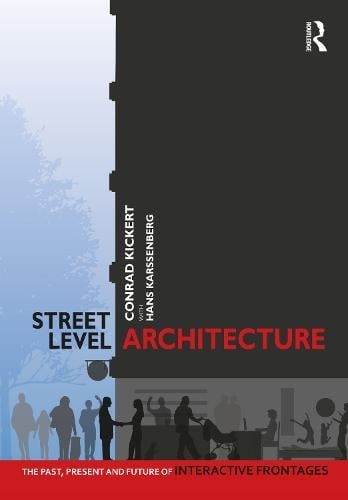
Street-Level Architecture: The Past, Present and Future of Interactive Frontages
Provides the tools to maintain and rebuild the interaction between architecture and public space. Despite the best intentions of designers and planners, interactive frontages have dwindled over the past century in Europe and North America. This book demonstrates why even our best intentions for interactive frontages are currently unable to turn a swelling tide of economic and technological evolution, land consolidation, introversion, stratification, and contagious decline. It uses these lessons to offer concrete locational, programming, design, and management strategies to maximize street-level interaction and trust between street-level architecture, its inhabitants, and the city. Demonstrates that designers, developers, planners, and managers ultimately have to create the right preconditions for inhabitants and passersby to bring frontages to life. These preconditions connect architecture to its urban, social, economical, and technological context.

Strategy, planning and organization of Test processes : Basis for successful project execution in software testing
Provides concrete tips for the successful organization of software tests. Because: Planning and conception in advance are essential for successful test projects. Setting the right course prevents problems from the outset and highlights the need for action in software testing. In addition to theoretical basics, this work shows the implementation in practice and deals with typical problems.

Strand Corrosion in Prestressed Concrete Structures
Focuses on the durability problems of existing prestressed concrete (PC) structures caused by strand corrosion, clarifies the mechanical behavior of corroded prestressing strands, corrosion-induced cracking, bond degradation, prestress loss and structural performance deterioration, and proposes the corresponding prediction models. Its aim is to provide the knowledge, tools, and methods to understand the deterioration phenomena of PC structures.

Storie di cose semplici = Stories of simple things
The nut, the thread, the key, the ring, the mirror, the button and the sphere are simple things that we encounter every day, but of which we often forget, because contemporary culture is more and more bewitched by the complexity of the systems and the lightness of virtual realities. This essay, countering Italo Calvino's five American Lectures, examines how "simple things" in fact often demonstrate their importance in simplicity, slowness, heaviness, singularity, in invisibility itself. But their "consistency" - this precisely should have been the sixth Lesson - lies precisely in the fact that their symbolic and real strength lies precisely in the fact that they are concrete things, which we can all touch, even when they take on a metaphorical meaning. The seven simple objects could have been accompanied by many other examples, but this book must remain above all a stimulus so that we can recover greater attention to the concreteness of things, which is not only important when they are placed in the windows of a museum of material culture, but because they are part of us. Literature and technique, art and philosophy, music and news, every day show how these "things" are the real protagonists of what the French call civilization: the Ring of the Nibelung, Pushkin's Button, and the "Brunelleschi's nut" are just a few examples of how these "things" have found a place of honor in history. And this is a book in which many stories are told, like fairy tales that introduce our things, to let us enter their world accompanied by fantasy.

Stochastic Learning and Optimization : A Sensitivity-Based Approach
Covers various disciplines in learning and optimization, including perturbation analysis (PA) of discrete-event dynamic systems, Markov decision processes (MDP)s), reinforcement learning (RL), and adaptive control, within a unified framework. (A simple approach to MDPs) This book introduces MDP theory through a simple approach based on performance difference formulas. This approach leads to results for the n-bias optimality with long-run average-cost criteria and Blackwell's optimality without discounting.
