



الصفحة 5
الصفحة 5
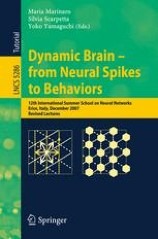
Dynamic brain : From neural spikes to behaviors ; 12th International Summer School on Neural Networks, Erice, Italy, December 5-12, 2007, Revised Lectures
The volume presents 12 thoroughly revised tutorial papers based on lectures given by leading researchers at the 12th International Summer School on Neural Networks in Erice, Italy, in December 2007.

DNA nanotechnology for cell research : from bioanalysis to biomedicine
Bringing together multidisciplinary aspects of chemical, material, and biological engineering, DNA Nanotechnology for Cell Research: From Bioanalysis to Biomedicine presents an overview of DNA nanotechnology with emphasis on a variety of different applications in cell research and engineering, covering a unique collection of DNA nanotechnology for fundamental research and engineering of living cells, mostly in cellulo and in vivo, for the first time. Broad coverage of this book ranges from pioneering concepts of DNA nanotechnology to cutting-edge reports regarding the use of DNA nanotechnology for fundamental cell science and related biomedical engineering applications in sensing, bioimaging, cell manipulation, gene therapy, and drug delivery.

DNA manipulation and analysis
Details technologies on recombinant DNA and nucleic acid manipulation that underpin much of the biological sciences and instructions on how to conduct them successfully. Chapters guide the reader through the basics of oligonucleotide synthesis and DNA sequencing; recombinant DNA plasmid work; cell-free experiments and the latest developments in CRISPR approaches to genome modification.

DNA barcoding : Methods and protocols
Covers the latest advancements and methods used to study DNA barcoding. The chapters in this book are organized into six parts: theory, DNA manipulation, specialized barcoding methods, analysis of DNA barcodes, completing a successful DNA barcode project, and barcoding as citizen science. Part One looks at several theoretical issues in DNA barcoding concerned with DNA barcodes that can and should be used. Part Two discusses protocols for processing samples into DNA barcodes, including DNA isolation, sequencing and managing samples, and the resulting DNA barcodes. Part Three explores the next generation of DNA barcoding such as FRET-based detection, dual nanopore detection, skimming, and closed-tube methods. Part Four addresses programs and websites that handle DNA barcoding data, and includes character-based approaches, barcode gap methods, integrated approaches, and Barcode of Life Database

Developments in Language Theory ; 12th International Conference, DLT 2008, Kyoto, Japan, September 16-19, 2008. Proceedings
This book constitutes the refereed proceedings of the 12th International Conference on Developments in Language Theory, DLT 2008, held in Kyoto, Japan, September 2008.

Design of Integrally-Attached Timber Plate Structures
Outlines a new design methodology for digitally fabricated spatial timber plate structures, presented with examples from recent construction projects. It proposes an innovative and sustainable design methodology, algorithmic geometry processing, structural optimization, and digital fabrication; technology transfer and construction are formulated and widely discussed. The methodology relies on integral mechanical attachment whereby the connection between timber plates is established solely through geometric manipulation, without additional connectors, such as nails, screws, dowels, adhesives, or welding.

Dental materials : Properties and manipulation ; 11th ed.
Comprehensive and cutting-edge content describes the latest materials commonly used in dental practice, including those in esthetics, ceramics, dental implants, and impressions. Approximately 500 illustrations and photographs make it easier to understand properties and differences in both materials and specific types of products. Review questions provide an excellent study tool with 20 to 30 self-test questions in each chapter. Quick Review boxes summarize the material in each chapter. Note boxes highlight key points and important terminology throughout the text. Key terms are bolded at their initial mention in the text and defined in the glossary. A logical and consistent format sets up a solid foundation before progressing into discussions of specific materials, moving from the more common and simple applications such as composites to more specialized areas such as polymers and dental implants. Learning objectives in each chapter focus readers’ attention on essential information. Supplemental readings in each chapter cite texts and journal articles for further research and study.

Dental materials : Properties and manipulation
Focusing on the dental materials most commonly used, Dental Materials: Properties and Manipulation, 10th Edition covers the tasks that dental assistants and dental hygienists typically perform. It shows the most current materials, how to mix and apply them in a clinical setting, and how to educate patients about them. Now in full color, this edition adds more photographs of materials actually being mixed, used, and applied, and includes detailed coverage of ceramics, metals, and implant and impression materials. Written by well-known experts on restorative dentistry and materials

Deliberative public engagement with science : An empirical investigation
This compact open access reference delves beyond popular concepts of educated consumers and an informed public by examining the science behind deliberative engagement. Using data from four longitudinal studies, the authors assess public engagement methods in deliberative discussions of ethical, legal, and social issues concerning innovations in nanotechnology. Coverage includes the theoretical origins of the studies, forms of engagement and variations used, and in-depth details on cognitive, affective, and social components that go into the critical thinking process and forming of opinions. Not only are the findings intriguing in and of themselves, but researchers from varied fields will also find them useful in pursuing their own projects.

Deepfake detection
Recently, various techniques of manipulating the video content have become available to everyone – online, one can find free applications e.g., for face swapping in videos. Such universal accessibility carries a notable risk of flooding online content with false information, affecting not only the greats of this world, but also the whole societies, also the rapid progress in synthetic image generation and manipulation has now come to a point where it raises significant concerns for the implications towards society. It is therefore necessary to develop a verification tool that will help assess the authenticity of the videos posted on the internet. This project describes the approach of using artificial intelligence solutions to detect doctored videos.

Data science in theory and practice : Techniques for big data analytics and complex data sets
Delivers a comprehensive treatment of the mathematical and statistical models useful for analyzing data sets arising in various disciplines, like banking, finance, health care, bioinformatics, security, education, and social services. Written in five parts, the book examines some of the most commonly used and fundamental mathematical and statistical concepts that form the basis of data science. The authors go on to analyze various data transformation techniques useful for extracting information from raw data, long memory behavior, and predictive modeling. Readers will also learn from topics like: Analyses of foundational theoretical subjects, including the history of data science, matrix algebra and random vectors, and multivariate analysis A comprehensive examination of time series forecasting, including the different components of time series and transformations to achieve stationarity Introductions to both the R and Python programming languages, including basic data types and sample manipulations for both languages An exploration of algorithms, including how to write one and how to perform an asymptotic analysis A comprehensive discussion of several techniques for analyzing and predicting complex data sets

Data Manipulation with R
Since its inception, R has become one of the preeminent programs for statistical computing and data analysis. The ready availability of the program, along with a wide variety of packages and the supportive R community make R an excellent choice for almost any kind of computing task related to statistics. However, many users, especially those with experience in other languages, do not take advantage of the full power of R. Because of the nature of R, solutions that make sense in other languages may not be very efficient in R. This book presents a wide array of methods applicable for reading data into R, and efficiently manipulating that data.

Craig’s Restorative Dental Materials ; 1st ed.
Covers everything you need to know to understand the science of selecting dental materials when designing and fabricating restorations. It begins with fundamentals and moves on to advanced skills in the manipulation of dental materials, providing insight on the latest advances and research along the way. From an expert author team led by Ronald Sakaguchi, this comprehensive resource is considered to be the standard in the field of dental restorations.

Cours doptique : Simulations et exercices résolus avec Maple, Matlab, Mathematica, Mathcad = Optics course: Simulations and exercises solved with Maple, Matlab, Mathematica, Mathcad
Intended for students at the L and M levels of the university as well as for engineers wishing to study certain subjects in greater depth. It covers all the themes of a traditional optics course, from geometric optics to holography, interference, diffraction, coherence and the use of the Fourier transform for spectroscopy. The presentation is developed from mathematical models deriving from typical situations and fundamental examples which are presented in the form of computer programs ready to be implemented. These programs are also available on the CD accompanying the book, for each of the following scientific programming environments: Matlab, Maple, Mathematica and Mathcad. Thus, the reader will be able to modify the parameters of the examples proposed to adapt them to new situations.

Controlled Synthesis of Nanoparticles in Microheterogeneous Systems
contains descriptions of one of the most powerful bottom-up methods of synthesizing size controlled and stable nanoparticles. This method is based on the use of surfactant-containing microheterogeneous systems: liquid crystals, monolayers and multilayers, solutions of direct and reversed micelles, direct and reversed vesicles, and water-in-oil and oil-in-water microemulsions. The author is prominent in the field of physico-chemical characterization of microheterogeneous systems and their use as ideal solvent and reaction media for the production and long-term storage of nanomaterials. This is the first book that attempts to unify the knowledge necessary for judicious manipulation of surfactant-based systems and a fine tuning of geometric and physico-chemical properties of nanoparticles of a wide variety of substances

Control of Biofilm Infections by Signal Manipulation
Describes the molecular mechanisms of cell-to-cell communication among bacterial cells in a biofilm, the development of antibiofilm inhibitors, like quorum-sensing inhibitors, and the use of biofilm inhibitors to prevent and treat bacterial infections in humans and other animals.

Conditional Mutagenesis : An Approach to Disease Models
Leading experts provide timely and comprehensive information on methods for conditional mutagenesis in the mouse (part 1) and their application to model human physiology and pathophysiology (part 2). It illustrates how sophisticated genetic manipulations of the mouse genome are employed to model human diseases and to identify underlying molecular mechanisms. Finally the book considers the development of new drugs to treat them.

Conceptual Modeling for Traditional and Spatio-Temporal Applications : The MADS Approach
This book shows that a conceptual design approach for spatio-temporal databases is both feasible and easy to apprehend. While providing a firm basis through extensive discussion of traditional data modeling concepts, the major focus of the book is on modeling spatial and temporal information. Parent, Spaccapietra and Zimányi provide a detailed and comprehensive description of an approach that fills the gap between application conceptual requirements and system capabilities, covering both data modeling and data manipulation features.

Computer Mathematics ; 8th Asian Symposium, ASCM 2007, Singapore, December 15-17, 2007. Revised and Invited Papers
This book constitutes thoroughly refereed post-conference proceedings of the 8th Asian Symposium on Computer Mathematics, ASCM 2007, held in Singapore in December 2007.

Computer algebra in scientific computing ; Vol. 3718 ; 8th International workshop, CASC 2005, Kalamata, Greece, September 12-16, 2005, Proceedings
This volume contains the proceedings of the CASC 2005 continued a tradition — started in 1998 — of international con-ferences on the latest advances in the application of computer algebra systems(CASs) and methods to the solution of various problems in scientific computing.The methods of scientific computing play an important role in research andengineering applications in the natural and the engineering sciences. The signif-icance and impact of computer algebra methods and computer algebra systemsfor scientific computing has increased considerably in recent times. Nowadays,such general-purpose computer algebra systems as Maple, Magma, Mathematica,MuPAD, Singular, CoCoA and others enable their users to solve the followingthree important tasks within a uniform framework:(a) symbolic manipulation;(b) numerical computation;(c) visualization. The result of this job is reflected in this volume, which contains revised versionsof the accepted papers. The collection of papers included in the proceedingscovers various topics of computer algebra methods, algorithms, and softwareapplied to scientific computing:
