



الصفحة 5
الصفحة 5
Issues in Multi-Agent Systems : The AgentCities.ES Experience
The purpose of this book is to present current status of this technology by looking at its application in different domains, such as electronic markets, e-tourism, ambience intelligence, and complex system analysis.It starts by discussing software engineering issues for the development of multi-agent systems, how much it costs to build a multi-agent system, and which methods and tools are currently available. Next chapters present some of the most relevant aspects that are considered for the development of multi-agent systems.
Complexity Management in Fuzzy Systems : A Rule Base Compression Approach
This book presents a systematic study on the inherent complexity in fuzzy systems, resulting from the large number and the poor transparency of the fuzzy rules. The study uses a novel approach for complexity management, aimed at compressing the fuzzy rule base by removing the redundancy while preserving the solution. The compression is based on formal methods for presentation, manipulation, transformation and simplification of fuzzy rule bases, which are illustrated by algorithms as well as results from numerous examples and two case studies. The results are directly applicable or easily extendable to a wide class of fuzzy systems and detailed benchmarks for expanding these systems to new areas such as fuzzy networks and fuzzy multi-agent systems are introduced. The intended readers are people from both academia and industry, who would be interested in building and implementing advanced fuzzy systems.

Browning Agents and Active Particles : Collective Dynamics in the Natural and Social Sciences
Lays out a vision for a coherent framework for understanding complex systems'' (from the foreword by J. Doyne Farmer). By developing the genuine idea of Brownian agents, the author combines concepts from informatics, such as multiagent systems, with approaches of statistical many-particle physics. This way, an efficient method for computer simulations of complex systems is developed which is also accessible to analytical investigations and quantitative predictions. The book demonstrates that Brownian agent models can be successfully applied in many different contexts, ranging from physicochemical pattern formation, to active motion and swarming in biological systems, to self-assembling of networks, evolutionary optimization, urban growth, economic agglomeration and even social systems.

Blockchains For Network Security : Principles, technologies and applications
Blockchain technology is a powerful, cost-effective method for network security. Essentially, it is a decentralized ledger for storing all committed transactions in trustless environments by integrating several core technologies such as cryptographic hash, digital signature and distributed consensus mechanisms. Over the past few years, blockchain technology has been used in a variety of network interaction systems such as smart contracts, public services, Internet of Things (IoT), social networks, reputation systems and security and financial services. With its widespread adoption, there has been increased focus on utilizing blockchain technologies to address network security concerns and vulnerabilities as well as understanding real-world security implications.

Automated reasoning with analytic tableaux and related methods ; International Conference, TABLEAUX 2005, Koblenz, Germany, September 14-17, 2005, Proceedings
This volume contains the research papers presented at the International C- ference on Automated Reasoning with Analytic Tableaux and Related Methods (TABLEAUX2005)heldSeptember 2005inKoblenz,Germany. which included conferences covering a broad spectrum of topics and intere- ing ?elds of application for tableau-based methods: arti?cial intelligence (KI), multi-agent systems (MATES), automated reasoning and knowledge represen- tion (FTP), and software engineering and formal methods (SEFM).

Artificial Intelligence. IJCAI 2019 International Workshops ; Macao, China, August 10–12, 2019, Revised Selected Best Papers
This book presents selected papers of 12 Workshops held in conjunction with the 28th International Joint Conference on Artificial Intelligence, IJCAI 2019, in Macao, China, in August 2019.

Artificial intelligence and soft computing ; 19th International conference, ICAISC 2020, Zakopane, Poland, October 12-14, 2020, Proceedings, Part II
The two-volume set LNCS 12415 and 12416 constitutes the refereed proceedings of of the 19th International Conference on Artificial Intelligence and Soft Computing, ICAISC 2020, held in Zakopane, Poland*, in October 2020. The 112 revised full papers presented were carefully reviewed and selected from 265 submissions. The papers included in the first volume are organized in the following six parts: neural networks and their applications; fuzzy systems and their applications; evolutionary algorithms and their applications; pattern classification; bioinformatics, biometrics and medical applications; artificial intelligence in modeling and simulation. The papers included in the second volume are organized in the following four parts: computer vision, image and speech analysis; data mining; various problems of artificial intelligence; agent systems, robotics and control.

Artificial intelligence and soft computing ; 19th International Conference, ICAISC 2020, Zakopane, Poland, October 12-14, 2020, Proceedings, Part I
The two-volume set LNCS 12415 and 12416 constitutes the refereed proceedings of of the 19th International Conference on Artificial Intelligence and Soft Computing, ICAISC 2020, held in Zakopane, Poland*, in October 2020. The 112 revised full papers presented were carefully reviewed and selected from 265 submissions. The papers included in the first volume are organized in the following six parts: neural networks and their applications; fuzzy systems and their applications; evolutionary algorithms and their applications; pattern classification; bioinformatics, biometrics and medical applications; artificial intelligence in modeling and simulation. The papers included in the second volume are organized in the following four parts: computer vision, image and speech analysis; data mining; various problems of artificial intelligence; agent systems, robotics and control.
Artificial intelligence : A modern approach ; global ed.
Explores the full breadth and depth of the field of artificial intelligence (AI). The 4th edition brings readers up to date on the latest technologies, presents concepts in a more unified manner, and offers new or expanded coverage of machine learning, deep learning, transfer learning, multi agent systems, robotics, natural language processing, causality, probabilistic programming, privacy, fairness, and safe AI

Argumentation in multi-agent systems ; Vol. 4049 ; 2nd International Workshop, ArgMAS 2005, Utrecht, Netherlands, July 26, 2005, revised selected and invited papers
This book constitutes the thoroughly refereed post-proceedings of the Second International Workshop on Argumentation in Multi-Agent Systems held in Utrecht, Netherlands in July 2005 as an associated event of AAMAS 2005, the main international conference on autonomous agents and multi-agent systems. The 10 revised full papers presented together with an invited paper were carefully reviewed and selected from 17 submissions. The papers are organized in topical sections on foundations, negotiation, protocols, deliberation and coalition formation, and consensus formation.

Argumentation in multi-agent systems ; Vol. 3366 ; 1st International Workshop, ArgMAS 2004, New York, NY, USA, July 19, 2004, revised selected and invited papers
The theory of argumentation is a rich, interdisciplinary area of research lying across philosophy, communication studies, linguistics, and psychology (at least). Its techniques and results have found a wide range of applications in both t- oretical and practical branches of arti'cial intelligence and computer science. Several theories of argumentation with various semantics have been proposed in the literature. Multi-agent systems theory has picked up argument-inspired approaches and speci'cally argumentation-theoretic results from many di'erent areas. The community of researchers in argumentation and multi-agent systems is currently presented with a unique opportunity to integrate the various und- standings of argument into a coherent and core part of the functioning of - tonomouscompu...
Argumentation in multi-agent systems ; Third International Workshop, ArgMAS 2006, Hakodate, Japan, May 8, 2006, revised selected and invited papers
Argumentation provides tools for designing, implementing and analyzing sophisticated forms of interaction among rational agents. It has made a solid contribution to the practice of multiagent dialogues. Application domains include: legal disputes, business negotiation, labor disputes, team formation, scientific inquiry, deliberative democracy, ontology reconciliation, risk analysis, scheduling, and logistics.

Argumentation in multi-agent systems ; 4th International Workshop, ArgMAS 2007, Honolulu, HI, USA, May 15, 2007, revised selected and invited papers
This volume presents the latest developments in the growing area of research at the interface of argumentation theory and multiagent systems. Argumentation provides tools for designing, implementing and analyzing sophisticated forms of interaction among rational agents.

ANEMONA : A Mulit-agent Methodology for Holonic Manufacturing Systems
ANEMONA is a multi-agent system (MAS) methodology for holonic manufacturing system (HMS) analysis and design, based on HMS requirements. The development process of ANEMONA provides clear and HMS-specific modeling guidelines for HMS designers, and complete development phases for the HMS life cycle.
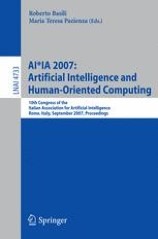
AI*IA 2007 : Artificial intelligence and human-oriented computing ; 10th Congress of the Italian Association for Artificial Intelligence, Rome, Italy, September 10-13, 2007, Proceedings
The book is organized in topical sections on knowledge representation and reasoning, multiagent systems, distributed AIai, knowledge engineering, ontologies and the semantic Web, machine learning, natural language processing, information retrieval and extraction, planning and scheduling, AI and applications. Three special tracks depicting progresses in significant application fields that represent increasingly relevant topics contain 18 additional papers on AI and robotics, AI and expressive media, and intelligent access to multimedia information

Agents and peer-to-peer computing ; Vol. 4118 : 4th International workshop, AP2PC 2005, Utrecht, Netherlands, J uly 25, 2005, Revised and Invited Papers
Constitutes the thoroughly refereed post-proceedings of the 4th International Workshop on Agents and Peer-to-Peer Computing, AP2PC 2005, held in Utrecht, Netherlands, July 2005, in the context of the 4th International Joint Conference on Autonomous Agents and Multi-Agent Systems, AAMAS 2005. The 13 revised full papers cover trust and reputation, P2P infrastructure, semantic infrastructure, as well as community and mobile applications.

Agents and peer-to-peer computing ; Vol. 3601 ; 3rd international workshop, AP2PC 2004, New York, NY, USA, July 19, 2004, revised and invited papers
This volume presents the fully revised papers presented at the Third International Workshop on Agents and Peer-to-Peer Computing, AP2PC 2004, held in New York City on July 19, 2004 in the context of the Third International Joint Conference on Autonomous Agents and Multi-Agent Systems (AAMAS 2004). The volume is organized in topical sections on P2P networks and search performance, emergent communities and social behaviours, semantic integration, mobile P2P systems, adaptive systems, agent-based resource discovery, as well as trust and reputation.

Agents and peer-to-peer computing ; 5th International workshop, AP2PC 2006, Hakodate, Japan, May 9, 2006, Revised and Invited Papers
This book constitutes the thoroughly refereed post-workshop proceedings of the 5th International Workshop on Agents and Peer-to-Peer Computing, AP2PC 2006, held in Hakodate, Japan, in May 2006, in the context of the 5th International Joint Conference on Autonomous Agents and Multi-Agent Systems, AAMAS 2006.

Agents and peer-to-peer computing ; 2nd International workshop, AP2PC 2003, Melbourne, Australia, July 14, 2003, revised and invited papers
This book brings together an introduction, three invited articles, and revised versions of the papers presented at the Second International Workshop on Agents and Peer-to-Peer Computing, AP2PC 2003, held in Melbourne, Australia, July 2003."" "Peer-to-peer (P2P) computing is currently attracting enormous public attention, a very large number of autonomous computing nodes, the peers, rely on each other for services. P2P networks are emerging as a new distributed computing paradigm because of their potential to harness the computing power and the storage capacity of the hosts composing the network, and because they realize a completely open decentralized environment where everybody can join in autonomously.

Agent-oriented software engineering VII ; 7th International Workshop, AOSE 2006, Hakodate, Japan, May 8, 2006, Revised and Invited Papers
Software architectures that contain many dynamically interacting components, each with their own thread of control, and engaging in complex coordination protocols, are difficult to correctly and efficiently engineer. Agent-oriented modelling techniques are important for supporting the design and development of such applications.The book is organized in topical sections on modelling and design of agent systems, modelling open agent systems, formal reasoning about designs, as well as testing, debugging and evolvability.
