



الصفحة 47
الصفحة 47

Knowledge Management and Management Learning : Extending the Horizons of Knowledge-Based Management
The book begins with an extended introduction and theoretical framework. Contributing authors have written chapters that add to both the framework and the practical consequences of knowledge management. These chapters suggest many lessons learned that will find considerable use in practice. Some of these chapters include an investigation of the "do’s and don’ts" virtual learning based on real-life cases, the use of design teams for group learning, the role of language and the creation of common ground between company and client, culture as a dynamic and non-linear constructed concept, innovation and knowledge management and more. The book offers an exceptional range of contributions within a developing paradigm. Within this context, the book illustrates why and how of knowledge management is important for companies.

Knowledge management : Value creation through organizational learning, 2nd
Features substantial updates to all chapters, reflecting the implications of the digital transformation on knowledge work and knowledge management. It also addresses three new topics: the impact of knowledge management practices on performance; knowledge management in the public sector; and an introduction to ISO 9001:2015 as an implementation framework.The book is intended not only for academic education but also as an essential guide for managers, consultants, trainers, coaches, and all those engaged in business, public administration or non-profit work who are interested in learning about organizations in a knowledge economy.
Knowledge Management : Organizational and Technological Dimensions
Presents a unique blend of articles which combines both conceptual and practical concerns related to devising and implementing sustainable Knowledge Management systems and solutions in contemporary global organizations. The book's contributors are among the leading thinkers and practitioners in this growing field. The seamless synthesis of the human, organizational, and technological dimensions of Knowledge Management makes this book a definitive guide for academics and practising managers alike.

Knowledge graphs and big data processing
This book is part of the LAMBDA Project (Learning, Applying, Multiplying Big Data Analytics), funded by the European Union, GA No. 809965. Data Analytics involves applying algorithmic processes to derive insights.
Knowledge for Governance
Focuses on theoretical and empirical intersections between governance, knowledge and space from an interdisciplinary perspective. The contributions elucidate how knowledge is a prerequisite as well as a driver of governance efficacy, and conversely, how governance affects the creation and use of knowledge and innovation in geographical context.

Knowledge discovery, knowledge engineering and knowledge management ; 10th International Joint Conference, IC3K 2018, Seville, Spain, September 18-20, 2018, Revised Selected Papers
Constitutes the thoroughly refereed proceedings of the 10th International Joint Conference on Knowledge Discovery, Knowledge Engineering and Knowledge Management, IC3K 2018, held in Seville, Spain, in September 2018. The 12 full papers presented were carefully reviewed and selected from 167 submissions. The papers are organized in topical sections on knowledge discovery and information retrieval; knowledge engineering and ontology development; and knowledge management and information sharing.

Knowledge Discovery in Inductive Databases ; Vol.3933 ; 4th International Workshop, KDID 2005, Porto, Portugal, October 3, 2005, Revised Selected and Invited Papers
The 4th International Workshop on Knowledge Discovery in Inductive Databases (KDID 2005) was held in Porto, Portugal, on October 3, 2005 in conjunction with the 16th European Conference on Machine Learning and the 9th European Conference on Principles and Practice of Knowledge Discovery in Databases. Ever since the start of the ?eld of data mining, it has been realized that the integration of the database technology into knowledge discovery processes was a crucial issue. This vision has been formalized into the inductive database perspective introduced by T. Imielinski and H. Mannila (CACM 1996, 39(11)). The main idea is to consider knowledge discovery as an extended querying p- cess for which relevant query languages are to be speci?ed.

Knowledge Discovery in Inductive Databases ; 5th International Workshop, KDID 2006 Berlin, Germany, September 18th, 2006 Revised Selected and Invited Papers
Constitutes the thoroughly refereed joint postproceedings of the 5th International Workshop on Knowledge Discovery in Inductive Databases, KDID 2006. The papers address various current topics in knowledge discovery and data mining in the framework of inductive databases such as constraint-based mining, database technology and inductive querying.
Knowledge Discovery in Databases : PKDD 2007 ; 11th European Conference on Principles and Practice of Knowledge Discovery in Databases, Warsaw, Poland, September 17-21, 2007, Proceedings
The two premier annual European conferences in the areas of machine learning and data mining have been collocated ever since the ?rst joint conference in Freiburg, 2001. The European Conference on Principles and Practice of Knowledge Discovery in Databases (PKDD) was?rstheldin1997inTrondheim, Norway.
Knowledge discovery in databases : PKDD 2006 ; 10th European Conference on Principles and practice of knowledge discovery in databases, Berlin, Germany, September 18-22, 2006, Proceedings
The European Conference on Principles and Practice of Knowledge Discovery in Databases celebrates its tenth anniversary ; the first PKDD took place in 1997 in Trondheim, Norway. Over the years, the ECML/PKDD series has evolved into one of the largest and most selective international conferences in these areas, the only one that provides a common forum for the two closely related ?elds. In 2006, the 6th collocated ECML/PKDD took place during September 18-22, when the Humboldt-Universität zu Berlin hosted the 17th European Conference on Machine Learning (ECML) and the 10th European Conference on Principles and Practice of Knowledge Discovery in Databases (PKDD). The successful model of a hierarchical reviewing process that was introduced last year for the ECML/PKDD 2005 in Porto has been taken over in 2006.
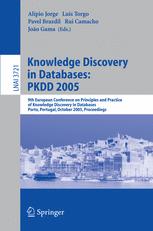
Knowledge Discovery in Databases : PKDD 2005 ; 9th European Conference on Principles and Practice of Knowledge Discovery in Databases, Porto, Portugal, October 3-7, 2005, Proceedings
585 different paper submissions were received for both events, which maintains the high s- mission standard of last year. Of these, 335 were submitted to ECML only, 220 to PKDD only and 30 to both. Such a high volume of scientific work required a tremendous effort from Area Chairs, Program Committee members and some additional reviewers. On average, PC members had 10 papers to evaluate, and Area Chairs had 25 papers to decide upon. We managed to have 3 highly qua- ?ed independent reviews per paper (with very few exceptions)and one additional overall input from one of the Area Chairs. After the authors’ responses and the online discussions for many of the papers, we arrived at the final selection of 40 regular papers for ECML and 35 for PKDD. Besides these, 32 others were accepted as short papers for ECML and 35 for PKDD. This represents a joint acceptance rate of around 13% for regular papers and 25% overall. We thank all involved for all the e?ort with reviewing and selection of papers. Besides the core technical program, ECML and PKDD had 6 invited speakers, 10 workshops, 8 tutorials and a Knowledge Discovery Challenge.

Knowledge Discovery from XML Documents ; 1st International Workshop, KDXD 2006, Singapore, April 9, 2006, Proceedings
The KDXD 2006 (Knowledge Discovery from XML Documents) workshop is the ?rst international workshop running this year in conjunction with the 10th Pacific-Asia Conference on Knowledge Discovery and Data Mining, PAKDD 2006. The workshop provided an important forum for the dissemination and exchange of new ideas and research related to XML data discovery and retrieval. The eXtensible Markup Language (XML) has become a standard language for data representation and exchange. With the continuous growth in XML data sources,the ability to manage collections of XML documents and discover knowledge from them for decision support becomes increasingly important. Due to the inherent ?exibility ofXML, in both structure and semantics, inferring important knowledge from XML data is faced with new challenges as well as bene?ts. The objective of the workshop was to bring together researchers and practitioners to discuss all aspects of the emerging XML data management challenges.

Knowledge Discovery and Emergent Complexity in Bioinformatics ; 1st International Workshop, KDECB 2006, Ghent, Belgium, May 10, 2006, Revised Selected Papers
Contains selected and revised papers of the International Symposium on Knowledge Discovery and Emergent Complexity in Bioinformatics (KDECB 2006), held at the University of Ghent, Belgium, May 10, 2006.

Knowledge Cartography : Software Tools and Mapping Techniques
The authors see mapping software as a set of visual tools for reading and writing in a networked age. In an information ocean, the primary challenge is to find meaningful patterns around which we can weave plausible narratives. Maps of concepts, discussions and arguments make the connections between ideas tangible and disputable.With 17 chapters from the leading researchers and practitioners, the reader will find the current state–of-the-art in the field. Part 1 focuses on educational applications in schools and universities, before Part 2 turns to applications in professional communities.

Knowledge and Information Visualization : Searching for Synergies
The basic ideas underlying knowledge visualization and information vi- alization are outlined. In a short preview of the contributions of this volume, the idea behind each approach and its contribution to the goals of the book are outlined. 2 The Basic Concepts of the Book Three basic concepts are the focus of this book: "data", "information", and "kno- edge". There have been numerous attempts to define the terms "data", "information", and "knowledge", among them, the OTEC Homepage "Data, Information, Kno- edge, and Wisdom" (Bellinger, Castro, & Mills, see http://www.syste- thinking.org/dikw/dikw.htm): Data are raw. They are symbols or isolated and non-interpreted facts. Data rep- sent a fact or statement of event without any relation to other data. Data simply exists and has no significance beyond its existence (in and of itself). It can exist in any form, usable or not. It does not have meaning of itself.

Knowing, Knowledge and Beliefs : Epistemological Studies across Diverse Cultures
Bringing together prominent educators and researchers, this book focuses on conceptual and methodical issues and state-of-the-art theoretical understanding on epistemological beliefs from educational and psychological perspectives. It is a critical and specialized source that describes recent advances in conceptualization and epistemological studies across diverse cultures.

KI 2008 : Advances in Artificial Intelligence ; 31st Annual German Conference on AI, KI 2008, Kaiserslautern, Germany, September 23-26, 2008. Proceedings
This book constitutes the thoroughly refereed proceedings of the 31th Annual German Conference on Artificial Intelligence, KI 2008, held in Kaiserslautern, Germany, September 2008.The 15 revised full papers presented together with 2 invited contributions and 30 posters were carefully reviewed and selected from 77 submissions. The papers cover important areas such as pattern recognition, multi-agent systems, machine learning, natural language processing, constraint reasoning, knowledge representation and management, planning, and temporal reasoning.

KI 2007: Advances in Artificial Intelligence ; 30th Annual German Conference on AI, KI 2007, Osnabrück, Germany, September 10-13, 2007, Proceedings
The 30th Annual German Conference on Artifcial Intelligence (KI-2007) took place in the University of Osnabru ¨ck, September 10–13, 2007. Some topic clusters are apparent in the overall conference program, which re?ect recent trends in AI research, convolved with foci of work in Germany and Europe.
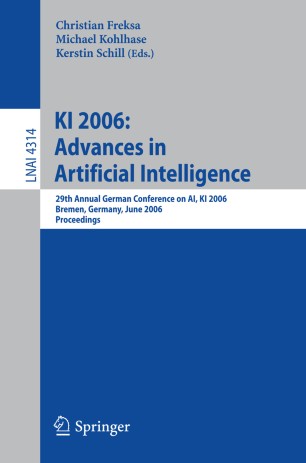
KI 2006 ; 29th Annual German Conference on AI, KI 2006, Bremen, Germany, June 14-17, 2006, Proceedings
Constitutes the thoroughly refereed post-proceedings of the 29th Annual German Conference on Artificial Intelligence, KI 2006, held in Bremen, Germany, in June 2006. This was co-located with RoboCup 2006, the innovative robot soccer world championship, and with ACTUATOR 2006, the 10th International Conference on New Actuators.

KI 2005 : Advances in Artificial Intelligence ; 28th Annual German Conference on AI, KI 2005, Koblenz, Germany, September 11-14, 2005, Proceedings
Constitutes the refereed proceedings of the 28th Annual German Conference on Artificial Intelligence, KI 2005, held in Germany. This work presents papers organized in topical sections on knowledge representation and reasoning, machine learning, diagnosis, neural networks, planning, robotics, and cognitive modeling, philosophy, natural language.
