



الصفحة 44
الصفحة 44

Calibration Techniques in Nyquist A/D Converters
It is shown that in order to achieve high speed and high accuracy at high power efficiency, calibration is required. Calibration reduces the overall power consumption by using the available digital processing capability to relax the demands on critical power hungry analog components. Several calibration techniques are analyzed. The calibration techniques presented in this book are applicable to other analog-to-digital systems, such as those applied in integrated receivers. Further refinements will allow using analog components with less accuracy, which will then be compensated by digital signal processing. The presented methods allow implementing this without introducing a speed or power penalty.

Business Intelligence for the Real-Time Enterprises ; 1st International Workshop, BIRTE 2006, Seoul, Korea, September 11, 2006, Revised Selected Papers
The book includes different aspects in the lifecycle of business intelligence on very large enterprise-wide operational real-time data sets. In today’s competitive and highly dynamic environment, analyzing data to und- stand how the business is performing, to predict outcomes and trends, and to improve the effectiveness of business processes underlying business operations has become critical. The traditional approach to reporting is not longer adequate; users now - mand easy-to-use intelligent platforms and applications capable of analyzing real-time business data to provide insight and actionable information at the right time. The end goal is to improve the enterprise performance by better and timelier decision making, enabled by the availability of up-to-date, high-quality information.

Business Information Systems ; 11th International Conference, BIS 2008, Innsbruck, Austria, May 5-7, 2008. Proceedings
This book contains the refereed proceedings of the 11th International Conference on Business Information Systems, BIS 2008, held in Innsbruck, Austria, in May 2008.

Building XNA 2.0 Games : A Practical Guide for Independent Game Development
Building XNA 2.0 Games: A Practical Guide for Independent Game Development is written by James Silva, who recently won the prestigious Microsoft Dream Build Play game competition with his award–winning game, The Dishwasher: Dead Samurai. Building XNA 2.0 Games: A Practical Guide for Independent Game Development is an in–depth and exclusive look into the entire XNA game development process and includes the creation of a software game masterpiece. James Silva guides you through the process he took to build his award–winning title, from concept to reality. He reveals tips and techniques for creating a polished, high–quality game with very few resources, while bridging the gap between coding and art.

Building with earth : Design and technology of a sustainable architecture
Offers a practical systematic overview of the many uses of earth and techniques for processing it. Its properties and physical characteristics are described in informed and knowledgeable detail. The presentation reflects the rich and varied experiences gained over thirty years of building earth structures all over the world. Numerous photographs of construction sites and drawings show the concrete execution of earth architecture. Documentation of 30 international earth buildings. The characteristics of the building material earth and its applications in modern architecture

Brainlesion: Glioma, Multiple Sclerosis, Stroke and Traumatic Brain Injuries ; 7th International Workshop, BrainLes 2021, Held in Conjunction with MICCAI 2021, Virtual Event, September 27, 2021, Revised Selected Papers, Part I
The content of thebook covers the current state-of-the-art literature on federated learning applications for cancer research and Vclinical oncology analysis, as well as an overview of the deep learning approaches improving the current standard of care for brain lesions and current neuroimaging challenges. It is also focusing on the accepted BrainLes workshop submissions, is to provide an overview of new advances of medical image analysis in all the aforementioned brain pathologies. It brings together researchers from the medical image analysis domain, neurologists, and radiologists working on at least one of these diseases. The aim is to consider neuroimaging biomarkers used for one disease applied to the other diseases.

Brain-inspired computing ; 4th International Workshop, BrainComp 2019, Cetraro, Italy, July 15–19, 2019, Revised Selected Papers
The 11 papers presented in this volume were carefully reviewed and selected for inclusion in this book. They deal with research on brain atlasing, multi-scale models and simulation, HPC and data infra-structures for neuroscience as well as artificial and natural neural architectures.

Brain research in language
processing with precise temporal and spatial resolutions, respectively. This book presents data obtained from various studies employing behavioral, electrophysiological and imaging methodologies in different languages focusing on the regular reading process and the dyslexic population.Educators and researchers within neuroscience, literacy, and special education will benefit from Brain Research in Language.

Brain and Heart Dynamics
Despite the increasing awareness that neural mechanisms are the primary cause of cardiac disease and its progression, therapy continues to focus on end-organ protection and does not approach the neural core of the problem. Growing public health problems such as heart failure are still treated with autonomic drugs that are 30-40 years old and simply act on cardiac receptors. However, it has now been shown that the progression of ischemic heart disease to heart failure is mainly due to abnormal central responses to incipient cardiac disease, with neural activation the primary cause rather than the consequence of cardiac remodeling.

Boosting Collaborative Networks 4.0 ; 21st IFIP WG 5.5 Working Conference on Virtual Enterprises, PRO-VE 2020, Valencia, Spain, November 23–25, 2020, Proceedings
This book constitutes the refereed proceedings of the 21st IFIP WG 5.5 Working Conference on Virtual Enterprises, PRO-VE 2020, held in Valencia, Spain, in November 2020. The conference was held virtually. The 53 full papers were carefully reviewed and selected from 135 submissions. They provide a comprehensive overview of major challenges and recent advances in various domains related to the digital transformation and collaborative networks and their applications with a strong focus on the following areas related to the main theme of the conference: collaborative business ecosystems; collaborative business models; collaboration platform; data and knowledge services; blockchain and knowledge graphs; maintenance, compliance and liability; digital transformation; skills for organizations of the future
Body Sensor Networks
While the problems of long-term stability and biocompatibility are being addressed, several promising prototypes are starting to emerge for managing patients with acute diabetes, for treatment of epilepsy and other debilitating neurological disorders and for monitoring of patients with chronic cardiac diseases. Despite the technological developments in sensing and monitoring devices, issues related to system integration, sensor miniaturization, low-power sensor interface circuitry design, wireless telemetric links and signal processing still have to be investigated.

Blind Equalization and System Identification : Batch Processing Algorithms, Performance and Applications
Discrete-time signal processing has had a momentous impact on advances in engineering and science over recent decades. The rapid progress of digital and mixed-signal integrated circuits in processing speed, functionality and cost-effectiveness has led to their ubiquitous employment in signal processing and transmission in diverse milieux. Topics covered include: • SISO, MIMO and 2-d non-blind equalization (deconvolution) algorithms. • SISO, MIMO and 2-d blind equalization (deconvolution) algorithms. • SISO, MIMO and 2-d blind system identification algorithms. • algorithm analyses and improvements. • applications of SISO, MIMO and 2-d blind equalization/identification algorithms.
Biotechnology for Fuels and Chemicals : The Twenty-Ninth Symposium
In Biotechnology for Fuels and Chemicals: The Twenty-Ninth Symposium, leading US and international researchers from academia, industry, and government exchange cutting-edge technical information and update current trends in the development and application of biotechnology for sustainable production of fuels and chemicals. This symposium emphasizes advances in biotechnology to produce high-volume, low-price products from renewable resources, while improving the environment. The major areas of interest include advanced feedstock production and processing, enzymatic and microbial biocatalysis, bioprocess research and development, opportunities in biorefineries, and commercialization of biobased products. International and domestic progress on producing liquid biofuels, especially ethanol and biodiesel, is highlighted, and related topics, including bioseparations and optimal integration of biochemical and thermochemical conversion technologies, are featured.
Biotechnology for fuels and chemicals : The Twenty-Eighth symposium
In Biotechnology for Fuels and Chemicals: The Twenty-Eighth Symposium, leading US and international researchers from academia, industry, and government exchange cutting-edge technical information and update current trends in the development and application of biotechnology for sustainable production of fuels and chemicals. This symposium emphasizes advances in biotechnology to produce high-volume, low-price products from renewable resources, while improving the environment. The major areas of interest include advanced feedstock production and processing, enzymatic and microbial biocatalysis, bioprocess research and development, opportunities in biorefineries, and commercialization of biobased products.
Bioprocessing Technology for Production of Biopharmaceuticals and Bioproducts
Written for industrial and academic researchers and development scientists in the life sciences industry, Bioprocessing Technology for Production of Biopharmaceuticals and Bioproducts is a guide to the tools, approaches, and useful developments in bioprocessing. This important guide: •Summarizes state-of-the-art bioprocessing methods and reviews applications in life science industries •Includes illustrative case studies that review six milestone bio-products •Discuses a wide selection of host strain types and disruptive bioprocess technologies
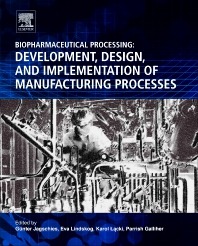
Biopharmaceutical processing : Development, design, and Implementation of manufacturing processes
Biopharmaceutical Processing: Development, Design, and Implementation of Manufacturing Processes covers bioprocessing from cell line development to bulk drug substances. The methods and strategies described are essential learning for every scientist, engineer or manager in the biopharmaceutical and vaccines industry. The integrity of the bioprocess ultimately determines the quality of the product in the biotherapeutics arena, and this book covers every stage including all technologies related to downstream purification and upstream processing fields. Economic considerations are included throughout, with recommendations for lowering costs and improving efficiencies.
Biopharmaceutical manufacturing progress, trends and challenges
Source of the latest innovative research and technical development in biomanufacturing systems. It is organised into 2 parts: 1) Manufacturing of recombinant therapeutic proteins (e.g. therapeutic antibodies, biosimilars/biogenerics) and 2) Manufacturing aspects of cell and gene therapy. Each with selected chapters on the following topics for both up- and downstream, such as: Advanced process strategies, especially continuous manufacturing, Advanced culture techniques, especially single-use systems, Process transfer, scale-up/scale-down models, Processing advances/Manufacturing productivity/efficiency, Model-assisted process understanding and development/Digital Twins, Process controls and analytics, Quality control, Quality by design, Facility design and full-scale commercial systems, manufacturing technology innovation.
Biomining
Biomining is the biotechnology that uses microorganisms to recover metals, in particular copper and gold, from ores and concentrates. Having developed from a very simple operational (in terms of both engineering and biology) process, biomining has developed into a multifaceted technology, to the extent that many of the largest industrial stirred tanks and heaps throughout the world are employed for bioprocessing minerals. This book has a strong applied approach and describes emerging and established industrial processes, as well as the underlying theory of the process, and the biology of the microorganisms involved. Chapters have been written by personnel from leading biomining companies, consultants and internationally recognized researchers and academics
Biomineralization II : Mineralization Using Synthetic Polymers and Templates
In nature, biological organisms produce mineralized tissues such as bone, teeth, diatoms, and shells. Biomineralization is the sophisticated process of production of these inorganic minerals by living organisms. Construction of organic–inorganic hybrid materials with controlled mineralization analogous to those produced by nature has recently received much attention because it can aid in understanding the mechanisms of the biomineralization process and development of biomimetic materials processing. The biomineralization processes use aqueous solutions at temperatures below 100 ◦C and no toxic intermediates are produced in these systems. This series presents critical reviews of the present position and future trends in modern chemical research. The short and concise reports on chemistry are each written by world renowned experts. This series is still valid and useful after 5 or 10 years.
Biomineralization I : Crystallization and Self-Organization Process
The five chapters of Biomineralization, volume 1, provide a bridge between the mineralogy and the organic substrates that enable the mineral formation by organisms in nature and under laboratory conditions. The book is a most useful reference for all concerned with biomineralization and biogenic minerals.In nature, biological organisms produce mineralized tissues such as bone, teeth, diatoms, and shells. Biomineralization is the sophisticated process of production of these inorganic minerals by living organisms. Construction of organic–inorganic hybrid materials with controlled mineralization analogous to those produced by nature has recently received much attention because it can aid in understanding the mechanisms of the biomineralization process and development of biomimetic materials processing.
