



الصفحة 4
الصفحة 4

New Challenges in Applied Intelligence Technologies
This book includes 37 chapters which discuss examples of applications of intelligence technologies to five fields, reflecting main streams of practical and scientific interest of computer related community: agent and multi-agent systems; personal assistants and recom mender systems; knowledge modeling and processing; optimization and combinatorial problems; computer and telecommunication systems.

New Age herbals : Resource, quality and pharmacognosy
Importance of herbs (medicinal plants) can hardly be overemphasized. They are exploited for manyfold applications, ranging from phytopharmaceuticals, to nutraceuticals, to cosmetics and many others. Keeping in view the richness of herbs and their vast potential, this book collates the most up-to-date knowledge of important herbs and herbals. The book also gives an overview of some issues causing hindrance in the promotion of herbals. This book attempts to compile the rich experience of experts working on various herbs. New age single plant species, having multiple medicinal traits worth exploiting i.e. Hippophae rhamnoides (seabuckthorn), and Morinda citrifolia (noni) also find place as full chapters in the book.

Neutron and X-ray Spectroscopy
Neutron and X-Ray Spectroscopy delivers an up-to-date account of the principles and practice of inelastic and spectroscopic methods available at neutron and synchrotron sources, including recent developments. The chapters are based on a course of lectures and practicals (the HERCULES course) delivered to young scientists who require these methods in their professional careers. Each chapter, written by a leading specialist in the field, introduces the basic concepts of the technique and provides an overview of recent work. This volume, which focuses on spectroscopic techniques in synchrotron radiation and inelastic neutron scattering, will be a primary source of information for physicists, chemists and materials scientists who wish to acquire a basic understanding of these techniques and to discover the possibilities offered by them. Emphasizing the complementarity of the neutron and X-ray methods, this tutorial will also be invaluable to scientists already working in neighboring fields who seek to extend their knowledge.

Neurosurgery : Principles and Practice
This book provides coverage of a broad range of topics in the ?eld of neurosurgery, 5 for residents and registrars in training and for recent graduates of training programs. 6 As neurosurgical training incorporates expertise from centers worldwide, there is a 7 need to have input from specialists in neurosurgery from various countries. This text 8 is a compilation by expert authors in the USA and the UK to provide information on 9 the basic knowledge and clinical management required for optimal care of neuro- 2011 surgical patients. 1 The text is an up-to-date synopsis of the ?eld of neurosurgery from American and 2 British perspectives, which covers the most common clinical conditions encountered 3 by neurosurgeons. The chapters are organized under broad topics, including inves- 4 tigative studies, perioperative care, the role of newer techniques and the management 5 of tumors, vascular and traumatic lesions. Additional topics are then covered, includ- 6 ing pediatrics, spine and peripheral nerve lesions, as well as functional neurosurgery 7 and infections. We anticipate that trainees will ?nd this information useful for certi?- 8 cation examinations and recent graduates of neurosurgical training programs can 9 utilize this text as an update of the most important neurosurgical topics.
Neuropathology Review
The scope of neuropathology continues to expand, as evidenced by increasing numbers of multivolume and specialty texts, which have been published in recent years. For those in the neuroscience disciplines, the ever increasing amount of information one needs to assimilate and master can be challenging and even at times daunting. As with the first edition, this second edition of Neuropathology Review summarizes, in outline form, the essentials of neuropathology. The objective is twofold: 1) to provide an overview of neuropathology for those initially encountering the discipline and, 2) to provide a framework for review for those preparing for in-service and board examinations in the disciplines of neurology, neurosurgery and pathology, which require some knowledge of neuropathology.

Neuro-Oncology of CNS Tumors
Diagnosis and treatment modalities for neuro-oncologic diseases have made considerable advances in recent years. There is hardly a segment of the field of solid tumours that is experiencing such dynamic development with regard to basic scientific findings and clinical results. In the present book the world's leading experts have compiled the current practice-relevant knowledge of neuro-oncologic deseases. The book's clear structure and the uniform presentation of all chapters make this volume a valuable reference, especially for practice-oriented activities, allowing swift access to information about current treatment standards. Hence it will be of great value to both clinicians and researchers.
Neurocutaneous Disorders : Phakomatoses and Hamartoneoplastic Syndromes
Neurocutaneous diseases are a wide group of conditions that affect the nervous system but appear as lesions of the skin. Some of the more common entities have variable forms of expression that can confuse the diagnosis; for the rare conditions it is difficult to find descriptions in the literature. Recent insights into their cellular, biochemical and molecular genetic bases have shown the essential need for a new nosology and updated genotype-phenotype correlations. The book provides an authoritative source of knowledge about these difficult problems and bridges the gap between clinical recognition and the new molecular medicine. The editors, distinguished clinicians and geneticists, assembled an internationally renowned group of collaborators, many of them the experts who first described a particular disorder or established its present accepted definition.
Neurobiology of Human Values
Man has been pondering for centuries over the basis of his own ethical and aesthetic values. Until recent times, such issues were primarily fed by the thinking of philosophers, moralists and theologists, or by the findings of historians or sociologists relating to universality or variations in these values within various populations. Science has avoided this field of investigation within the confines of philosophy. Beyond the temptation to stay away from the field of knowledge science may also have felt itself unconcerned by the study of human values for a simple heuristic reason, namely the lack of tools allowing objective study. For the same reason, researchers tended to avoid the study of feelings or consciousness until, over the past two decades, this became a focus of interest for many neuroscientists
Neurobiology of Exceptionality
Nurture or nature? Biology or environment? Why are some people intelligent, or personable, or creative and others obtuse, or shy, or unimaginative? Although each human being is a unique mixture of positive and negative traits and behaviors, the question remains: What is the neurobiological basis for each individual’s makeup? For example, why does one person suffer from a disorder (e.g., ADHD, autism, mental retardation) and another lives free of maladies?

Neuroanatomy for the Neuroscientist
Neurology, more than any other system of medicine, is rooted in the firm knowledge of basic science material (i.e., the anatomy, physiology, and pathology of the nervous system). This material enables students to readily arrive at diagnoses and to apply their knowledge at solving problems in clinical situations. Neuroanatomy for the Neuroscientist gives neuroscientists the tools to teach this material at levels appropriate for students at several levels of study, including undergraduate, graduate, dental, and medical school. The text also provides an updated approach to lesion localization in neurology, utilizing the techniques of computerized axial tomography (CT scanning), magnetic resonance imaging (MRI), and magnetic resonance angiography (MRA). Multiple illustrations demonstrating the value of these techniques in clinical neurology and neuroanatomical localization has been provided.

Neural Networks : Methodology and Applications
Neural networks represent a powerful data processing technique that has reached maturity and broad application. When clearly understood and appropriately used, they are a mandatory component in the toolbox of any engineer who wants make the best use of the available data, in order to build models, make predictions, mine data, recognize shapes or signals, etc. Ranging from theoretical foundations to real-life applications, this book is intended to provide engineers and researchers with clear methodologies for taking advantage of neural networks in industrial, financial or banking applications, many instances of which are presented in the book. For the benefit of readers wishing to gain deeper knowledge of the topics, the book features appendices that provide theoretical details for greater insight, and algorithmic details for efficient programming and implementation. The chapters have been written by experts ands seemlessly edited to present a coherent and comprehensive, yet not redundant, practically-oriented introduction.
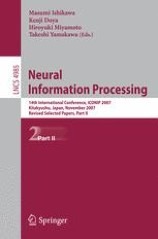
Neural Information Processing ; 14th International Conference, ICONIP 2007, Kitakyushu, Japan, November 13-16, 2007, Revised Selected Papers, Part II
The 228 revised full papers presented were carefully reviewed and selected from numerous ordinary paper submissions and 15 special organized sessions. The 116 papers of the first volume are organized in topical sections on computational neuroscience, learning and memory, neural network models ,supervised /unsupervised/reinforcement learning, statistical learning algorithms, optimization algorithms, novel algorithms, as well as motor control and vision. The second volume contains 112 contributions related to statistical and pattern recognition algorithms, neuromorphic hardware and implementations, robotics, data mining and knowledge discovery, real world applications, cognitive and hybrid intelligent systems, bioinformatics, neuroinformatics, brain-conputer interfaces, and novel approaches.

Neural Information Processing ; 14th International Conference, ICONIP 2007, Kitakyushu, Japan, November 13-16, 2007, Revised Selected Papers, Part I
The 228 revised full papers presented were carefully reviewed and selected from numerous ordinary paper submissions and 15 special organized sessions. The 116 papers of the first volume are organized in topical sections on computational neuroscience, learning and memory, neural network models, supervised/unsupervised/reinforcement learning, statistical learning algorithms, optimization algorithms, novel algorithms, as well as motor control and vision. The second volume contains 112 contributions related to statistical and pattern recognition algorithms, neuromorphic hardware and implementations, robotics, data mining and knowledge discovery, real world applications, cognitive and hybrid intelligent systems, bioinformatics, neuroinformatics, brain-conputer interfaces, and novel approaches.

Network-Centric Service-Oriented Enterprise
Network-Centric Service-Oriented Enterprise (NSCOE) is seen as heralding the next generation of mainstream Enterprise-business information collaboration solution that can enforce information and decision superiority in the decentralized, loosely-coupled, and highly interoperable service environments. Network-Centric Service Oriented Enterprise establishes a system-of-systems (SoS) view of information technologies, offering a synergistic combination of data and information-processing capacity upon an innovative networked-management framework.

Network-Centric Collaboration and Supporting Frameworks ; IFIP TC 5 WG 5.5, Seventh IFIP Working Conference on Virtual Enterprises, 25-27 September 2006, Helsinki, Finland
This book contains a number of selected articles from PRO-VE’06, the seventh working conference on virtual enterprises held in Helsinki, Finland, which was sponsored by the International Federation for Information Processing (IFIP) and the Society of Collaborative Networks (SOCOLNET). Being recognized as the most focused scientific and technical conference on Collaborative Networks, PRO-VE continues offering the opportunity for presentation and discussion of both the latest research developments as well as the practical application case studies. Following the vision of IFIP and SOCOLNET, the PRO-VE conference offers a forum for collaboration and knowledge exchange among experts from different regions of the world.

Netter's essential histology with correlated histopathology
Concise and easy to use, it integrates gross anatomy and embryology with classic histology slides and state-of-the-art scanning electron microscopy, offering a clear, visual understanding of this complex subject. Additional histopathology images, more clinical boxes, and new histopathology content ensure that this textbook-atlas clearly presents the most indispensable histologic concepts and their clinical relevance. Helps you recognize both normal and diseased structures at the microscopic level with the aid of succinct explanatory text as well as numerous clinical boxes. Features more histopathology content and additional clinical boxes to increase your knowledge of pathophysiology and clinical relevance. Includes high-quality light and electron micrographs, including enhanced and colorized electron micrographs that show ultra-structures in 3D, side by side with classic Netter illustrations that link your knowledge of anatomy and cell biology to what is seen in the micrographs.

Neonatal Pain : Suffering, Pain and Risk of Brain Damage in the Fetus and Newborn
Until the 1980s it was denied that fetuses and neonates feel pain. With the advent of a deeper understanding of the pathophysiology and new diagnostic tools, the last 30 years have seen great developments in this field. This volume aims to give an overview of current knowledge in the field.

Nectaries and Nectar
This book is a modern and interdisciplinary text on nectar and nectaries, prompted by the expansion of knowledge, especially in the more ecological and now molecular fields, and the strong recent interest in pollination biology.

Natures Versatile Engine : Insect Flight Muscle Inside and Out
Integrates knowledge from various disciplines that study muscle function, from single molecule biophysics to flight aerodynamics. This work features information on advances in muscle research, from the molecular to the organismal. It focuses on Drosophila melanogaster, and other species of flying insects are also covered.

Nature Inspired Problem-Solving Methods in Knowledge Engineering ; 2nd International Work-Conference on the Interplay Between Natural and Artificial Computation, IWINAC 2007, La Manga del Mar Menor, Spain, June 18-21, 2007, Proceedings, Part II
The second of a two-volume set, this book constitutes the refereed proceedings of the Second International Work-Conference on the Interplay between Natural and Artificial Computation, IWINAC 2007, held in La Manga del Mar Menor, Spain in June 2007.
