



الصفحة 4
الصفحة 4

New Stream Cipher Designs : The eSTREAM Finalists
The goal of eSTREAM was to promote the design of new stream ciphers with a particular emphasis on algorithms that would be either very fast in software or very resource-efficient in hardware. Algorithm designers were invited to submit new stream cipher proposals to eSTREAM, and 34 candidates were proposed from around the world. Over the following years the submissions were assessed with regard to both security and practicality by the cryptographic community, and the results were presented at major conferences and specialized workshops dedicated to the state of the art of stream ciphers.

New Methods of Concurrent Checking
New Methods of Concurrent Checking is the ultimate reference to answer the question as to how the best possible state-of-the-art error detection circuits can be designed. The most effective methods of concurrent checking for digital circuits are comprehensively described which were developed in the last 15 years. Some of the methods are published for the first time. How concurrent checking can be combined with soft error correction is also shown for the first time. This book is invaluable in considering the design of reliable systems in the emerging Nanotechnologies with an associated growing number of transient faults.

New insights in machine learning and deep neural networks
Gatheres ten exemplary papers, each delineating advancements within the spheres of machine learning and deep neural networks. Commencing with a thorough exploration by Figueira and Vaz, readers are introduced to the nuances of synthetic data generation and evaluation, followed closely by Silva and Pedroso's systematic approach to leveraging deep reinforcement learning within the intricate realm of delivery logistics. Kamran et al. contribute an astute methodology for camouflage object segmentation, whereas Pinheiro and collaborators offer a crafted semi-supervised strategy for predicting EGFR mutations via CT images. Subsequent contributions, such as Lee and Yoo's framework for portrait emotion recognition and Balakrishnan et al.'s analytical exploration of transformer models for Twitter disaster detection, further exemplify the depth of research contained herein.

New Horizons of Parallel and Distributed Computing
Parallel and distributed computing is one of the foremost technologies for shaping future research and development activities in academia and industry. Hyperthreading in Intel processors, hypertransport links in next generation AMD processors, multicore silicon in today’s high-end microprocessors, emerging cluster and grid computing, has moved parallel/distributed computing into the mainstream of computing. New Horizons of Parallel and Distributed Computing is a collection of self-contained chapters written by pioneers and researchers to provide solutions for newly emerging problems in this field. This volume will not only provide novel ideas, work in progress and state-of-the-art techniques in the field, but also stimulate future research activities in the area of parallel and distributed computing with applications. New Horizons of Parallel and Distributed Computing is intended for researchers and graduate students in computer science and electrical engineering, as well as researchers and developers in industry. This book can be used as a textbook and a reference for use by students, researchers, and developers.

New horizons for a data-driven economy : A roadmap for usage and exploitation of big data in Europe
The book is structured in four parts: Part I “The Big Data Opportunity” explores the value potential of big data with a particular focus on the European context. It also describes the legal, business and social dimensions that need to be addressed, and briefly introduces the European Commission’s BIG project. Part II “The Big Data Value Chain” details the complete big data lifecycle from a technical point of view, ranging from data acquisition, analysis, curation and storage, to data usage and exploitation. Next, Part III “Usage and Exploitation of Big Data” illustrates the value creation possibilities of big data applications in various sectors, including industry, healthcare, finance, energy, media and public services. Finally, Part IV “A Roadmap for Big Data Research” identifies and prioritizes the cross-sectorial requirements for big data research, and outlines the most urgent and challenging technological, economic, political and societal issues for big data in Europe.

New frontiers in artificial intelligence ; JSAI-isAI International Workshops, JURISIN, AI-Biz, LENLS, Kansei-AI, Yokohama, Japan, November 10–12, 2019, Revised Selected Papers
This book constitutes extended, revised and selected papers from the 11th International Symposium of Artificial Intelligence supported by the Japanese Society for Artificial Intelligence, JSAI-isAI 2019. It was held in November 2019 in Yokohama, Japan. The 26 papers were carefully selected from 46 submissions and deal with topics of AI research and are organized into 4 sections, according to the 4 workshops: JURISIN 2019, AI-Biz 2019, LENLS 16, and Kansei-AI 2019.

New Frontiers in Artificial Intelligence ; JSAI 2007 Conference and Workshops, Miyazaki, Japan, June 18-22, 2007, Revised Selected Papers
The technology of artifcial intelligence is increasing its importance thanks to the rapid growth of the Internet and computer technology. In Japan, the annual conference series of JSAI (The Japanese Society for Arti?cial Intelligence) has been playing a leading role in promoting AI research, and selected papers of the annual conferences have been published in the LNAI series since 2003. This book consists of award papers from the 21st annual conference of JSAI (JSAI 2007) and selected papers from the four co-located workshops.

New Frontiers in Artificial Intelligence ; JSAI 2006 Conference andWorkshops
The objectives of this book are to present the award papers of the 20th annual conference of JSAI 2006 and selected papers from the three co-located international workshops and to promote the study exchange among researchers worldwide.

New Frontiers in Artificial Intelligence ; JSAI 2003 and JSAI 2004 Conferences and Workshops, Niigata, Japan, June 23-27, 2003, Kanazawa, Japan, May 31-June 4, 2004, Revised Selected Papers
This book constitutes the thoroughly refereed joint post-proceedings of the 17th and 18th annual conferences of the Japanese Society for Artificial Intelligence, JSAI 2003 and JSAI 2004, and co-located international workshops, held in Niigata, Japan in June 2003 and in Kanazawa, Japan in May/June 2004 respectively.
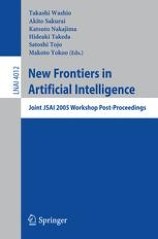
New Frontiers in Artificial Intelligence ; Joint JSAI 2005 Workshop Post-Proceedings
The objectives of this book are to present the award papers from the 19th annual conference of JSAI 2005 and the selected papers from the ?ve co-located international workshops and to promote the study exchange among worldwide researchers. Five papers received awards among more than 200 presentations in the conference, and 40 papers were selected from the workshops of Logic and Engineering of Natural Language Semantics 2005 (LENLS 2005), Learning with Logics and Logics for Learning (LLLL 2005), Agent Network Dynamics and Intelligence (ANDI 2005), Conversational Informatics (CI 2005) and Risk Management Systems with Intelligent Data Analysis (RMSIDA 2005).

New Frontiers in Applied Artificial Intelligence ; 21st International Conference on Industrial, Engineering and Other Applications of Applied Intelligent Systems, IEA/AIE 2008 Wrocław, Poland, June 18-20, 2008 Proceedings
The 75 revised full papers presented were carefully reviewed and selected from 302 submissions. The papers are organized in topical sections on computer vision, fuzzy system applications, robot and manufacturing, data mining and KDS, neural networks, machine learning, natural language processing, internet application and education, heuristic search, application systems, agent-based system, evolutionary and genetic algorithms, knowledge management, and other applications. The book concludes with 15 contributions from the following special sessions: knowledge driven manufacturing systems, joint session on adaptive networked systems and fuzzy knowledge bases, and software agents and multi-agent systems.

New Frontiers for Entertainment Computing ; IFIP 20th World Computer Congress, First IFIP Entertainment Computing Symposium (ECS 2008), September 7-10, 2008, Milano, Italy
The IFIP series publishes state-of-the-art results in the sciences and technologies of information and communication. The scope of the series includes: foundations of computer science; software theory and practice; education; computer applications in technology; communication systems; systems modeling and optimization; information systems; computers and society; computer systems technology; security and protection in information processing systems; artificial intelligence; and human-computer interaction. Proceedings and post-proceedings of refereed international conferences in computer science and interdisciplinary fields are featured. These results often precede journal publication and represent the most current research.

New Directions in Human Information Behavior
The book presents chapters by an interdisciplinary range of scholars who show new directions that often challenge the established views and paradigms of information behavior studies. Beginning with an evolutionary framework, the book examines information behaviors over various epochs of human existence from the Palaeolithic Era and within pre-literate societies, to contemporary behaviors by 21st century humans. Drawing upon social and psychological science theories the book presents a more integrated and holistic approach to the understanding of information behaviors that include multitasking and non-linear longitudinal processes, individuals’ information ground, information practices and information sharing, digital behaviors and human information organizing behaviors. The final chapter of the book integrates these new approaches and presents an overview of the key trends, theories and models for further research.

New Directions in Cognitive Information Retrieval
New Directions in Cognitive Information Retrieval presents an exciting new direction for research into cognitive oriented information retrieval (IR) research, a direction based on an analysis of the user’s problem situation and cognitive behavior when using the IR system. This contrasts with the current dominant IR research paradigm which concentrates on improving IR system matching performance. The chapters describe the leading edge concepts and models of cognitive IR that explore the nexus between human cognition, information and the social conditions that drive humans to seek information using IR systems. Chapter topics include: Polyrepresentation, cognitive overlap and the boomerang effect, Multitasking while conducting the search, Knowledge Diagram Visualizations of the topic space to facilitate user assimilation of information, Task, relevance, selection state, knowledge need and knowledge behavior, search training built into the search, children’s collaboration for school projects, and other cognitive perspectives on IR concepts and issues.

New Developments in Parsing Technology
Parsing can be defined as the decomposition of complex structures into their constituent parts, and parsing technology as the methods, the tools, and the software to parse automatically. Parsing is a central area of research in the automatic processing of human language. Parsers are being used in many application areas, for example question answering, extraction of information from text, speech recognition and understanding, and machine translation. New developments in parsing technology are thus widely applicable. This book contains contributions from many of today's leading researchers in the area of natural language parsing technology. The contributors describe their most recent work and a diverse range of techniques and results. This collection provides an excellent picture of the current state of affairs in this area. This volume is the third in a series of such collections, and its breadth of coverage should make it suitable both as an overview of the current state of the field for graduate students, and as a reference for established researchers.

New Developments in Formal Languages and Applications
The theory of formal languages is widely recognized as the backbone of theoretical computer science, originating from mathematics and generative linguistics, among others. As a foundational discipline, formal language theory concepts and techniques are present in a variety of theoretical and applied fields of contemporary research which are concerned with symbol manipulation: discrete mathematics, bioinformatics, natural language processing, pattern recognition, text retrieval, learning, cryptography, compression, etc.

New Computational Paradigms ; 1st Conference on Computability in Europe, CiE 2005, Amsterdam, The Netherlands, June 8-12, 2005, Proceedings
This book constitutes the refereed proceedings of the first International Conference on Computability in Europe, CiE 2005, held in Amsterdam, The Netherlands in June 2005. The 68 revised full papers presented were carefully reviewed and selected from 144 submissions. Among them are papers corresponding to two tutorials, six plenary talks and papers of six special sessions involving mathematical logic and computer science at the same time as offering the methodological foundations for models of computation. The papers address many aspects of computability in Europe with a special focus on new computational paradigms. These include first of all connections between computation and physical systems (e.g., quantum and analog computation, neural nets, molecular computation), but also cover new perspectives on models of computation arising from basic research in mathematical logic and theoretical computer science.

New Computational Paradigms : Changing Conceptions of What is Computable
This book examines new developments in the theory and practice of computation from a mathematical perspective, with topics ranging from classical computability to complexity, from biocomputing to quantum computing. The book opens with an introduction by Andrew Hodges, the Turing biographer, who analyzes the pioneering work that anticipated recent developments concerning computation’s allegedly new paradigms. The remaining material covers traditional topics in computability theory such as relative computability, theory of numberings, and domain theory, in addition to topics on the relationships between proof theory, computability, and complexity theory.

New approaches for security, privacy and trust in complex environments ; Proceedings of the IFIP TC 11 22nd International Information Security Conference (SEC 2007), 14-16 May 2007, Sandton, South Africa
The IFIP series publishes state-of-the-art results in the sciences and technologies of information and communication. The principal aim of the IFIP series is to encourage education and the dissemination and exchange of information about all aspects of computing.

New Algorithms for Macromolecular Simulation
Molecular simulation is a widely used tool in biology, chemistry, physics and engineering. This book contains a collection of articles by leading researchers who are developing new methods for molecular modelling and simulation. Topics addressed here include: multiscale formulations for biomolecular modelling, such as quantum-classical methods and advanced solvation techniques; protein folding methods and schemes for sampling complex landscapes; membrane simulations; free energy calculation; and techniques for improving ergodicity. The book is meant to be useful for practitioners in the simulation community and for those new to molecular simulation who require a broad introduction to the state of the art.
