



الصفحة 39
الصفحة 39
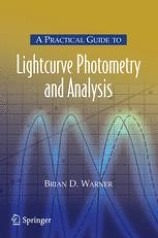
A Practical Guide to Lightcurve Photometry and Analysis
A Practical Guide to Lightcurve Photometry and Analysis provides, for those with access to even a modest telescope and CCD camera, all the information needed to take part in the scientific study of asteroids and variable stars.A Practical Guide to Lightcurve Photometry and Analysis contains all the material needed for readers to understand the theory, and avoid the practical pitfalls of lightcurve photometry. Detailed examples are given for obtaining data, and of course for the exciting and rewarding task of analyzing the data to determine the physical properties of the object.

A Personal History of Nuclear Medicine
In A Personal History of Nuclear Medicine, Dr. Henry N. Wagner, Jr. outlines his significant contribution to the field of nuclear medicine over the past half-century, while also discussing the hurdles that the field faced in becoming a major component of modern medical practice. Further, the author explores challenges within the academic and medical establishments, which have often been known for resisting change
A New Foundation of Physical Theories
Written in the tradition of G. Ludwig’s groundbreaking works, this book aims to clarify and formulate more precisely the fundamental ideas of physical theories. By introducing a basic descriptive language of simple form, in which it is possible to formulate recorded facts, ambiguities of physical theories are avoided as much as possible. In this approach the field of physics that should be described by a theory is determined by basic concepts only, i.e. concepts that can be explained without a theory.In this context the authors introduce a new concept of idealization and review the process of discovering new concepts. They believe that, when the theories are formulated within an axiomatic basis, solutions can be found to many difficult problems such as the interpretation of physical theories, the relations between theories as well as the introduction of physical concepts.

A new deal for an effective European research policy : The design and impacts of the 7th Framework programme
It underlines an important truth: that science has always advanced most rapidly when it is a collective endeavour, with a strong circulation of knowledge.This book will show how the new Framework Programme was put together and explain why it took the shape it did. It will also set out its potential impacts and the conditions necessary for it to be a success.
A Modern Theory of Factorial Design
Factorial design plays a fundamental role in efficient and economic experimentation with multiple input variables and is extremely popular in various fields of application, including engineering, agriculture, medicine and life sciences. Factorial experiments are often used in case studies in quality management and Design for Six Sigma (DFSS).Factorial design plays a fundamental role in efficient and economic experimentation with multiple input variables and is extremely popular in various fields of application, including engineering, agriculture, medicine and life sciences. Factorial experiments are often used in case studies in quality management and Design for Six Sigma (DFSS).

A Logical Approach to Philosophy : Essays in Honour of Graham Solomon
The papers in this collection are united by an approach to philosophy. They illustrate the manifold contributions that logic makes to philosophical progress, both by the application of formal methods to traditional philosophical problems and by opening up new avenues of inquiry as philosophers sort out the implications of new and often surprising technical results. Contributions include new technical results rich with philosophical significance for contemporary metaphysics, attempts to diagnose the philosophical significance of some recent technical results, philosophically motivated proposals for new approaches to negation, investigations in the history and philosophy of logic, and contributions to epistemology and philosophy of science that make essential use of logical techniques and results.
A life cycle for clusters? : The dynamics of agglomeration, change, and adaption
The phenomenon of non-random spatial concentrations of firms in one or few related sectors (clusters) is intensively debated in economic theory and policy. The euphoria about successful clusters however neglects that historically, many thriving clusters did deteriorate into old industrial areas. This book studies the determinants of cluster survival by analyzing their adaptability to change in the economic environment. Linking theoretic knowledge with empirical observations, a simulation model (based in the N/K method) is developed, which explains when and why the cluster's architecture assists or hampers adaptability. It is found that architectures with intermediate degrees of division of labour and more collective governance forms foster adaptability. Cluster development is thus path dependent as architectures having evolved over time impact on the likelihood of future survival.

A History of Chinese Mathematics
It includes many new recent insights and illustrations, a new appendix on Chinese primary sources and a guide to the to the bibliography. From the reviews: "This book ranks with the most erudite Asian publications, and is the most informative and most broadly informed on its topic in any language.this book apart from the usual histories of mathemathics (in any language, Chinese or Western, of any period or country) is its emphasis first on context, then on content, in describing the long history of Chinese mathematics. It is primarily the question of context that Martzloff approaches directly. Perhaps the greatest contribution his book makes is the chance it offers to consider issues of cultural context as significant, determining factors in the history of mathematics.
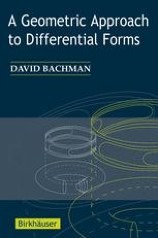
A Geometric Approach to Differential Forms
The modern subject of differential forms subsumes classical vector calculus. This text presents differential forms from a geometric perspective accessible at the undergraduate level. The book begins with basic concepts such as partial differentiation and multiple integration and gently develops the entire machinery of differential forms. Each new concept is presented with a natural picture that students can easily grasp. Algebraic properties then follow. This facilitates the development of differential forms without assuming a background in linear algebra. Throughout the text, emphasis is placed on applications in 3 dimensions, but all definitions are given so as to be easily generalized to higher dimensions. A centerpiece of the text is the generalized Stokes' theorem. Although this theorem implies all of the classical integral theorems of vector calculus, it is far easier for students to both comprehend and remember.
A First Course in Statistics for Signal Analysis
This essentially self-contained, deliberately compact, and user-friendly textbook is designed for a first, one-semester course in statistical signal analysis for a broad audience of students in engineering and the physical sciences. The emphasis throughout is on fundamental concepts and relationships in the statistical theory of stationary random signals, explained in a concise, yet fairly rigorous presentation.
A First Course in Differential Equations
This text is designed for the standard post-calculus course in elementary differential equations. It is a brief, one-semester treatment of the basic ideas, models, and solution methods. The book, which serves as an alternative to existing texts for instructors who want more concise coverage, emphasizes graphical, analytical, and numerical approaches, and is written with clear language in a user-friendly format. It provides students with the tools to continue on to the next level in applying differential equations to problems in engineering, science, and applied mathematics.

A Dictionary of Neurological Signs
The Dictionary is not a handbook for treatment of neuropathies. While many entries provide the latest treatment options, up-to-the-minute therapies are not discussed in bedside level detail. The Dictionary is not a board review book because it is not in Q&A format but could easily serve in that capacity since each entry is a fairly complete snapshot of a specific disorder or disease. The Dictionary is an alphabetical listing of commonly presenting neurological diseases and disorders designed to guide the physician toward the correct clinical diagnosis. The content is focused, problem-based, concise and practical.
A Course in Calculus and Real Analysis
Provides a self-contained and rigorous introduction to calculus of functions of one variable. The presentation and sequencing of topics emphasizes the structural development of calculus. At the same time, due importance is given to computational techniques and applications. The authors have strived to make a distinction between the intrinsic definition of a geometric notion and its analytic characterization. It highlight the fact that calculus provides a firm foundation to several concepts and results that are generally encountered in high school and accepted on faith. For example, one can find here a proof of the classical result that the ratio of the circumference of a circle to its diameter is the same for all circles. Also, this book helps get a clear understanding of the concept of an angle and the definitions of the logarithmic, exponential and trigonometric functions together with a proof of the fact that these are not algebraic functions. A number of topics that may have been inadequately covered in calculus courses and glossed over in real analysis courses are treated here in considerable detail. As such, this book provides a unified exposition of calculus and real analysis.
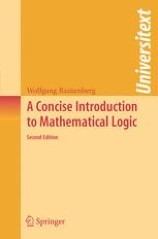
A Concise Introduction to Mathematical Logic
This book is unique in that it is more concise than most others; the material is treated in a streamlined fashion. This allows the lecturer to select the material for a one-semester course on a topic more easily. These initial chapters cover just the material for an introductory course on mathematical logic combined with the necessary material from set theory. Chapter 3 is partly of a descriptive nature, providing a view towards decision problems, automated theorem proving, non-standard models and related subjects. The other chapters contain material on logic programming for computer scientists, model theory, recursion theory, Gödel's Incompleteness Theorems, and applications of mathematical logic. Philosophical and foundational problems of mathematics are discussed where appropriate.
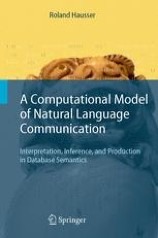
A Computational Model of Natural Language Communication : Interpretation, Inference, and Production in Database Semantics
Presents a high-level description of an artificial agent which humans can freely communicate with in their accustomed language. Part II analyzes the major constructions of natural language, i.e., intra- and extrapropositional functor - argument structure, coordination, and coreference, in the speaker and the hearer mode. Part III defines declarative specifications for fragments of English, which are used for an implementation in Java.

A companion to astronomy and astrophysics : Chronology and glossary with data tables
Astronomy and Astrophysics is a comprehensive, fundamental, up-to-date reference book. It is filled with vital information and basic facts for amateur astronomers and professional astrophysicists, and for anyone interested in the Universe, from the Earth and other planets to the stars, galaxies and beyond. Although serious and thorough, the language, and ideas will attract the general reader, as well as students and professionals. Astronomy and Astrophysics consists of two main parts, a Timeline and a Dictionary. The Timeline is a concise history, arranged chronologically, which provides the complete story of cosmic discovery from early Chinese and Greek astronomy to the latest findings of modern astrophysics and robotic spacecraft.
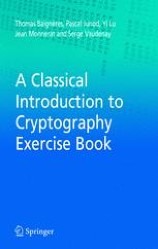
A Classical Introduction to Cryptography Exercise Book
A Classical Introduction to Cryptography Exercise Book for A Classical Introduction to Cryptography: Applications for Communications Security covers a majority of the subjects that make up today's cryptology, such as symmetric or public-key cryptography, cryptographic protocols, design, cryptanalysis, and implementation of cryptosystems. Exercises do not require a large background in mathematics, since the most important notions are introduced and discussed in many of the exercises.

A Classical Introduction to Cryptography : Applications for Communications Security
This advanced-level textbook covers conventional cryptographic primitives and cryptanalysis of these primitives; basic algebra and number theory for cryptologists; public key cryptography and cryptanalysis of these schemes; and other cryptographic protocols, e.g. secret sharing, zero-knowledge proofs and undeniable signature schemes.

A Benchmark Approach to Quantitative Finance
The general framework is used to provide an understanding of the nature of stochastic volatility. The book is intended for a wide audience that includes quantitative analysts, postgraduate students and practitioners in finance, economics and insurance. It aims to be a self-contained, accessible but mathematically rigorous introduction to quantitative finance for readers that have a reasonable mathematical or quantitative background. Finally, the book should stimulate interest in the benchmark approach by describing some of its power and wide applicability.

3-D Structural Geology : A Practical Guide to Quantitative Surface and Subsurface Map Interpretation
This book provides an overview of techniques for constructing structural interpretations in 2-D, 2½-D and 3-D environments; for interpolating - tween and extrapolating beyond the control points; and for validating the final int- pretation. The underlying philosophy is that structures are three-dimensional solid bodies and that data from throughout the structure, whether in 2-D or 3-D format, should be integrated into an internally consistent 3-D interpretation. It is assumed that most users of this book will do their work on a computer. C- sequently, the book provides quantitative structural methods and techniques that are designed for use with spreadsheets, mapping software, and three-dimensional c- puter-graphics programs. The book is also intended to provide the background for understanding what interpretive software, for example, a computer contouring p- gram, does automatically. Most techniques are presented in both a traditional format appropriate for paper, pencil, and a pocket calculator, and in quantitative format for use with spreadsheets and computer-graphics or computer-aided-design programs.
