



الصفحة 346
الصفحة 346
AI 2007: Advances in artificial intelligence ; 20th Australian Joint Conference on Artificial Intelligence, Gold Coast, Australia, December 2-6, 2007, Proceedings
The book is organized in topical sections on machine learning, neural networks, evolutionary computing, constraint satisfaction, satisfiability, automated reasoning, knowledge discovery, robotics, social intelligence, ontologies and semanti.

AI 2006 : Advances in artificial intelligence ; 19th Australian Joint Conference on Artificial Intelligence, Hobart, Australia, December 4-8, 2006, Proceedings
This volume contains the proceedings of the 19th Australian Joint Conference on Artificial Intelligence (AI 2006) held at Hobart, Australia. AI 2006 received a record number of submissions, a total of 689 submissions from 35 countries. The papers in this volume give an indication of recent advances in artificial int- ligence. The topics covered include Machine Learning, Robotics, AI Applications, Planning, Agents, Data Mining and Knowledge Discovery, Cognition and User Interface, Vision and Image Processing, Information Retrieval and Search, AI in the Web, Knowledge Representation, Knowledge-Based Systems, and Neural Networks.

AI 2005 : Advances in artificial intelligence ; 18th Australian joint conference on artificial intelligence, Sydney, Australia, December 5-9, 2005, proceedings
The 18th Australian Joint Conference on Artificial Intelligence (AI 2005) was held at the University of Technology, Sydney (UTS), Sydney, Australia from 5 to 9 December 2005. AI 2005 attracted a historical record number of submissions, a total of 535 papers. This volume of the proceedings contains the abstracts of three keynote speeches and all the full and short papers. The full papers were categorized into three broad sections, namely: AI foundations and technologies, computational intelligence, and AI in specialized domains. AI 2005 also hosted several tutorials and workshops, providing an interacting mode for specialists and scholars from Australia and other countries.

AI 2004 : Advances in artificial intelligence ; 17th Australian Joint conference on artificial intelligence, Cairns, Australia, December 4-6, 2004, proceedings
AI 2004 was the seventeenth in the series of annual Australian artificial intelli-gence conferences. This conference is the major forum for artificial intelligenceresearch in Australia. It has consistently attracted strong international partic-ipation. This year more than two thirds of the submissions were from outsideAustralia.The current volume is based on the proceedings of AI 2004. AI 2004 was collo-cated with Complex 2004, the 7th Asia-Pacific Conference on Complex Systems,with the aim of promoting cross-fertilization and collaboration in areas of com-plex and intelligent systems
Agroforestry in Europe : Current Status and Future Prospects
Brings together some of the most important current research in European agroforestry, and evaluates the current scope and future potential of agroforestry across the EU.While the majority of Europe’s agroforestry practices are currently focused in the Mediterranean, this volume draws together examples from a wide range of countries – including Greece, Spain, the UK, Hungary, Germany, Italy, the Netherlands, Switzerland, France and Slovenia. The book also covers a range of agroforestry types, including silvopastoralism – Europe’s predominant form of agroforestry – as well as alley cropping, forest farming, silvoarable systems and the use of trees for shelter. Through these examples the book also discusses the potential roles for these traditional land management systems in addressing both environmental issues such as water quality, biodiversity conservation, desertification, ecosystem services and socioeconomic issues such as rural population stabilization.
Agroecology now! : Transformations towards more just and sustainable food systems
Develops a framework for advancing agroecology transformations focusing on power, politics and governance. It explores the potential of agroecology as a sustainable and socially just alternative to today’s dominant food regime. Agroecology is an ecological approach to farming that addresses climate change and biodiversity loss while contributing to the Sustainable Development Goals
Agroecological transitions : From theory to practice in local participatory design
There is wide agreement on the need to change the prevalent agricultural models, given their negative impacts and their incompatibility with current societal issues. Agroecological transition has been promoted as a potential solution to the ecological, social and economic problems generated by these models. It however involves a systemic, multi-scale and transdisciplinary process. Due to this complexity, the overall picture of what farms and food systems “actually are” and “might be” may not be apparent at the individual level. Yet individuals’ knowledge and values provide complementary insights on how to proceed in deepening ecological modernisation. Expertise can also provide landmarks to be considered in that process. Because local stakeholders’ experience and skills are key resources in the adaptation and adoption of agroecological transition, new conceptual and methodological frameworks and tools have to be developed to support them in the design process of such a complex transition. This book presents feedback from the ‘Territorial Agroecological Transition in Action’- TATA-BOX research project, which was devoted to these specific issues.
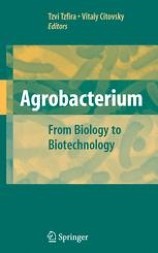
Agrobacterium : From Biology to Biotechnology
Agrobacterium’ is a comprehensive book on Agrobacterium research, including its history, application, basic biology discoveries, and effects on human society. Although the book largely focuses on providing a detailed review of virtually all molecular events of the genetic transformation process, it also provides coverage of ethical and legal issues relevant to the use of Agrobacterium as a "genetic transformation machine". The result is an all-inclusive text which readers—including scientists and students involved in plant genetic engineering—will find useful as a reference source for all major aspects of the Agrobacterium-mediated genetic transformation of plant and non-plant organisms.

Agricultural value chains in India : Ensuring competitiveness, inclusiveness, sustainability, scalability, and improved finance
This book provides a clear holistic conceptual framework of CISS-F (competitiveness, inclusiveness, sustainability, scalability and access to finance) to analyse the efficiency of value chains of high value agricultural commodities in India. It is based on the understanding that agriculture is an integrated system that connects farming with logistics, processing and marketing. Farmer’s welfare being central to any agricultural policy makes it very pertinent to study how a value chain works and can be strengthened further to realize this policy goal.
Agricultural Research Management
Agricultural research is one of the most widespread forms of organized research in the world, in both developed and developing countries. Management of agricultural research involves many decisions that have scientific, social and political consequences. Every country has established agricultural research priorities based on many complex factors that must be considered when decisions are made on the choice of research problems to be investigated. Resources must be divided among projects that often compete for the limited funding available that supports the total research enterprise.

Agricultural Medicine : A Practical Guide
Covering both injury prevention and environmental h- ards, this innovative work is a practical guide for the family physician wo- ing in a rural area. The contents demonstrate the vitality of agromedicine and the vision and insight of the authors. The chapters on farm chemicals provide thorough information about the many types of chemicals commonly used in the farm environment, how they are applied, and the principles of diagnosis and management for family physicians treating patients for toxic chemical exposure.
Agricultural Implications of the Fukushima Nuclear Accident (III)
Reports on studies undertaken at contaminated sites such as farmland, forests, and marine and freshwater environments, with a particular focus on livestock, wild plants and mushrooms, crops, and marine products in those environments. It also provides additional data collected in the subsequent years to show how the radioactivity levels in agricultural products and their growing environments have changed with time and the route by which radioactive materials entered agricultural products as well as their movement between different components (e.g., soil, water, and trees) within an environmental system (e.g., forests). The book covers various topics, including radioactivity testing of food products; decontamination trials for rice and livestock production; the state of contamination in, trees, mushrooms, and timber; the dynamics of radioactivity distribution in paddy fields and upland forests; damage incurred by the forestry and fishery industries; and the change in consumers’ attitudes. Chapter 19 introduces a real-time radioisotope imaging system, a pioneering technique to visualize the movement of cesium in soil and in plants.
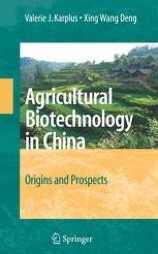
Agricultural Biotechnology in China : Origins and Prospects
Building on a long tradition of agricultural advances, Chinese scientists have applied biotechnology techniques to develop hundreds of novel crop varieties suited to local farming conditions and challenges.Agricultural Biotechnology in China: Origins and Prospects is a comprehensive examination of how the origins of biotechnology research agendas, along with the effectiveness of the seed delivery system and biosafety oversight, help to explain current patterns of crop development and adoption in China. Based on firsthand insights from China’s laboratories and farms, Valerie Karplus and Dr. Xing Wang Deng explore the implications of China’s investment for the nation’s rural development, environmental footprint, as well as its global scientific and economic competitiveness.
Agricultural biodiversity and biotechnology in economic development
The topics addressed in this book are of vital importance to the survival of humankind. Agricultural biodiversity, encompassing genetic diversity as well as human knowledge, is the base upon which agricultural production has been built, and protecting this resource is critical to ensuring the capacity of current and future generations to adapt to unforeseen challenges. Agricultural biodiversity underpins the productivity of all agricultural systems and is particularly important for poor and food-insecure farmers, who maintain highly diverse production systems in response to the marginal and risky production conditions they operate under. Understanding the importance of agricultural biodiversity in the livelihoods of the food insecure and enhancing its performance through the use of a variety of tools, including biotechnology, is a critically important issue in the world today

Agitator Design for Gas-Liquid Fermenters and Bioreactors
Agitator Design for Gas-Liquid Fermenters and Bioreactors delivers a concise treatment and explanation of how to design mechanically sound agitation systems that will perform the agitation process function efficiently and economically. The book covers agitator fundamentals, impeller systems, optimum power and air flow at peak mass transfer calculations, optimizing operation for minimum energy per batch, heat transfer surfaces and calculations, shaft seal considerations, mounting methods, mechanical design, and vendor evaluation.

Aging, shaking, and cracking of infrastructures : From mechanics to concrete dams and nuclear structures
Focuses on the safety assessment of existing structures subjected to multi-hazard scenarios through advanced numerical methods. Whereas the focus is on concrete dams and nuclear containment structures, the presented methodologies can also be applied to other large-scale ones. This book is composed of seven sections: Fundamentals: theoretical coverage of solid mechnics, plasticity, fracture mechanics, creep, / seismology, dynamic analysis, probability and statistics / Damage: that can affect concrete structures, such as cracking of concrete, AAR, chloride ingress, and rebar corrosion, / Finite Element: formulation for both linear and nonlinear analysis including stress, heat and fracture mechanics, / Engineering Models: for soil/fluid-structure interaction, uncertainty quantification, probablilistic and random finite element analysis, machine learning, performance based earthquake engineering, ground motion intensity measures, seismic hazard analysis, capacity/fragility functions and damage indeces, / Applications to dams through potential failure mode analyses, risk-informed decision making, deterministic and probabilistic examples, / Applications to nuclear structures through modeling issues, aging management programs, critical review of some analyses, / Other applications and case studies: massive RC structures and bridges, detailed assessment of a nuclear containment structure evaluation for license renewal.

Aging Well : Solutions to the Most Pressing Global Challenges of Aging
Outlines the challenges of supporting the health and wellbeing of older adults around the world and offers examples of solutions designed by stakeholders, healthcare providers, and public, private and nonprofit organizations in the United States. The solutions presented address challenges including: providing person-centered long-term care, making palliative care accessible in all healthcare settings and the home, enabling aging-in-place, financing long-term care, improving care coordination and access to care, delivering hospital-level and emergency care in the home and retirement community settings, merging health and social care, supporting people living with dementia and their caregivers, creating communities and employment opportunities that are accessible and welcoming to those of all ages and abilities, and combating the stigma of aging. The innovative programs of support and care in Aging Well serve as models of excellence that, when put into action, move health spending toward a sustainable path and greatly contribute to the well-being of older adults.

Aging and Senescence
Aging is characterized by a progressive loss of physiological integrity, leading to impaired function and increased vulnerability to death. This deterioration is the primary risk factor for major human pathologies, including cancer, diabetes, cardiovascular disorders, and neurodegenerative diseases. Aging research has experienced an unprecedented advance over recent years, particularly with the discovery that the rate of aging is controlled, at least to some extent, by genetic pathways and biochemical processes conserved in evolution. Although recent developments in molecular biology are far from understanding the biological basis of aging, research suggests that targeting the aging process itself could ameliorate many age-related pathologies.

Agility by ARIS business process management : Yearbook business process excellence 2006/2007
Business Process Management has recently become a real "hype" topic. Too often, however, the technical aspects are being focused upon. The book offers valuable ideas to companies on how to optimize their own business processes and thus become more competitive.
Agile software engineering
This textbook presents the crucial issues in software engineering using the agile approach to software development - one of the mainstream paradigms for the management of software projects and one that is being applied more and more extensively.
