



الصفحة 32
الصفحة 32

Genome editing in drug discovery
In Genome Editing in Drug Discovery, a team of distinguished biologists delivers a comprehensive exploration of genome editing in the drug discovery process, with coverage of the technology’s history, current issues and techniques, and future perspectives and research directions. The book discusses techniques for disease modeling, target identification with CRISPR, safety studies, therapeutic editing, and intellectual property issues.

Genome Editing : Gene Therapy or Gene Optimization?
Genome editing technology is considered one of the most revolutionary techniques lately. The ability of modifying the human genome has been one of the biggest dreams for therapist for the reason that the genetic modification with exogenous DNA can be considered a problem solver for many diseases and disorders (genetic disorders), especially those with high risks and low survival rates, on this case, gene therapy appears as the tool to be used, with its many protocols and approaches. Gene therapy is based on delivering a therapeutic gene throw suitable vectors, which is most of the time-modified viruses to carry the therapeutic genes to the target cells and so on providing the functional copy of the defective gene.

Genetics of Adaptation
What is the genetic basis of adaptive evolution? In this volume, a new generation of biologists have taken up this challenge. Using advances in both molecular genetic and statistical techniques, evolutionary geneticists have made considerable progress in this emerging field. In this volume, a diversity of examples from plant and animal studies provides valuable information for those interested in the genetics and evolution of complex traits.

Genetic surgery : from genes to solutions
As a tool for modifying the genome, gene editing technologies has developed rapidly in recent years, the application of these technologies in basic biomedical research has yielded significant advances in identifying and studying key molecular targets relevant to human diseases and their treatment. The clinical translation of genome editing techniques offers unprecedented biomedical engineering capabilities in the diagnosis, prevention, and treatment of disease or disability...

Genetic Programming Theory and Practice V
Genetic Programming Theory and Practice V was developed from the fifth workshop at the University of Michigan’s Center for the Study of Complex Systems to facilitate the exchange of ideas and information related to the rapidly advancing field of Genetic Programming (GP). Contributions from the foremost international researchers and practitioners in the GP arena examine the similarities and differences between theoretical and empirical results on real-world problems. The text explores the synergy between theory and practice, producing a comprehensive view of the state of the art in GP application.

Generator remote controlling using internet connection
The traditional technique of monitoring the electricity generated through regular checks on the alternator variables: oil, temperature, voltage and current on a daily basis. Therefore, maintaining a normal performance cycle requires hard work and is often imprecise. The idea is to create an application that monitors wireless generators using the popular smartphone Android operating system. Implemented sensors deliver analog signals that provide real-time data on the status of the generator. This data is converted and programmed through the Node MCU microcontroller, which reads the results from the sensors and then converts into a signal, which is transmitted to the android phone, through a router. Thus live feedback of the generator status is ensured. In addition, this project provides a control button that can actually turn this generator on and off. This project is the first step towards bringing systems and control together as it revolutionizes the ideology of monitoring and displaying real-time data that can be implemented in different fields according to different needs. These fields include electricity, mechanics, and communications.

Generative and transformational techniques in software engineering II : International Summer School, GTTSE 2007, Braga, Portugal, July 2-7, 2007. Revised Papers
This tutorial book presents an augmented selection of the material presented at the International Summer School on Generative and Transformational Techniques in Software Engineering, GTTSE 2007, held in Braga, Portugal, in July 2007.The 7 tutorial lectures presented together with 5 short tutorials and 4 contributions to the participants workshop were carefully selected during multiple rounds of reviewing and improvement. The tutorials given by renowned representatives of complementary approaches and problem domains combine foundations, methods, examples, and tool support.
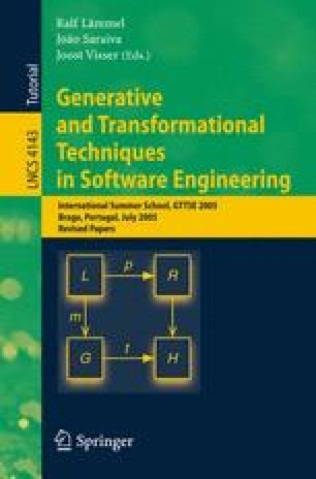
Generative and transformational techniques in software engineering ; International Summer School, GTTSE 2005, Braga, Portugal, July 4-8, 2005. Revised Papers
This tutorial book presents an augmented selection of material presented at the International Summer School on Generative and Transformational Techniques in Software Engineering, GTTSE 2005. The book comprises 7 tutorial lectures presented together with 8 technology presentations and 6 contributions to the participants workshop.
Generalized collocations methods : Solutions to nonlinear problems
This book examines various mathematical tools—based on generalized collocation methods—to solve nonlinear problems related to partial differential and integro-differential equations. Covered are specific problems and models related to vehicular traffic flow, population dynamics, wave phenomena, heat convection and diffusion, transport phenomena, and pollution. Based on a unified approach combining modeling, mathematical methods, and scientific computation, each chapter begins with several examples and problems solved by computational methods; full details of the solution techniques used are given. The last section of each chapter provides problems and exercises giving readers the opportunity to practice using the mathematical tools already presented.

Generalized Bounds for Convex Multistage Stochastic Programs
The auther was involved in several industry projects in the field of power management, on the occasion of which I was repeatedly c- fronted with complex decision problems under uncertainty. Although usually hard to solve, I quickly learned to appreciate the benefit of stochastic progr- ming models and developed a strong interest in their theoretical properties. Motivated both by practical questions and theoretical concerns, I became p- ticularly interested in the art of finding tight bounds on the optimal value of a given model. The present work attempts to make a contribution to this important branch of stochastic optimization theory. In particular, it aims at extending some classical bounding methods to broader problem classes of practical relevance.

Gene delivery systems development and applications
Covers the development of gene therapy today, the technology involved, clinical applications of siRNA, non-viral vector-based mRNA delivery using nanotechnology, and RNA based vaccines for treating the infectious diseases. It also presents the current application of the CRISPR/Cas9 gene-editing technique which has revolutionized genome editing and which was awarded the 2020 Nobel Prize in Chemistry. Several new drug delivery systems are explored for the applications of gene therapy. These are found to be useful in treating chronic illnesses, including cancer and infectious diseases.

Gastrointestinal Tract Sonography in Fetus and in Children
Sonography of the gastrointestinal tract in fetuses, neonates and children entails no known biological risk, permits serial scanning and can provide information unobtainable with any other imaging modality. In experienced hands it can be used as the initial imaging technique in a number of gastrointestinal diseases and conditions. This book provides a comprehensive account of the current state of the art regarding sonography in this context.

Gastrointestinal malignancies
Details the advances in drug discovery and delivery and the present need for emerging technologies. Throughout the text new micro and nanofabrication techniques are described, including methods such as electrohydrodynamic processes, additive manufacturing, and microfluidics, which have the potential to produce drug delivery systems that were not possible a few years ago. This book is of great use to both entry-level and experienced researchers in the field of emerging technologies for the manufacturing of drug delivery devices.

Gastrointestinal Cancer
Gastrointestinal cancer includes cancer of the digestive system - the esophagus, colon, rectum, anus, liver, pancreas, and other digestive organs. Taken as a whole, there are an estimated 250,600 new cases in the US. Colon and rectum cancer is the third leading cause of cancer and cancer deaths in the US. Gastrointestinal Cancer is the third volume in the M.D. Anderson Cancer Care series, featuring the current standard approach to GI cancer care from the experts at M.D. Anderson Cancer Center. Designed for the practicing oncologist, this clinical guidebook allows for quick, authoritative access to the latest and best multimodality therapies. Topics covered in this volume include AJCC staging of gastrointestinal malignancies, recent advances in histopathology of gastroinestinal cancers, imaging techniques and endoscopy in the management of GI malignancies, colorectal cancer, liver cancer, gastric cancer, esophageal cancer, anal cancer, and palliative therapy. Each of the 20 chapters ends with an up-to-date list of suggested readings, as well as "key practice points" highlighting the most principles and practices of each chapter for at-a-glance reference. More than 80 illustrations complement the text. This thorough, practical volume is the essential clinical guide for the oncologists, surgeons, and all physicians involved in the care of patients with GI cancer.

Galaxy Formation
This second edition of Galaxy Formation is an up-to-date text on astrophysical cosmology, expounding the structure of the classical cosmological models from a contemporary viewpoint. This forms the background to a detailed study of the origin of structure and galaxies in the Universe. The derivations of many of the most important results are derived by simple physical arguments which illuminate the results of more advanced treatments. A very wide range of observational data is brought to bear upon these problems, including the most recent results from WMAP, the Hubble Space Telescope, galaxy surveys like the Sloan Digital Sky Survey and the 2dF Galaxy Redshift Survey, studies of Type 1a supernovae, and many other observations.

Galaxies in the Local Vol.
Studies of Nearby Galaxies are currently the focus of many observations and numerical simulations. This book presents an overview of the galaxies within the Local Volume (D < 10 Mpc), including the Local Group (D < 1 Mpc) and our closest neighbours, the Andromeda Galaxy and the Magellanic Clouds. Presented are the latest results from radio, infrared and optical surveys as well as detailed multi-wavelength studies of individual galaxies. Accurate distances are now available for the majority of Local Volume galaxies providing a true 3-dimensional view of their distribution and flow pattern as well as their star formation.

Galaxies and How to Observe Them
Satisfies the need for a modern, comprehensive review in combining the three major aspects: the physical background on the nature and data of galaxies, the relevant instrumentation and viewing techniques, and finally the targets and their individual appearance in telescopes of various apertures. To illustrate the latter, a comprehensive sample of galaxies, including quasars, groups and clusters of galaxies is presented. This combination of theoretical knowledge and practical information guarantees successful observing sessions. The book could become a standard source on galaxy observing for all kinds of amateur observers, from the beginner to the experienced.
Fuzzy systems and knowledge discovery ; Vol. 4223 ; Third International Conference, FSKD 2006, Xi'an, China, September 24-28, 2006, Proceedings
ICNC-FSKD 2006 featured the most up-to-date research results in com- tational algorithms inspired from nature, including biological, ecological, and physical systems. It is an exciting and emerging interdisciplinary area in which a wide rangeof techniques and methods arebeing studied for dealing with large, complex, and dynamic problems.

Fuzzy systems and knowledge discovery ; Vol. 3614 ; 2nd International Conference, FSKD 2005, Changsha, China, August 27-29, 2005, Proceedings, Part II
This book and its sister volume, LNAI 3613 and 3614, constitute the proce- ings of the Second International Conference on Fuzzy Systems and Knowledge Discovery (FSKD 2005), jointly held with the First International Conference on Natural Computation (ICNC 2005, LNCS 3610, 3611, and 3612) from - gust 27–29, 2005 in Changsha, Hunan, China. FSKD 2005 successfully attracted 1249 submissions from 32 countries/regions (the joint ICNC-FSKD 2005 received 3136 submissions). After rigorous reviews, 333 high-quality papers, i. e. , 206 long papers and 127 short papers, were included in the FSKD 2005 proceedings, r- resenting an acceptance rate of 26. 7%. The ICNC-FSKD 2005 conference featured the most up-to-date research - sults in computational algorithms inspired from nature, including biological, e- logical, and physical systems. It is an exciting and emerging interdisciplinary area in which a wide range of techniques and methods are being studied for dealing with large, complex, and dynamic problems. The joint conferences also promoted cross-fertilization over these exciting and yet closely-related areas, which had a signi?cant impact on the advancement of these important technologies. Speci?c areas included computation with words, fuzzy computation, granular com- tation, neural computation, quantum computation, evolutionary computation, DNA computation, chemical computation, information processing in cells and tissues, molecular computation, arti?cial life, swarm intelligence, ants colony, arti?cial immune systems, etc. , with innovative applications to knowledge d- covery, ?nance, operations research, and more.

Fuzzy systems and knowledge discovery ; Vol. 3613 ; 2nd International Conference, FSKD 2005, Changsha, China, August 27-29, 2005, Proceedings, Part I
This book and its sister volume, LNAI 3613 and 3614, constitute the proce- ings of the Second International Conference on Fuzzy Systems and Knowledge Discovery (FSKD 2005), jointly held with the First International Conference on Natural Computation (ICNC 2005, LNCS 3610, 3611, and 3612) from - gust 27–29, 2005 in Changsha, Hunan, China. FSKD 2005 successfully attracted 1249 submissions from 32 countries/regions (the joint ICNC-FSKD 2005 received 3136 submissions). After rigorous reviews, 333 high-quality papers, i. e. , 206 long papers and 127 short papers, were included in the FSKD 2005 proceedings, r- resenting an acceptance rate of 26. 7%. The ICNC-FSKD 2005 conference featured the most up-to-date research - sults in computational algorithms inspired from nature, including biological, e- logical, and physical systems. It is an exciting and emerging interdisciplinary area in which a wide range of techniques and methods are being studied for dealing with large, complex, and dynamic problems. The joint conferences also promoted cross-fertilization over these exciting and yet closely-related areas, which had a signi?cant impact on the advancement of these important technologies. Speci?c areas included computation with words, fuzzy computation, granular com- tation, neural computation, quantum computation, evolutionary computation, DNA computation, chemical computation, information processing in cells and tissues, molecular computation, arti?cial life, swarm intelligence, ants colony, arti?cial immune systems, etc. , with innovative applications to knowledge d- covery, ?nance, operations research, and more.
