



الصفحة 32
الصفحة 32

Computational Quantum Mechanics for Materials Engineers : The EMTO Method and Applications
Computational Quantum Mechanics for Materials Engineers describes new approaches to the modelling of disordered alloys that combine the most efficient quantum-level theories of random alloys with the most sophisticated numerical techniques to establish a theoretical insight into the electronic structure of complex materials such as stainless steels, Hume-Rothery alloys and silicates. The practical success of these approaches to applications in all of these areas are covered in detail. The new EMTO-CPA method is detailed, including its application in alloys to model structural stability and elastic properties of random alloys of arbitrary composition and the effect of alloying elements on elastic stiffnesses stacking fault energies and structural parameters. The EMTO-CPA method makes new approaches to computational alloy design feasible. Computational Quantum Mechanics for Materials Engineers shows how the technique will soon allow materials engineers to become "quantum blacksmiths

Computational Plasticity
The different chapters of this book present recent progress and future research directions in the field of computational plasticity. A common line of many contributions is that a stronger interaction between the phenomenological and micromechanical modelling of plasticity behaviour is apparent and the use of inverse identification techniques is also more prominent. The development of adaptive strategies for plasticity problems continues to be a challenging goal, while it is interesting to note the permanence of element modelling as a research issue. Industrial forming processes, geomechanics, steel and concrete structures form the core of the applications of the different numerical methods presented in the book.

Computational Physiology : Simula Summer School 2021 − Student Reports
Compiles student reports from the 2021 Simula Summer School in Computational Physiology. Interested readers will find herein a number of modern approaches to modeling excitable tissue. This should provide a framework for tools available to model subcellular and tissue-level physiology across scales and scientific questions.

Computational Multiscale Modeling of Fluids and Solids : Theory and Applications
The book includes the micro-scale, the meso-scale and the macro-scale. The chapters follow this classification. The book will explain in detail many tricks of the trade of some of the most important methods and techniques that are used to simulate materials on the perspective levels of spatial and temporal resolution. Case studies are occasionally included to further illustrate some methods or theoretical considerations. Example applications for all techniques are provided, some of which are from the author’s own contributions to some of the research areas. Methods are explained, if possible, on the basis of the original publications but also references to standard text books established in the various fields are mentioned.
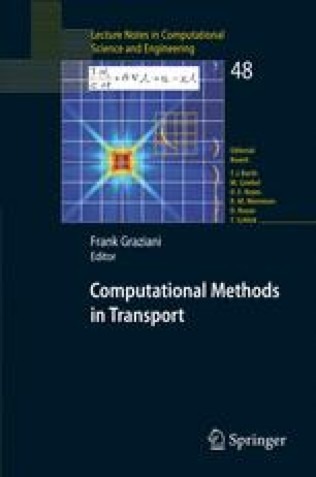
Computational Methods in Transport ; Granlibakken 2004
Based on a series of lectures given in the Granlibakken workshop was devoted to providing a forum, where computational transport researchers could communicate their methods with their results. This book presents computational transport in mathematics, astrophysics, high energy density physics, atmospheric physics, oceanography, and plant canopies.

Computational Methods in Transport : Verification and Validation
The focus of this book deals with a cross cutting issue affecting all particle transport algorithms and applications; verification and validation (V&V). In other words, are the equations being solved correctly and are the correct equations being solved? Verification and validation assures a scientist, engineer or mathematician that a simulation code is a mirror of reality and not just an expensive computer game. In this book, we will learn what the astrophysicist, atmospheric scientist, mathematician or nuclear engineer do to assess the accuracy of their code. What convergence studies, what error analysis, what problems do each field use to benchmark and ascertain the accuracy of their transport simulations.

Computational methods for nanoscale applications : Particles, plasmons and waves
Computational Methods for Nanoscale Applications: Particles, Plasmons and Waves presents new perspectives on modern nanoscale problems where fundamental science meets technology and computer modeling. This book describes well-known computational techniques such as finite-difference schemes, finite element analysis and Ewald summation, as well as a new finite-difference calculus of Flexible Local Approximation MEthods (FLAME) that qualitatively improves the numerical accuracy in a variety of problems. Application areas in the book include long-range particle interactions in homogeneous and heterogeneous media, electrostatics of colloidal systems, wave propagation in photonic crystals, photonic band structure, plasmon field enhancement, and metamaterials with backward waves and negative refraction.

Computational Methods for Algebraic Spline Surfaces : ESF Exploratory Workshop
The papers included in this volume provide an overview about the state-of-the-art in approximative implicitization and various related topics, including both the theoretical basis and the existing computational techniques. The novel idea of approximate implicitization has strengthened the existing link between Computer Aided Geometric Design and classical algebraic geometry. There is a growing interest from researchers and professionals both in CAGD and Algebraic Geometry, to meet and combine knowledge and ideas, in order to better solve industrial--type challenges, as well as to initiate new directions for basic research. This volume will support this exchange of ideas between the various communities.

Computational Many-Particle Physics
Complicated many-particle problems abound in nature and in research alike. Plasma physics, statistical physics and condensed matter physics, as primary examples, are all heavily dependent on efficient methods for solving such problems. Addressing graduate students and young researchers, this book presents an overview and introduction to state-of-the-art numerical methods for studying interacting classical and quantum many-particle systems. A broad range of techniques and algorithms are covered, and emphasis is placed on their implementation on modern high-performance computers.

Computational Life Sciences ; Vol. 3695 ; 1st International Symposium, CompLife 2005, Konstanz, Germany, September 25-27, 2005, Proceedings
This book constitutes the refereed proceedings of the First International Symposium on Computational Life Sciences, CompLife 2005, held in Konstanz, Germany in September 2005. The integration of knowledge in the life sciences is continuing apace with ev- increasingimportancebeing placedoncomputer-basedmethodsofdata capture, analysis, and knowledge representation. Today, our many di?erent sciences are providing us with a sea of information: it is the handling of this in?ux that is becoming a key discovery and regulatory question. The solutions to these problems will result in advancements to all of the involved sciences and will be highly in?uential both in the selection of the areas scientists seek to investigate and also on their success. For this to happen, it is crucial to establish an open and lively exchange between computer scientists, biologists, and chemists. To encourage precisely this type of exchange, crossing the borders of the sciences, we organized the 1st Symposium on Computational Life Science in Konstanz, Germany(September 25 27,2005).
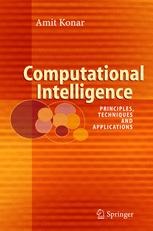
Computational intelligence : Principles, techniques and applications
The book Computational Intelligence: Principles, Techniques and Applications presents both theories and applications of Computational Intelligence in a clear, precise and highly comprehensive style. The textbook addresses the fundamental aspects of Fuzzy Sets and Logic, Neural Networks, Evolutionary Computing and Belief Networks. The application areas include Fuzzy Databases, Fuzzy Control, Image Understanding, Expert Systems, Object Recognition, Criminal Investigation, Telecommunication Networks and Intelligent Robots. The book contains many numerical examples and homework problems with sufficient hints so that the students can solve them on their own. Emerging areas of Computational Intelligence such as artificial life, particle swarm optimization, artificial immune systems, fuzzy chaos theory, rough sets and granular computing have also been addressed with examples in this book. The book ends with a discussion on a number of open- ended research problems in Computational Intelligence. Graduate students interested to pursue their research in this subject will greatly be benefited with these problems.

Computational Granular Dynamics : Models and Algorithms
Computer simulations not only belong to the most important methods for the theoretical investigation of granular materials, but also provide the tools that have enabled much of the expanding research by physicists and engineers. The present book is intended to serve as an introduction to the application of numerical methods to systems of granular particles. Accordingly, emphasis is placed on a general understanding of the subject rather than on the presentation of the latest advances in numerical algorithms. Although a basic knowledge of C++ is needed for the understanding of the numerical methods and algorithms in the book, it avoids usage of elegant but complicated algorithms to remain accessible for those who prefer to use a different programming language. While the book focuses more on models than on the physics of granular material, many applications to real systems are presented.

Computational Fluid Dynamics 2004 ; Proceedings of the Third International Conference on Computational Fluid Dynamics, ICCFD3, Toronto, 12-16 July 2004
The International Conference on Computational Fluid Dynamics (ICCFD) is the merger of the International Conference on Numerical Methods in Fluid Dynamics (ICNMFD) and the International Symposium on Computational Fluid Dynamics (ISCFD). It is held every two years and brings together physicists, mathematicians and engineers to review and share recent advances in mathematical and computational techniques for modeling fluid dynamics. The proceedings of the 2004 conference held in Toronto, Canada, contain a selection of refereed contributions and are meant to serve as a source of reference for all those interested in the state of the art in computational fluid dynamics.

Computational Fluid Dynamics : Applications in Water, Wastewater and Stormwater Treatment
Provides a valuable introduction and overview of computational fluid dynamics and how it can be used in the water and wastewater industry. This book reviews procedures for conducting flow, transport, and reaction simulations using computational fluid dynamics along with specific practical examples.

Computational Engineering : Introduction to Numerical Methods
This book is an introduction to modern numerical methods in engineering. It covers applications in fluid mechanics, structural mechanics, and heat transfer as the most relevant fields for engineering disciplines such as computational engineering, scientific computing, mechanical engineering as well as chemical and civil engineering. The content covers all aspects in the interdisciplinary field which are essential for an ''up-to-date'' engineer.

Computational Electronic Circuits : Simulation and Analysis with MATLAB®
This textbook teaches in one, coherent presentation the three distinct topics of analysis of electronic circuits, mathematical numerical algorithms and coding in a software such as MATLAB®. By combining the capabilities of circuit simulators and mathematical software, the author teaches key concepts of circuit analysis and algorithms, using a modern approach. The DC, Transient, AC, Noise and behavioral analyses are implemented in MATLAB to study the complete characteristics of a variety of electronic circuits, such as amplifiers, rectifiers, hysteresis circuits, harmonic traps and passes, polyphaser filters, directional couplers, electro-static discharge and piezoelectric crystals. This book teaches basic and advanced circuit analysis, by incorporating algorithms and simulations that teach readers how to develop their own simulators and fully characterize and design electronic circuits.

Computational Electromagnetics
Computational Electromagnetics is a young and growing discipline, expanding as a result of the steadily increasing demand for software for the design and analysis of electrical devices. This book introduces three of the most popular numerical methods for simulating electromagnetic fields: the finite difference method, the finite element method and the method of moments. In particular it focuses on how these methods are used to obtain valid approximations to the solutions of Maxwell's equations, using, for example, "staggered grids" and "edge elements." The main goal of the book is to make the reader aware of different sources of errors in numerical computations, and also to provide the tools for assessing the accuracy of numerical methods and their solutions. To reach this goal, convergence analysis, extrapolation, von Neumann stability analysis, and dispersion analysis are introduced and used frequently throughout the book. Another major goal of the book is to provide students with enough practical understanding of the methods so they are able to write simple programs on their own. To achieve this, the book contains several MATLAB programs and detailed description of practical issues such as assembly of finite element matrices and handling of unstructured meshes.

Computational earthquake physics ; Part I
The book is divided into two parts: The present volume - Part I - focuses on microscopic simulation, scaling physics, dynamic rapture and wave propagation, earthquake generation, cycle and seismic pattern. Topics covered range from numerical developments, rupture and gouge studies of the particle model, Liquefied Cracks and Rayleigh Wave Physics, studies of catastrophic failure and critical sensitivity, numerical and theoretical studies of crack propagation, developments in finite difference methods for modeling faults, long time scale simulation of interacting fault systems, modeling of crustal deformation, through to mantle convection.
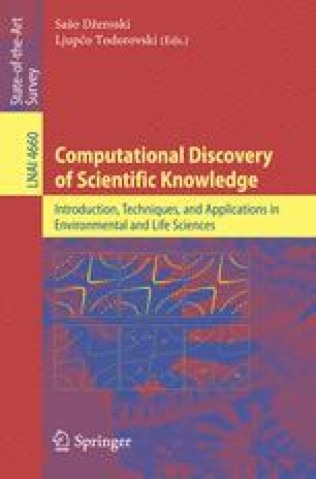
Computational Discovery of Scientific Knowledge : Introduction, Techniques, and Applications in Environmental and Life Sciences
Advances in technology have enabled the collection of data from scientific observations, simulations, and experiments at an ever-increasing pace. For the scientist and engineer to benefit from these enhanced data collecting capabilities, it is becoming clear that semi-automated data analysis techniques must be applied to find the useful information in the data. Computational scientific discovery methods can be used to this end: they focus on applying computational methods to automate scientific activities, such as finding laws from observational data. In contrast to mining scientific data, which focuses on building highly predictive models, computational scientific discovery puts a strong emphasis on discovering knowledge represented in formalisms used by scientists and engineers, such as numeric equations and reaction pathways. This state-of-the-art survey provides an introduction to computational approaches to the discovery of scientific knowledge and gives an overview of recent advances in this area, including techniques and applications in environmental and life sciences.

Computational Contact Mechanics
Topics of this book span the range from spatial and temporal discretization techniques for contact and impact problems with small and finite deformations over investigations on the reliability of micromechanical contact models over emerging techniques for rolling contact mechanics to homogenization methods and multi-scale approaches in contact problems. Furthermore, solution algorithms for single- and multi-processor computing environments, enabling methods that span from multi-contact to multi-scale approaches are discussed together with numerical experiments related to soil mechanics using discontinuous deformation analysis.
