



الصفحة 31
الصفحة 31
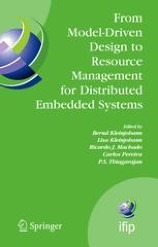
From model-driven design to resource management for distributed embedded systems ; IFIP TC 10 Working conference on distributed and parallel embedded systems (DIPES 2006) October 11-13, 2006, Braga, Portugal
From Model-Driven Design to Resource Management for Distributed Embedded Systems contains 16 original contributions as well as 12 invited papers by distinguished invited speakers. These papers were presented at the Working Conference on Distributed and Parallel Embedded Systems (DIPES 2006), which was held in October 2006 in Braga, Portugal, and sponsored by the International Federation for Information Processing (IFIP). This volume covers the following very timely topics: model-driven design, test and evolution of embedded systems, timing analysis and predictability, scheduling, allocation, communication and resource management in distributed real-time systems.

From microphysics to macrophysics : Methods and applications of statistical physics; Vol.1
Volume 1 discusses in detail the probabilistic description of quantum or classical systems, the Boltzmann-Gibbs distributions, the conservation laws, and the interpretation of entropy as missing information. Thermodynamics and electromagnetism in matter are dealt with, as well as applications to gases, both dilute and condensed, and to phase transitions.

From microphysics to macrophysics : Methods and applications of statistical physics ; Vol.2
Volume 2 applies statistical methods to systems governed by quantum effects, in particular to solid state physics, explaining properties due to the crystal structure or to the lattice excitations or to the electrons. Liquid helium is discussed and radiative equilibrium and transport are studied. The last chapters are devoted to non-equilibrium processes and to kinetic equations, with many applications included.

From integrated publication and information systems to information and knowledge environments : Essays dedicated to Erich J. Neuhold on the Occasion of His 65th Birthday
This book constitutes a commemorative volume devoted to Erich J. Neuhold on the occasion of his 65th birthday. The 32 invited reviewed papers presented are written by students and colleagues of Erich Neuhold throughout all periods of his scientific career. The papers are organized in the following topical sections: Database management enabling information systems Semantic Web drivers for advanced information management Securing dynamic media content integration From digital libraries to intelligent knowledge environments Visualization – key to external cognition in virtual information environments From human-computer interaction to human-artefact interaction Domains for virtual information and knowledge environments.

From herbs to healing : Pharmacognosy - phytochemistry - phytotherapy - biotechnology
Demonstrates the place of phytotherapy in healing, the role of herbs in complementary and traditional therapy, and research strategies for the development of drugs of natural plant origin. This book is primarily designed for scientific researchers, but is also very useful for undergraduate and postgraduate students in their professional training. As this book discusses herbs from all over the world, it is specifically drafted to be useful not only in Hungary and Europe, but also for people in other continents as an English language encyclopaedia of medicinal plants and their biologically active compounds.

From Data to Models and Back ; 9th International Symposium, DataMod 2020, Virtual Event, October 20, 2020, Revised Selected Papers
This book constitutes the refereed proceedings of the 9th International Symposium on From Data Models and Back, DataMod 2020, held virtually, in October 2020. The 11 full papers and 3 short papers presented in this book were selected from 19 submissions. The papers are grouped in these topical sections: machine learning; simulation-based approaches, and data mining and processing related approaches.

From Bulk to Nano : The Many Sides of Magnetism
The field of magnetism is rapidly advancing in this new millennium, revealing an ever-wider diversity of magnetic phenomena on more than one scale. With the emergence of countless applications particularly on a nanoscale, and their unpredictable implications mostly on a macroscale, it may seem that different aspects of magnetism are unrelated. Quite often, the overwhelming amount of topics discussed in the professional literature views only parts of a field, ignoring a broader context. Therefore, the present book aims at addressing the relationship between apparently unconnected topics in magnetism. Less obvious relationships are revealed among individual fields on various scales, making them better understandable.

Freshwater Animal Diversity Assessment
The Freshwater Animal Diversity Assessment gives a state of the art assessment of the diversity and distribution of Metazoa in the continental waters of the world. The project deals with all major animal groups plus the macrophytes, and encompasses the complete array of terrestrial aquatic ecosystems. It is the most comprehensive study of species- and genus-level diversity and chorology of the global freshwater fauna to date, and is the first to present comparable data on the different faunal groups concerned. The project draws from the collected expertise of numerous world-renowned taxonomic experts that have bundled efforts to produce this outstanding volume. The result is invaluable to all scientists, managers and conservationists interested in non-marine aquatic animals.

Frailty and Kidney Disease : A Practical Guide to Clinical Management
This book is of importance in nephrology, specifically nephrogeriatrics, since frailty is a condition affecting many elderly patients and which is becoming increasingly common in medical practice. As such, there is a considerable need for information to assist professionals treating these patients. The book includes chapters on the frailty syndrome (definition, evaluation and treatment), the main geriatric syndromes (gait disorder, falls, incontinence, and delirium), the main renal syndromes (acute renal injury, chronic kidney disease) as well as dialysis and kidney transplant, and the relationship between geriatrics and renal syndromes.

Fragmented Intimacy : Addiction in a Social World
Fragmented Intimacy transcends familiar concepts of addiction by focusing not on addicts in isolation but on the social contexts that are disrupted and on the struggle that affects all those involved as they attempt to regroup and initiate change. Applicable to drugs, alcohol, and gambling, this engagingly written book offers both innovative theory and practice-strengthening interventions.

Fractional calculus—theory and applications
Fractional calculus has led to tremendous progress in various areas of science and mathematics. New definitions of fractional derivatives and integrals have been uncovered, extending their classical definitions in various ways. Moreover, rigorous analysis of the functional properties of these new definitions has been an active area of research in mathematical analysis. Systems considering differential equations with fractional-order operators have been investigated thoroughly from analytical and numerical points of view, and potential applications have been proposed for use in sciences and in technology. The purpose of this Special Issue is to serve as a specialized forum for the dissemination of recent progress in the theory of fractional calculus and its potential applications.

Fractal Geometry, Complex Dimensions and Zeta Functions : Geometry and Spectra of Fractal Strings
Number theory, spectral geometry, and fractal geometry are interlinked in this in-depth study of the vibrations of fractal strings, that is, one-dimensional drums with fractal boundary. Key Features The Riemann hypothesis is given a natural geometric reformulation in the context of vibrating fractal strings Complex dimensions of a fractal string, defined as the poles of an associated zeta function, are studied in detail, then used to understand the oscillations intrinsic to the corresponding fractal geometries and frequency spectra Explicit formulas are extended to apply to the geometric, spectral, and dynamical zeta functions associated with a fractal Examples of such explicit formulas include a Prime Orbit Theorem with error term for self-similar flows, and a geometric tube formula The method of Diophantine approximation is used to study self-similar strings and flows Analytical and geometric methods are used to obtain new results about the vertical distribution of zeros of number-theoretic and other zeta functions Throughout new results are examined. The final chapter gives a new definition of fractality as the presence of nonreal complex dimensions with positive real parts, and discusses several open problems and extensions.

Foundations of learning classifier systems
This volume brings together recent theoretical work in Learning Classifier Systems (LCS), which is a Machine Learning technique combining Genetic Algorithms and Reinforcement Learning. It includes self-contained background chapters on related fields (reinforcement learning and evolutionary computation) tailored for a classifier systems audience and written by acknowledged authorities in their area - as well as a relevant historical original work by John Holland.

Foundations of Intelligent Systems ; Vol. 4203 ; 16th International Symposium, ISMIS 2006, Bari, Italy, September 27-29, 2006, Proceedings
This book constitutes the refereed proceedings of the 16th International Symposium on Methodologies for Intelligent Systems, ISMIS 2006. The book presents 81 revised papers together with 3 invited papers. Topical sections include active media human-computer interaction, computational intelligence, intelligent agent technology, intelligent information retrieval, intelligent information systems, knowledge representation and integration, knowledge discovery and data mining, logic for AI and logic programming, machine learning, text mining, and Web intelligence.

Foundations of Data Mining and Knowledge Discovery
This volume presents the results of investigations into the foundations of the discipline, and represents the state-of-the-art for much of the current research. This book will prove extremely valuable and fruitful for data mining researchers, no matter whether they would like to uncover the fundamental principles behind data mining, or apply the theories to practical applications.

Foundation Web Design with Dreamweaver 8
Dreamweaver is Macromedia's bestselling web design/development environment. Dreamweaver has the capability to generate dynamic website code using server-side languages like ASP, PHP, and ASP.NET. We know that you don't always require a full database-driven site though, so this book focuses on using version 8 of Dreamweaver to design and create usable, standards-compliant websites using XHTML and CSS. One of the highlights of this version is much closer, tighter CSS/XHTML. This book will show you how to make the most of that feature. After a brief introduction to the latest version of Dreamweaver, and how CSS and XHTML fit into it, Craig Grannell looks at using the software for your web design projects in a hands-on, task based manner.

Foundation models for natural language processing : pre-trained language models integrating media
Covers basic natural language processing models, pre-trained language models BERT, GPT, and sequence-to-sequence converters, as well as the concepts of self-attention and context-sensitive embedding. Various approaches to improving these models are then discussed, such as expanding the pre-training parameters, increasing the length of input texts, or incorporating additional knowledge. An overview of the best performing models is then provided for about twenty application areas, e.g., question answering, translation, story generation, dialogue systems, image generation from text, etc. For each application area, the strengths and weaknesses of existing models are discussed, and an overview of further developments is provided. In addition, links to freely available code are provided. The concluding chapter summarizes the economic opportunities, risk mitigation, and potential developments of AI.

Formulating poorly water soluble drugs
A pharmaceutical scientist’s approach toward solubility enhancement of a poorly water-soluble molecule typically includes detailed characterization of the compound’s physiochemical properties, solid-state modifications, advanced formulation design, non-conventional process technologies, advanced analytical characterization, and specialized product performance analysis techniques. The scientist must also be aware of the unique regulatory considerations pertaining to the non-conventional approaches often utilized for poorly water-soluble drugs. One faced with the challenge of developing a drug product from a poorly soluble compound must possess at a minimum a working knowledge of each of the above mentioned facets and detailed knowledge of most. In light of the magnitude of the growing solubility problem to drug development, this is a significant burden especially when considering that knowledge in most of these areas is relatively new and continues to develop.

Formulas, ingredients and production of cosmetics technology of skin- and hair-care products in Japan
Provides the comprehensive knowledge and instruction necessary for researchers to design and create cosmetics products. The book’s chapters cover a comprehensive list of topics, which include, among others, the basics of cosmetics, such as the raw materials of cosmetics and their application; practical techniques and technologies for designing and manufacturing cosmetics, as well as theoretical knowledge; emulsification; sensory evaluations of cosmetic ingredients; and how to create products such as soap-based cleansers, shampoos, conditioners, creams, and others. The potential for innovation is great in Japan’s cosmetics industry. This book expresses the hope that the high level of dedicated research continues and proliferates, especially among those who are innovators at heart.

Formalizing the Shadow Economy in Serbia : Policy Measures and Growth Effects
The main objective of this book is to develop a strategy and policy measures to enhance the formalization of the shadow economy in order to improve the competitiveness of the economy and contribute to economic growth; it explores these issues with special reference to Serbia. The size and development of the shadow economy in Serbia and other Central and Eastern European countries are estimated using two different methods (the MIMIC method and household-tax-compliance method). Micro-estimates are based on a special survey of business entities in Serbia, which for the first time allows us to explore the shadow economy from the perspective of enterprises and entrepreneurs.
