



الصفحة 3
الصفحة 3

Mathematics of Program Construction ; 8th International Conference, MPC 2006, Kuressaare, Estonia, July 3-5, 2006, Proceedings
This volume contains the proceedings of the 8th International Conference on Mathematics of ProgramConstruction, MPC 2006,held at Kuressaare, Estonia, July 3-5, 2006, colocated with the 11th International Conference on Algebraic Methodology and Software Technology, AMAST 2006, July 5-8, 2006. TheMPCconferencesaimtopromotethedevelopmentofmathematicalpr- ciples and techniques that are demonstrably useful and usable in the process of constructing computer programs. Topics of interest range from algorithmics to support for program construction in programming languages and systems.

Mathematical Problems from Applied Logic I : Logics for the XXIst Century
Mathematical Problems from Applied Logic I presents chapters from selected, world renowned, logicians. Important topics of logic are discussed from the point of view of their further development in light of requirements arising from their successful application in areas such as Computer Science and AI language. An overview of the current state as well as open problems and perspectives are clarified in such fields as non-standard inferences in description logics, logic of provability, logical dynamics and computability theory. The book contains interesting contributions concerning the role of logic today, including some unexpected aspects of contemporary logic and the application of logic. This should be of interest to logicians and mathematicians in general.

Intuitive Human Interfaces for Organizing and Accessing Intellectual Assets ; International Workshop, Dagstuhl Castle, Germany, March 1-5, 2004, Revised Selected Papers
This book constitutes the thoroughly refereed post-proceedings of the 2004 International Workshop on Intuitive Human Interfaces for Organizing and Accessing Intellectual Assets, held in Dagstuhl Castle, Germany in March 2004. The 17 revised full papers presented together with an introductory overview have gone through two rounds of reviewing and revision. The papers are organized in topical sections on man-machine interface for intuitive knowledge access, intelligent pad and meme media, visualization and design of information access spaces, and semantics and narrative organization and access of knowledge.

Introduction to Biosemiotics : The New Biological Synthesis
This book is addressed to students, researchers and academics who have barely heard of the emerging young science of Biosemiotics, and who want to know more about it. Written by many of the field’s major contributors, it provides a highly qualified introduction to Biosemiotics and illustrates the most recent views in its background and development.

Interorganisational Standards : Managing Web Services Specifications for Flexible Supply Chains
Standards play crucial roles in many different aspects of today’s economy. They can define meanings of semantics, product interfaces, process steps, or performance levels. Interorganisational standards are specifications that define business-related semantics and processes, which are made accessible to other organisations’ information systems. While modular organisation forms such as supply chain networks demand such standards for higher flexibility, XML-based Web Services offer a relatively new technological platform to develop such standards.

Interactive Video : Algorithms and Technologies
This is a groundbreaking resource that covers both algorithms and technologies of interactive videos, so that businesses in IT and data managements, scientists, teachers, and software engineers in video processing and computer vision, coaches and instructors that use video technology in teaching, and finally end-users of hyper videos will greatly benefit from it. This comprehensive four part book contains excellent scientific and up-to-date contributions made by a number of pioneering scientists, futurists and experts in the field.

Intelligent information processing III ; IFIP TC12 International Conference on Intelligent Information Processing (IIP 2006), September 20-23, Adelaide, Australia
The IFIP series publishes state-of-the-art results in the sciences and technologies of information and communication. The principal aim of the IFIP series is to encourage education and the dissemination and exchange of information about all aspects of computing.
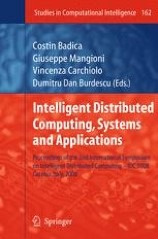
Intelligent Distributed Computing, Systems and Applications ; Proceedings of the 2nd International Symposium on Intelligent Distributed Computing – IDC 2008, Catania, Italy, 2008
Addresses many topics related to intelligent and distributed computing, systems and applications, including: adaptivity and learning; agents and multi-agent systems; argumentation; auctions; case-based reasoning; collaborative systems; data structures; distributed algorithms; formal modeling and verification; genetic and immune algorithms; grid computing; information extraction, annotation and integration; network and security protocols; mobile and ubiquitous computing; ontologies and metadata; P2P computing; planning; recommender systems; rules; semantic Web; services and processes; trust and social computing; virtual organizations; wireless networks; XML technologies.

Intelligent data engineering and automated Learning - IDEAL 2005 ; 6th International Conference, Brisbane, Australia, July 6-8, 2005, Proceedings
Constitutes the refereed proceedings of the 6th International Conference on Intelligent Data Engineering and Automated Learning, IDEAL 2005, held in Brisbane, Australia, in July 2005. These papers are organized in topical sections on data mining and knowledge engineering, learning algorithms and systems, bioinformatics, and more.

Intelligent Computer Mathematics ; 13th International Conference, CICM 2020, Bertinoro, Italy, July 26–31, 2020, Proceedings
This book constitutes the refereed proceedings of the 13th International Conference on Intelligent Computer Mathematics, CICM 2020, held in Bertinoro, Italy, in July 2020*. The 15 full papers, 1 invited paper and 2 abstracts of invited papers presented were carefully reviewed and selected from a total of 35 submissions. The papers focus on advances in automated theorem provers and formalization, computer algebra systems and their libraries, and applications of machine learning, among other topics.

Integrated formal methods ; 6th International Conference, IFM 2007, Oxford, UK, July 2-5, 2007, Proceedings
It addresses all aspects of formal methods integration, including of a process of analysis or design application of formal methods to analysis or design, extension of one method based upon the inclusion of ideas or concepts from others, and semantic integration or practical application.

Integrated formal methods ; 5th International conference, IFM 2005, Eindhoven, The Netherlands, November 29 - December 2, 2005. Proceedings
This book constitutes the refereed proceedings of the 5th International Conference on Integrated Formal Methods, IFM 2005, held in Eindhoven, The Netherlands, in November/December 2005. The 19 revised full papers presented together with 3 invited papers were carefully reviewed and selected from 40 submissions. The papers are organized in topical sections on components, state/event-based verification, system development, applications of B, tool support, non-software domains, semantics, as well as UML and statecharts.

Integrated formal methods ; 3rd International Conference, IFM 2002, Turku, Finland, May 15-18, 2002. Proceedings.
IFM 2002 explored the relations between formal methods and graphical notations, especially the industrial standard language for software design, the Unified Modeling Language (UML). The themes of IFM 2002 reflect what we believe is a growing trend in the Formal Methods and Software Engineering research communities. Over the last threedecades,computer scientists have developed a range of formalisms focusing on particular aspects of behavior or analysis, such as sequential program structures, concurrent program structures, data and information structures, temporal reasoning, deductive proof, and model checking. Much effort is now being devoted to integrating these methods in order to combine their advantages and ensure they scale up to industrial needs. Graphical notations are now widely used in software engineering and there is growing recognition of the importance of providing these with the for mal underpinnings and form alanalysis capabilities found in formal methods.

Information, Interaction, and Agency
Agents perform actions based on the available information and in the presence of other interacting agents. From this perspective Information, Interaction, and Agency neatly ties together classical themes like rationality, decision-making and belief revision with games, strategies and learning in a multi-agent setting.Unified by the central notions Information, Interaction, and Agency, the essays in this volume provide refreshing methodological perspectives on belief revision, dynamic epistemic logic, von Neumann games, and evolutionary game theory; all of which in turn are central approaches to understanding our own rationality and that of other agents.

Information Sharing on the Semantic Web
The more information is available, the harder it is to locate any particular piece of it. And even when it has been successfully found, it is even harder still to usefully combine it with other information we may already possess. It is commonly understood that this problem of information sharing can only be solved by giving computers better access to the semantics of the information. While it has been recognized that ontologies play a crucial role in solving the open problems, most approaches rely on the existence of well-established data structures. To overcome these shortcomings, Stuckenschmidt and van Harmelen describe ontology-based approaches for resolving semantic heterogeneity in weakly structured environments, in particular the World Wide Web. Addressing problems like missing conceptual models, unclear system boundaries, and heterogeneous representations, they design a framework for ontology-based information sharing in weakly structured environments like the Semantic Web. For researchers and students in areas related to the Semantic Web, the authors provide not only a comprehensive overview of the State of the art, but also present in detail recent research in areas like ontology design for information integration, metadata generation and management, and representation and management of distributed ontologies. For professionals in areas such as e-commerce and knowledge management, the book provides decision support on the use of novel technologies, information about potential problems, and guidelines for the successful application of existing technologies.

Information Management and Big Data ; 7th Annual International Conference, SIMBig 2020, Lima, Peru, October 1–3, 2020, Proceedings
This book constitutes the refereed proceedings of the 7th International Conference on Information Management and Big Data, SIMBig 2020, held in Lima, Peru, in October 2020.* The 32 revised full papers and 7 revised short papers presented were carefully reviewed and selected from 122 submissions. The papers address topics such as natural language processing and text mining; machine learning; image processing; social networks; data-driven software engineering; graph mining; and Semantic Web, repositories, and visualization.

Implementation and Application of Functional Languages ; Vol. 4015 ; 17th International Workshop, IFL 2005, Dublin, Ireland, September 19-21, 2005, Revised Selected Papers
The 17th International Workshop on Implementation and Application of Functional Languages (IFL 2005) was held in Dublin, Ireland, September 19–21, 2005. It was organized by the Department of Computer Science at Trinity College, University of Dublin. IFL 2005 was the 17th event in the annual series of IFL workshops. The aim of the workshop series is to bring together researchers actively engaged in the implementation and application of functional and function-based programming languages. It provides an open forum for researchers who wish to present and discuss new ideas and concepts, work in progress, preliminary results, etc., related primarily, but not exclusively, to the implementation and application of functional languages. Topics of interest cover a wide range from theoretical aspects over language design and implementation towards applications and tool support.

Implementation and Application of Functional Languages ; 19th International Workshop, IFL 2007, Freiburg, Germany, September 27-29, 2007. Revised Selected Papers
This book constitutes the thoroughly refereed post-proceedings of the 19th International Workshop on Implementation and Applications of Functional Languages, IFL 2007, held in Freiburg, Germany in September 2007.The 15 revised full papers presented went through two rounds of reviewing and improvement and were selected from 33 submissions. The papers address all current theoretical and methodological issues on functional and function-based languages such as type checking, contract checking, compilation, parallelism, development and debugging, data structures, parsing as well as various performance related concepts.

Implementation and application of functional languages ; 18th International Symposium, IFL 2006, Budapest, Hungary, September 4-6, 2006, Revised Selected Papers
This volume constitutes the post-proceedings of the 18th International Workshop on Implementation and Applications of Functional Languages. Each one was submitted to two rounds of reviews to ensure accuracy, thoroughness, and readability. The papers address all current theoretical and methodological issues in functional and function-based languages.

Imagination and Rigor : Essays on Eduardo R. Caianiello's Scientific Heritage
The aim of this Volume of scientific essays is twofold. From one side, by remembering the scientific figure of Eduardo R. Caianiello, it aims at focusing his outstanding contributions - from theoretical physics to cybernetics - which after so many years still represent occasion of innovative paths to be fruitfully followed. It must be stressed the contribution that his interdisciplinary methodology can still be of great help in affording and solving present day complex problems. On the other side, it aims at pinpointing with the help of the scientists contributing to the Volume - some crucial problems in present day research in the fields of interest of Eduardo Caianiello and which are still among the main lines of investigation of some of the Istitutes founded by Eduardo (Istituto di Cibernetica del CNR, IIAS, etc).
