



الصفحة 3
الصفحة 3

Emerging Economic Models for Sustainable Businesses : A Practical Approach
Analyses economic models that look at value propositions, creation and capture with ‘People, Planet and Profit’ deeply embedded in each stage of the value chain. The contributions bring out the interplay between new standards, evaluation frameworks, technology innovation and other emerging tools to show how they create a sustainable business. For this, they lean on learnings from successful sustainable businesses. Business leaders will find that this book provides deep insights on improving their existing sustainable practices, and speeding up the transition from linear to circular, narrow stakeholder driven to community driven.

Drug development for rare diseases
A disease is defined as rare if the prevalence is fewer than 200,000 in the United States. It is estimated that there are more than 7,000 rare diseases, which collectively affect 30 million Americans or 10% of the US population. This diverse and complex disease area poses challenges for patients, caregivers, regulators, drug developers, and other stakeholders. This book is proposed to give an overview of the common issues facing rare disease drug developers, summarize challenges specific to clinical development in small populations, discuss drug development strategies in the evolving regulatory environment, explain generation and utilization of different data and evidence

Digital Dilemmas : Exploring Social Media Ethics in Organizations
This book categorizes the dilemmas organizations across a range of industries can face when they implement social media to communicate with stakeholders. This book provides a systematic framework for analyzing these ethical dilemmas in social media using the Navigation Wheel. This tool leads the decision-maker through a series of considerations such as legal questions, corporate identity, morality, reputation, and ethics. Finally, the author considers implications for leaders and presents potential solutions to these dilemmas.

Designing big data platforms : How to use, deploy, and maintain big data systems
Provides expert guidance and valuable insights on getting the most out of Big Data systems. Helps readers understand how to process large amounts of data with well-known Linux tools and database solutions, use effective techniques to collect and manage data from multiple sources, transform data into meaningful business insights, and much more. Author Yusuf Aytas, a software engineer with a vast amount of big data experience, discusses the design of the ideal Big Data platform: one that meets the needs of data analysts, data engineers, data scientists, software engineers, and a spectrum of other stakeholders across an organization. Detailed yet accessible chapters cover key topics such as stream data processing, data analytics, data science, data discovery, and data security. This real-world manual for Big Data technologies: Provides up-to-date coverage of the tools currently used in Big Data processing and management / Offers step-by-step guidance on building a data pipeline, from basic scripting to distributed systems / Highlights and explains how data is processed at scale / Includes an introduction to the foundation of a modern data platform

Design to Value : The architecture of holistic design and creative technology
Design to Value is a commitment to process above all else. Well understood and applied in the manufacturing industries, its potential is only now starting to be realised in architecture, engineering and construction. It challenges designers to lead the way in creating more innovative and stakeholder-centric analyses, workflows, construction techniques and products. Through architectural thinking, value in the built environment can be maximised. Seeking to create deep and lasting impacts on industry, society and the planet, Design to Value rejects architecture’s current professional services model. The design and delivery stages of traditional procurement routes are not sustainable, and Design to Value outlines a new path for informed design processes.

Delivery of drugs ; Vol.2 : Expectations and realities of multifunctional drug delivery systems
Examines the formulation of micro-nanosized drug delivery systems and recaps opportunities for using physical methods to improve efficacy via mechano-, electroporation. The book highlights innovative delivery methods like PIPAC, including discussions on the regulatory aspects of complex injectables. Written by a diverse range of international researchers from industry and academia, the chapters examine specific aspects of characterization and manufacturing for pharmaceutical applications as well as regulatory and policy aspects.This book connects formulation scientists, regulatory experts, engineers, clinical experts and regulatory stakeholders.

Customising Stakeholder Management Strategies: Concepts for Long-term Business Success
The third in the series on Stakeholder Management, this volume presents a wide array of case studies to demonstrate how Stakeholder Management strategies are customized specifically to companies' requirements to fulfill their long term business goals.

Creative applications of artificial intelligence in education
Explores the synergy between AI and education, highlighting its potential impact on pedagogical practices. It navigates the evolving landscape of AI-powered educational technologies and suggests practical ways to personalise instruction, nurture human-AI co-creativity, and transform the learning experience. Spanning from primary to higher education, this short and engaging volume proposes concrete examples of how educational stakeholders can be empowered in their AI literacy to foster creativity, inspire critical thinking, and promote problem-solving by embracing AI as a tool for expansive learning. Structured in three parts, the book starts developing the creative engagement perspective for learning and teaching to then present practical applications of AI in K-12 and higher education, covering different fields (teacher education, professional education, business education) as well as different types of AI supported tools (games, chatbots, and AI assisted assessment).

Cost-effective energy efficient building retrofitting : Materials, technologies, optimization and case studies
The building sector is responsible for high energy consumption and its global demand is expected to grow as each day there are approximately 200,000 new inhabitants on planet Earth. The majority of electric energy will continue to be generated from the combustion of fossil fuels releasing not only carbon dioxide, but also methane and nitrous oxide. Energy efficiency measures are therefore crucial to reduce greenhouse gas emissions of the building sector. Energy efficient building retrofitting needs to not only be technically feasible, but also economically viable. New building materials and advanced technologies already exist, but the knowledge to integrate all active components is still scarce and far from being widespread among building industry stakeholders.

Corporate Sustainability Management in the Energy Sector : An Empirical Contigency Approach
Corporate social responsibility, sustainability, and citizenship are terms that often evoke considerable scepticism and cynicism, particularly in civil society. Much needed sector-specific and comparative research, which could facilitate a more fact-oriented debate, is still missing from the literature. The present study aims to fill this gap by presenting data collected from two groups of managers, namely sustainability experts and non-sustainability experts, from two different industry sectors (integrated oil and gas vs. electric utilities) and several geographical regions. Oliver Salzmann provides a comprehensive view on corporate sustainability management in companies such as Shell and RWE and investigates the key social and environmental issues driving the energy sector. The author analyses the influence which stakeholder pressure exercises on energy companies and their efforts to become more responsive. Moreover, he develops a model for strategic, thus profit-oriented, corporate sustainability management.

Corporate Sustainability as a Challenge for Comprehensive Management
Sustainability has become a topic of global relevance: Corporations and other economically acting organizations increasingly need to realize economic, environmental and social objectives in order to survive. Supplementary to "classical" environmental management, realizing corporate sustainability requires comprehensive approaches which allow the integration of social and economic aspects. Such concepts can be found e.g. in international excellence models mainly based on a TQM thinking but also in the field of human factors in organizational design and management. Understood as systems approaches, they include the interests of all relevant stakeholders with a mid- or long-term time perspective and are thus highly linked with the principles of sustainable development. In this book internationally leading scientists discuss the issue of sustainability from their perspective, resulting in an innovative view on different management approaches under the umbrella of corporate sustainability.

Corporate Social Responsibility as an International Strategy
CSR, a concept aimed at determining the amount of responsibilities to be shouldered by private business toward stakeholder groups and society at large, deserves to be dealt with in considerable detail and not simply as another "PR fuzz" or marketing gag. As a model, CSR epitomises the old saying "business is business"; offering broader stakeholder management which can be seen as a competitive advantage. Increased financial performance and employee commitment are among the benefits the CSR model can offer corporations. This discussion presents practitioners and scholars with a unique examination of how firms can maximise productivity through the implementation of CSR programs.

Corporate fraud across the globe
It is expected that uncovered corporate fraud negatively affects the public reputation, and financial performance of fraudulent firms. However, what is of more importance for fraudulent firms is how to regain the trust of customers, investors, and other stakeholders, as this impacts the long-term sustainability of businesses. Operational strategies, including reform, provide an effective channel for a fraudulent firm’s business sustainability yet this notion remains unexplored in the literature.

Corporate Brand Design : Developing and Managing Brand Identity
Corporate Brand Design offers a unique and comprehensive exploration of the relationship between companies, their brand design and their stakeholders. The book begins its approach with a literature review, to provide an overview of current thinking on the subject and establish a theoretical framework. The following sections cover key stages during the corporate brand development process: brand signature design, its components and impact on brand reputation; website design and how it builds customer perception of the brand; corporate architecture design and the branding of space and place; brand experience design from a sensuality perspective. International case studies from a range of industries feature in each chapter to demonstrate how the theory translates to practice, alongside case questions to cement learning and definitions of the key constructs. By combining academic theory with practical case studies and examples, readers will gain a thorough understanding of the corporate brand design process and how it influences customer identification and loyalty to the brand. The book is a useful resource for advanced undergraduate and postgraduate students of strategic brand management, corporate brand design and visual identity, and marketing communications

Construction Project Organising
Investigates the relationship between structure and action, and how patterns of action are created, recreated and maintained by scrutinising the myriad of organisational arrangements between clients, financiers, design teams, contractors, stakeholders and supply chains. It also discusses different concepts in the development and management of construction project organisations, including formation and maintenance issues.
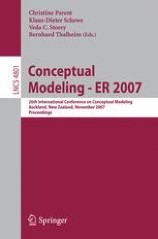
Conceptual Modeling - ER 2007 ; 26th International Conference on Conceptual Modeling, Auckland, New Zealand, November 5-9, 2007, Proceedings
Conceptual modeling is fundamental to the development of complex systems, because it provides the key communication means between systems developers, end-users and customers.Conceptua lmodeling provides languages,methods and tools to understand and represent the application domain;to elicitate,concepalize and formalize system requirements and user needs;to communicate systems designs to all stakeholders; to formally verify and validate system designs on high levels of abstractions; and to minimize ambiguities in system development. Initially, conceptual modeling mainly addressed data-intensive information s- tems and contributed to data modeling and database application engineering. The area of conceptual modeling has now matured to encompass all kinds of application areas such as e-applications (including e-business and e-learning), web-based systems (including the semantic web and ubiquitous systems), life science and geographic applications.

Co-creation for responsible research and innovation : Experimenting with design methods and tools
This book summarizes research being pursued within the SISCODE (Society in Innovation and Science through CO-DEsign) project, funded by the EU under the H2020 programme, the goal of which is to set up an analytical, reflective and learning framework to explore the transformations in initiatives and policies emerging from the interaction between citizens and stakeholders. The book provides a critical analysis of the co-design processes activated in 10 co-creation labs addressing societal challenges across Europe. Each lab as a case study of real-life experimentation is described through its journey, starting from the purpose on the ground of the experimentation and the challenge addressed.

Masterpieces of Swiss Entrepreneurship : Swiss SMEs Competing in Global Markets
This book focuses on Switzerland-based medium-sized companies with a longstanding export tradition and a proven dominance in global niche markets. Based upon in-depth documentation and analysis of 36 Swiss companies over their entire history, an expert team of authors presents several parallels in the pathways and success factors which allowed these firms to become dominant and operate from a high-cost location such as Switzerland.

Maritime Work Law Fundamentals : Responsible Shipowners, Reliable Seafarers
As the title suggests, a fundamental challenge of this branch of international maritime law is to achieve a balance between the interests of the two main stakeholders. Institutionally, the effort to achieve this balance dates back a number of decades with its genesis mainly found in the work of the International Labour Organization. It has to be said that whilst this effort achieved great progress, it has led to a haphazard, plethora of legal instruments.

Managing the Complexity of Critical Infrastructures : A Modelling and Simulation Approach
This book summarizes work being pursued in the context of the CIPRNet (Critical Infrastructure Preparedness and Resilience Research Network) research project, co-funded by the European Union under the Seventh Framework Programme (FP7). The project is intended to provide concrete and on-going support to the Critical Infrastructure Protection (CIP) research communities, enhancing their preparedness for CI-related emergencies, while also providing expertise and technologies for other stakeholders to promote their understanding and mitigation of the consequences of CI disruptions, leading to enhanced resilience.
