



الصفحة 3
الصفحة 3

Computational Science - ICCS 2008 ; 8th International Conference, Kraków, Poland, June 23-25, 2008, Proceedings, Part II
The three-volume set LNCS 5101-5103 constitutes the refereed proceedings of the 8th International Conference on Computational Science, ICCS 2008, held in Krakow, Poland in June 2008.
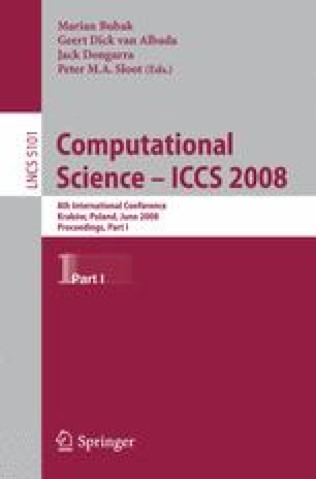
Computational Science - ICCS 2008 ; 8th International Conference, Kraków, Poland, June 23-25, 2008, Proceedings, Part I
The three-volume set LNCS 5101-5103 constitutes the refereed proceedings of the 8th International Conference on Computational Science, ICCS 2008, held in Krakow, Poland in June 2008.

Computational methods in systems biology ; 6th International Conference CMSB 2008, Rostock, Germany, October 12-15, 2008. Proceedings
This book constitutes the refereed proceedings of the 6th International Conference on Computational Methods in Systems Biology, CMSB 2008, held in Rostock, Germany, in September 2008.

Collaborative and Distributed Chemical Engineering : From Understanding to Substantial Design Process Support; Results of the IMPROVE Project
The focus of IMRPOVE is on understanding, formalizing, evaluating, and, consequently, improving design processes in chemical engineering. In particular, IMPROVE focuses on conceptual design and basic engineering, where the fundamental decisions concerning the design or redesign of a chemical plant are undertaken.
Cognition, Communication and Interaction : Transdisciplinary Perspectives on Interactive Technology
This book aims to provide a trans-disciplinary research framework and methodology for interaction design. The analysis directs attention to three human capacities that our engagement with interactive technology has made salient and open to constant redefinition.

Managing the Complexity of Critical Infrastructures : A Modelling and Simulation Approach
This book summarizes work being pursued in the context of the CIPRNet (Critical Infrastructure Preparedness and Resilience Research Network) research project, co-funded by the European Union under the Seventh Framework Programme (FP7). The project is intended to provide concrete and on-going support to the Critical Infrastructure Protection (CIP) research communities, enhancing their preparedness for CI-related emergencies, while also providing expertise and technologies for other stakeholders to promote their understanding and mitigation of the consequences of CI disruptions, leading to enhanced resilience.

Large-Scale Scientific Computing ; 6th International Conference, LSSC 2007, Sozopol, Bulgaria, June 5-9, 2007. Revised Papers
The 6th International Conference on Large-Scale Scienti?c Computations (LSSC 2007) was held in Sozopol, Bulgaria, June 5–9, 2007. The conference was organized by the Institute for Parallel Processing at the Bulgarian Academy of Sciences in cooperation with SIAM (Society for Industrial and Applied Ma- ematics). Partial support was also provided from project BIS-21++ funded by the European Commission in FP6 INCO via grant 016639/2005. The conference was devoted to the 60th anniversary of Richard E. Professor Ewing is internati- ally well known with his contributions in applied mathematics, mathematical modeling, and large-scale scientific computations.

Languages, Methodologies and Development Tools for Multi-Agent Systems ; 1st International Workshop, LADS 2007, Durham, UK, September 4-6, 2007. Revised Selected Papers
Constitutes the thoroughly refereed post-workshop proceedings of the First International Workshop on Languages, Methodologies and Development Tools for Multi-Agent Systems, LADS 2007, held in Durham, UK, in September 2007. The workshop was part of MALLOW 2007, a federation of workshops on Multi-Agent Logics, Languages, and Organizations.

Cellular Automaton Modeling of Biological Pattern Formation: Characterization, Applications, and Analysis
This book focuses on a challenging application field of cellular automata: pattern formation in biological systems, such as the growth of microorganisms, dynamics of cellular tissue and tumors, and formation of pigment cell patterns. These phenomena, resulting from complex cellular interactions, cannot be deduced solely from experimental analysis, but can be more easily examined using mathematical models, in particular, cellular automaton models.

Cellular automata ; 8th International conference on cellular automata for research and industry, ACRI 2008, Yokohama, Japan, September 23-26, 2008. Proceedings
This book constitutes the refereed proceedings of the 8th International Conference on Cellular Automata for Research and Industry, ACRI 2008, held in Yokohama, Japan, in September 2008.

Browning Agents and Active Particles : Collective Dynamics in the Natural and Social Sciences
Lays out a vision for a coherent framework for understanding complex systems'' (from the foreword by J. Doyne Farmer). By developing the genuine idea of Brownian agents, the author combines concepts from informatics, such as multiagent systems, with approaches of statistical many-particle physics. This way, an efficient method for computer simulations of complex systems is developed which is also accessible to analytical investigations and quantitative predictions. The book demonstrates that Brownian agent models can be successfully applied in many different contexts, ranging from physicochemical pattern formation, to active motion and swarming in biological systems, to self-assembling of networks, evolutionary optimization, urban growth, economic agglomeration and even social systems.

Biomedical Simulation; 4th International Symposium, ISBMS 2008, London, UK, July 7-8, 2008 Proceedings
This book constitutes the refereed proceedings of the 4th International Symposium on Biomedical Simulation, ISBMS 2008, held in London, UK, in July 2008.

Bio-inspired computing and communication ; 1st Workshop on Bio-inspired design of networks, BIOWIRE 2007 Cambridge, UK, April 2-5, 2007 Revised Selected Papers
The book constitutes the thoroughly refereed post-workshop proceedings of the First Workshop on Bio-Inspired Design of Networks, BIOWIRE 2007, held in Cambridge, UK, in April 2007.
Bayesian core : A practical approach to computational Bayesian statistics
This Bayesian modeling book provides an operational methodology for conducting Bayesian inference, rather than focusing on its theoretical justifications. Special attention is paid to the derivation of prior distributions in each case and specific reference solutions are given for each of the models.
Bayesian computation with R : Introduces Bayesian modeling by use of computation using the R language
R's open source nature, free availability, and large number of contributor packages have made R the software of choice for many statisticians in education and industry. Bayesian Computation with R introduces Bayesian modeling by the use of computation using the R language.

Auralization : Fundamentals of acoustics, modelling, simulation, algorithms and acoustic virtual reality
"Auralization" is the technique of creation and reproduction of sound on the basis of computer data. With this tool is it possible to predict the character of sound signals which are generated at the source and modified by reinforcement, propagation and transmission in systems such as rooms, buildings, vehicles or other technical devices. This book is organized as a comprehensive collection of the basics of sound and vibration, acoustic modelling, simulation, signal processing and audio reproduction. Implementations of the auralization technique are described using examples drawn from various fields in acoustic’s research and engineering, architecture, sound design and virtual reality.
Artificial intelligence for customer relationship management : Solving customer problems
This book describes a number of applications of Artificial Intelligence in the field of Customer Relationship Management with the focus of solving customer problems. We design a system that tries to understand the customer complaint, his mood, and what can be done to resolve an issue with the product or service. To solve a customer problem efficiently, we maintain a dialogue with the customer so that the problem can be clarified and multiple ways to fix it can be sought. We introduce dialogue management based on discourse analysis: a systematic linguistic way to handle the thought process of the author of the content to be delivered. We analyze user sentiments and personal traits to tailor dialogue management to individual customers. We also design a number of dialogue scenarios for CRM with replies following certain patterns and propose virtual and social dialogues for various modalities of communication with a customer.

Articulated motion and deformable objects ; 5th International Conference, AMDO 2008, Port d’Andratx, Mallorca, Spain, July 9-11, 2008. Proceedings
This book constitutes the refereed proceedings of the 5th International Conference on Articulated Motion and Deformable Objects, AMDO 2008, held in Port d'Andratx, Mallorca, Spain, in July 2008.
Anti-fragile ICT Systems
Introduces a novel approach to the design and operation of large ICT systems. It views the technical solutions and their stakeholders as complex adaptive systems and argues that traditional risk analyses cannot predict all future incidents with major impacts. To avoid unacceptable events, it is necessary to establish and operate anti-fragile ICT systems that limit the impact of all incidents, and which learn from small-impact incidents how to function increasingly well in changing environments. The book applies four design principles and one operational principle to achieve anti-fragility for different classes of incidents. It discusses how systems can achieve high availability, prevent malware epidemics, and detect anomalies. Analyses of Netflix’s media streaming solution, Norwegian telecom infrastructures, e-government platforms, and Numenta’s anomaly detection software show that cloud computing is essential to achieving anti-fragility for classes of events with negative impacts.

Annals of scientific society for assembly, handling and industrial robotics
This proceedings presents a good overview of the current research landscape of industrial robots. The objective of MHI Colloquium is the successful networking at both academic and management level. Thereby, the colloquium focuses an academic exchange at a high level in order to distribute the obtained research results, to determine synergy effects and trends, to connect the actors in person and in conclusion, to strengthen the research field as well as the MHI community. In addition, there is the possibility to become acquatined with the organizing institute. Primary audience is formed by members of the scientific society for assembly, handling and industrial robotics (WGMHI).
