



الصفحة 3
الصفحة 3

Decoherence and the Quantum-To-Classical Transition
This detailed but accessible text describes the concepts, formalism, interpretation, and experimental observation of decoherence and explains how decoherence is responsible for the emergence, from the realm of quantum mechanics, of the classical world of our experience.

Constructing quantum mechanics ; Vol. 1 : The scaffold : 1900‒1923
Covers the key developments in the field in the period between 1900-1923, which provided the scaffold on which modern quantum mechanics was built on.

Concise Guide to Quantum Computing : Algorithms, Exercises, and Implementations
This textbook is intended for practical, laboratory sessions associated with the course of quantum computing and quantum algorithms, as well as for self-study. It contains basic theoretical concepts and methods for solving basic types of problems and gives an overview of basic qubit operations, entangled states, quantum circuits, implementing functions, quantum Fourier transform, phase estimation, etc. The book serves as a basis for the application of new information technologies in education and corporate technical training: theoretical material and examples of practical problems, as well as exercises with, in most cases, detailed solutions, have relation to information technologies. A large number of detailed examples serve to better develop professional competencies in computer science.

Computational Quantum Mechanics for Materials Engineers : The EMTO Method and Applications
Computational Quantum Mechanics for Materials Engineers describes new approaches to the modelling of disordered alloys that combine the most efficient quantum-level theories of random alloys with the most sophisticated numerical techniques to establish a theoretical insight into the electronic structure of complex materials such as stainless steels, Hume-Rothery alloys and silicates. The practical success of these approaches to applications in all of these areas are covered in detail. The new EMTO-CPA method is detailed, including its application in alloys to model structural stability and elastic properties of random alloys of arbitrary composition and the effect of alloying elements on elastic stiffnesses stacking fault energies and structural parameters. The EMTO-CPA method makes new approaches to computational alloy design feasible. Computational Quantum Mechanics for Materials Engineers shows how the technique will soon allow materials engineers to become "quantum blacksmiths

Coherent Semiconductor Optics : From Basic Concepts to Nanostructure Applications
This book introduces the basic theoretical concepts required for the analysis of the optical response of semiconductor systems in the coherent regime. The entire presentation is based on a one-dimensional tight-binding model. Starting with discrete-level systems, increasing complexity is added gradually to the model by including band-structure and many-particle interaction.

Mathematica for Theoretical Physics : Electrodynamics, Quantum Mechanics, General Relativity, and Fractals
Mathematica for Theoretical Physics: Electrodynamics, Quantum Mechanics, General Relativity, and Fractals This second edition of Baumann's Mathematica® in Theoretical Physics shows readers how to solve physical problems and deal with their underlying theoretical concepts while using Mathematica® to derive numeric and symbolic solutions. Each example and calculation can be evaluated by the reader, and the reader can change the example calculations and adopt the given code to related or similar problems. The second edition has been completely revised and expanded into two volumes: The first volume covers classical mechanics and nonlinear dynamics. Both topics are the basis of a regular mechanics course. The second volume covers electrodynamics, quantum mechanics, relativity, and fractals and fractional calculus. New examples have been added and the representation has been reworked to provide a more interactive problem-solving presentation. This book can be used as a textbook or as a reference work, by students and researchers alike. A brief glossary of terms and functions is contained in the appendices.
Mathematica for Theoretical Physics : Classical Mechanics and Nonlinear Dynamics
Mathematica for Theoretical Physics: Classical Mechanics and Nonlinear Dynamics This second edition of Baumann's Mathematica® in Theoretical Physics shows readers how to solve physical problems and deal with their underlying theoretical concepts while using Mathematica® to derive numeric and symbolic solutions. Each example and calculation can be evaluated by the reader, and the reader can change the example calculations and adopt the given code to related or similar problems. The second edition has been completely revised and expanded into two volumes: The first volume covers classical mechanics and nonlinear dynamics. Both topics are the basis of a regular mechanics course. The second volume covers electrodynamics, quantum mechanics, relativity, and fractals and fractional calculus. New examples have been added and the representation has been reworked to provide a more interactive problem-solving presentation. This book can be used as a textbook or as a reference work, by students and researchers alike. A brief glossary of terms and functions is contained in the appendices.

Linearity, Symmetry, and Prediction in the Hydrogen Atom
The predictive power of mathematics in quantum phenomena is one of the great intellectual successes of the 20th century. This textbook, aimed at undergraduate or graduate level students (depending on the college or university), concentrates on how to make predictions about the numbers of each kind of basic state of a quantum system from only two ingredients: the symmetry and the linear model of quantum mechanics. This method, involving the mathematical area of representation theory or group theory, combines three core mathematical subjects, namely, linear algebra, analysis and abstract algebra. Wide applications of this method occur in crystallography, atomic structure, classification of manifolds with symmetry, and other areas.

Lectures on Quantum Mechanics
Presents theoretical physics with a breathtaking array of examples and anecdotes. Basdevant's style is clear and stimulating, in the manner of a brisk classroom lecture that students can follow with ease and enjoyment.
Compendium of Theoretical Physics
Mechanics, Electrodynamics, Quantum Mechanics, and Statistical Mechanics and Thermodynamics comprise the canonical undergraduate curriculum of theoretical physics. In Compendium of Theoretical Physics, Armin Wachter and Henning Hoeber offer a concise, rigorous and structured overview that will be invaluable for students preparing for their qualifying examinations, readers needing a supplement to standard textbooks, and research or industrial physicists seeking a bridge between extensive textbooks and formula books. The authors take an axiomatic-deductive approach to each topic, starting the discussion of each theory with its fundamental equations. By subsequently deriving the various physical relationships and laws in logical rather than chronological order, and by using a consistent presentation and notation throughout, they emphasize the connections between the individual theories. The reader’s understanding is then reinforced with exercises, solutions and topic summaries.

Chemistry from First Principles
This book examines the appearance of matter in its most primitive form, from the vacuum and the diversity that results from the fusion of elementary units in the genesis of atomic matter; considers the empirical rules of chemical affinity that regulate the synthesis and properties of molecular matter; analyzes the compatibility of the theories of chemistry with the quantum and relativity theories of physics; formulates a consistent theory, based on clear physical pictures and manageable mathematics, to account for chemical concepts such as the structure and stability of atoms and molecules, the periodicity of nuclides and elements, valence states, activation and chemical reactivity, electronegativity and general covalency, the exclusion principle, electronic energy, orbital angular momentum and spin in relation to molecular shape, torsional rigidity, chirality and molecular modeling; explains the self-similarity between space-time, nuclear structure, covalent assembly, biological growth, planetary systems and galactic conformation.
Calculus and mechanics on two-point homogenous riemannian spaces
The present monograph gives a short and concise introduction to classical and quantum mechanics on two-point homogenous Riemannian spaces, with empahsis on spaces with constant curvature. Chapter 1-4 provide the basic notations from differential geometry for studying two-body dynamics in these spaces. Chapter 5 deals with the problem of finding explicitly invariant expressions for the two-body quantum Hamiltonian. Chapter 6 addresses one-body problems in a central potential. Chapter 7 studies the classical counterpart of the quantum system of chapter 5. Chapter 8 investigates some applications in the quantum realm, namely for the coulomb and oscillator potentials.
Basic theoretical physics : A concise overview
This concise treatment embraces, in four parts, all the main aspects of theoretical physics (I . Mechanics and Basic Relativity, II. Electrodynamics and Aspects of Optics, III. Non-relativistic Quantum Mechanics, IV. Thermodynamics and Statistical Physics). It summarizes the material that every graduate student, physicist working in industry, or physics teacher should master during his or her degree course. It thus serves both as an excellent revision and preparation tool, and as a convenient reference source, covering the whole of theoretical physics. It may also be successfully employed to deepen its readers' insight and add new dimensions to their understanding of these fundamental concepts. Recent topics such as holography and quantum cryptography are included, thus making this a unique contribution to the learning material for theoretical physics.
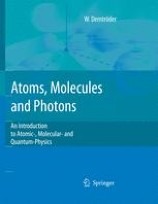
Atoms, molecules and photons : An introduction to atomic- molecular- and quantum physics
This introduction to Atomic and Molecular Physics explains how our present model of atoms and molecules has been developed over the last two centuries both by many experimental discoveries and, from the theoretical side, by the introduction of quantum physics to the adequate description of micro-particles. It illustrates the wave model of particles by many examples and shows the limits of classical description. The interaction of electromagnetic radiation with atoms and molecules and its potential for spectroscopy is outlined in more detail and in particular lasers as modern spectroscopic tools are discussed more thoroughly. Many examples and problems with solutions are offered to encourage readers to actively engage in experimentation.
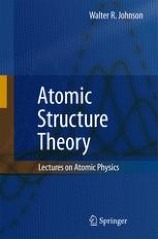
Atomic structure theory : Lectures on atomic physics
This is a textbook for students with a background in quantum mechanics. The text is designed to give hands-on experience with atomic structure calculations. Material covered includes angular momentum methods, the central field Schrödinger and Dirac equations, Hartree-Fock and Dirac-Hartree-Fock equations, multiplet structure, hyperfine structure, the isotope shift, dipole and multipole transitions, basic many-body perturbation theory, configuration interaction, and correlation corrections to matrix elements.
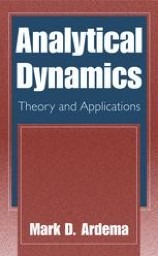
Analytical Dynamics : Theory and Applications
This book takes a traditional approach to the development of the methods of analytical dynamics, using two types of examples throughout: simple illustrations of key results and thorough applications to complex, real-life problems
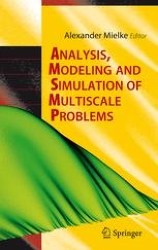
Analysis, Modeling and Simulation of Multiscale Problems
This book reports recent mathematical developments in the Programme "Analysis, Modeling and Simulation of Multiscale Problems", which started as a German research initiative in 2006. Multiscale problems occur in many fields of science, such as microstructures in materials, sharp-interface models, many-particle systems and motions on different spatial and temporal scales in quantum mechanics or in molecular dynamics. The book presents current mathematical foundations of modeling, and proposes efficient numerical treatment.
Advanced Visual Quantum Mechanics
Investigate and to teach quantum mechanics with the aid of computer-generated animations. It is a self-contained textbook that combines selected topics from atomic physics (spherical symmetry, the hydrogen atom, and particles with spin) with an introduction to quantum information theory (qubits, EPR paradox, teleportation, quantum computers). It explores relativistic quantum mechanics and the strange behavior of Dirac equation solutions. A series of appendices covers important topics from perturbation and scattering theory. The book places an emphasis on ideas and concepts, with a fair to moderate amount of mathematical rigor. Though this book stands alone, it can also be paired with Thaller Visual Quantum Mechanics to form a comprehensive course in quantum mechanics. The software for the first book earned the European Academic Software Award 2000 for outstanding innovation in its field.
Advanced Quantum Mechanics
Discusses nonrelativistic multi-particle systems, relativistic wave equations and relativistic quantum fields. Characteristic of the author´s work are the comprehensive mathematical discussions in which all intermediate steps are derived and where numerous examples of application and exercises help the reader gain a thorough working knowledge of the subject. The topics treated in the book lay the foundation for advanced studies in solid-state physics, nuclear and elementary particle physics. This text both extends and complements Schwabl´s introductory Quantum Mechanics, which covers nonrelativistic quantum mechanics and offers a short treatment of the quantization of the radiation field. The fourth edition has been thoroughly revised with new material having been added. Furthermore, the layout of the figures has been unified, which should facilitate comprehension.
Advanced Quantum Mechanics
Advanced Quantum Mechanics, the second volume on quantum mechanics by Franz Schwabl, discusses nonrelativistic multi-particle systems, relativistic wave equations and relativistic fields. Characteristic of Schwabl’s work, this volume features a compelling mathematical presentation in which all intermediate steps are derived and where numerous examples for application and exercises help the reader to gain a thorough working knowledge of the subject. The treatment of relativistic wave equations and their symmetries and the fundamentals of quantum field theory lay the foundations for advanced studies in solid-state physics, nuclear and elementary particle physics. This text extends and complements Schwabl’s introductory Quantum Mechanics, which covers nonrelativistic quantum mechanics and offers a short treatment of the quantization of the radiation field. New material has been added to this third edition of Advanced Quantum Mechanics on Bose gases, the Lorentz covariance of the Dirac equation, and the ‘hole theory’ in the chapter "Physical Interpretation of the Solutions to the Dirac Equation."
