



الصفحة 3
الصفحة 3

Applied Parallel Computing ; State of the Art in Scientific Computing ; 8th International Workshop, PARA 2006, Umea, Sweden, June 18-21, 2006, Revised Selected Papers
It covers partial differential equations, parallel scientific computing algorithms, linear algebra, simulation environments, algorithms and applications for blue gene/L, scientific computing tools and applications, parallel search algorithms, peer-to-peer computing, mobility and security, algorithms for single-chip multiprocessors.

Applied cryptography and network security ; 5th International Conference, ACNS 2007, Zhuhai, China, June 5-8, 2007, Proceedings
The book is organized in topical sections on signature schemes, computer and network security, cryptanalysis, group-oriented security, cryptographic protocols, anonymous authentication, identity-based cryptography, security in wireless, ad-hoc, and peer-to-peer networks, as well as efficient implementation.

Algorithms and architectures for parallel processing ; 7th International Conference, ICA3PP 2007, Hangzhou, China, June 11-14, 2007, Proceedings
The improvements in computation and communication capabilities have enabled the creation of demanding applications in critical domains such as the environment, health, aerospace, and other areas of science and technology. Similarly, new classes of applications are enabled by the availability of heterogeneous large-scale distributed systems which are becoming available nowadays (based on technologies such as grid and peer-to-peer systems).Parallel computing systems exploit a large diversity of computer architectures, from supercomputers, shared-memory or distributed-memory multi processors, to local networks and clusters of p- sonal computers. With the recent emergence of multi core architectures, parallel computing is now set to achieve “mainstream” status. Approaches that have been advocated by parallel computing researchers in the past are now being utilized in a number of software libraries and hardware systems that are available for everyday use. Parallel computing ideas have also come to dominate areas such as multi user gaming (especially in the development of gaming engines based on “cell” arc- tectures).

Agents and peer-to-peer computing ; Vol. 4118 : 4th International workshop, AP2PC 2005, Utrecht, Netherlands, J uly 25, 2005, Revised and Invited Papers
Constitutes the thoroughly refereed post-proceedings of the 4th International Workshop on Agents and Peer-to-Peer Computing, AP2PC 2005, held in Utrecht, Netherlands, July 2005, in the context of the 4th International Joint Conference on Autonomous Agents and Multi-Agent Systems, AAMAS 2005. The 13 revised full papers cover trust and reputation, P2P infrastructure, semantic infrastructure, as well as community and mobile applications.

Agents and peer-to-peer computing ; Vol. 3601 ; 3rd international workshop, AP2PC 2004, New York, NY, USA, July 19, 2004, revised and invited papers
This volume presents the fully revised papers presented at the Third International Workshop on Agents and Peer-to-Peer Computing, AP2PC 2004, held in New York City on July 19, 2004 in the context of the Third International Joint Conference on Autonomous Agents and Multi-Agent Systems (AAMAS 2004). The volume is organized in topical sections on P2P networks and search performance, emergent communities and social behaviours, semantic integration, mobile P2P systems, adaptive systems, agent-based resource discovery, as well as trust and reputation.

Agents and peer-to-peer computing ; 5th International workshop, AP2PC 2006, Hakodate, Japan, May 9, 2006, Revised and Invited Papers
This book constitutes the thoroughly refereed post-workshop proceedings of the 5th International Workshop on Agents and Peer-to-Peer Computing, AP2PC 2006, held in Hakodate, Japan, in May 2006, in the context of the 5th International Joint Conference on Autonomous Agents and Multi-Agent Systems, AAMAS 2006.

Agents and peer-to-peer computing ; 2nd International workshop, AP2PC 2003, Melbourne, Australia, July 14, 2003, revised and invited papers
This book brings together an introduction, three invited articles, and revised versions of the papers presented at the Second International Workshop on Agents and Peer-to-Peer Computing, AP2PC 2003, held in Melbourne, Australia, July 2003."" "Peer-to-peer (P2P) computing is currently attracting enormous public attention, a very large number of autonomous computing nodes, the peers, rely on each other for services. P2P networks are emerging as a new distributed computing paradigm because of their potential to harness the computing power and the storage capacity of the hosts composing the network, and because they realize a completely open decentralized environment where everybody can join in autonomously.

Advances in web-age information management ; Vol. 4016 : 7th International Conference, WAIM 2006, Hong Kong, China, June 17-19, 2006, Proceedings
This book constitutes the refereed proceedings of the 7th International Conference on Web-Age Information Management, WAIM 2006, held in Hong Kong, China in June 2006. The 50 revised full papers presented were carefully reviewed and selected from 290 submissions. The papers are organized in topical sections on, indexing, XML query processing, information retrieval, sensor networks and grid computing, peer-to-peer systems, Web services, Web searching, caching and moving objects, temporal database, clustering, clustering and classification, data mining, data stream processing, XML and semistructured data, data distribution and query processing, and advanced applications.
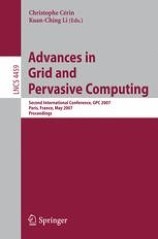
Advances in grid and pervasive computing ; 2nd International Conference, GPC 2007, Paris, France, May 2-4, 2007, Proceedings
This book address all aspects of grid and pervasive computing and focus on topics such as cluster computing, high performance computing, grid computing, semantic Web and semantic grid, service-oriented computing, peer-to-peer computing, pervasive computing, mobile computing, network storage, as well as grid and pervasive related applications.
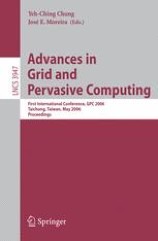
Advances in grid and pervasive computing ; 1st International Conference, GPC 2006, Taichung, Taiwan, May 3-5, 2006, Proceedings
This book constitutes the refereed proceedings of the First International Conference on Grid and Pervasive Computing, GPC 2006, held in Taichung, Taiwan, in May 2006.The 64 revised full papers were carefully reviewed and selected from 267 submissions. The papers are organized in topical sections on grid scheduling, peer-to-peer computing, Web/grid services, high performance computing, ad hoc networks, wireless sensor networks, grid applications, data grid, pervasive applications, semantic Web, semantic grid, grid load balancing, wireless ad hoc/sensor networks, and mobile computing.

Advanced Web and Network Technologies, and Applications ; APWeb 2006 International Workshops : XRA, IWSN, MEGA, and ICSE, Harbin, China, January 16-18, 2006, Proceedings
The QOS evaluating model for computational grid nodes put forward can help greatly improving the self-adaptability of resource management and accelerating the appli- tion and development of Computational Grid. Now this model has been applied in NPU Campus Computational Grid. And the good effect brought by it has effectively proved its function. References 1. Foster, I. and C. Kesselman, eds. The Grid: Blueprint for a New Computing Infrastructure. Morgan Kaufmann, 1999. 2. Liu Liang, Zhou Xing-she, and Gu Jian-hua: A Multi-Agent System for Grid Computing. The Second International Conference on Active Media Technology, 2003 3. Yao Wang, Julita Vassileva: Trust and Reputation Model in Peer-to-Peer Networks. Farag Azzedin and Muthucumaru Maheswaran: Integrating Trust into Grid Resource M- agement Systems.
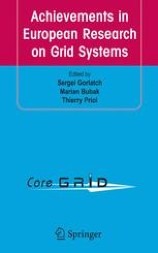
Achievements in European Research on Grid Systems ; CoreGRID Integration Workshop 2006 (Selected Papers)
Achievements in European Research on Grid Systems comprises the edited proceedings of the 2006 CoreGRID Integration Workshop (CGIW'2006), held October 2006 in Krakow, Poland.
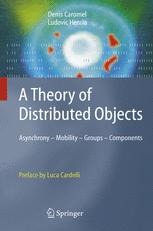
A Theory of Distributed Objects : Asynchrony - Mobility - Groups - Components
Distributed and communicating objects are becoming ubiquitous. In global, Grid and Peer-to-Peer computing environments, extensive use is made of objects interacting through method calls. So far, no general formalism has been proposed for the foundation of such systems. Caromel and Henrio are the first to define a calculus for distributed objects interacting using asynchronous method calls with generalized futures, i.e., wait-by-necessity -- a must in large-scale systems, providing both high structuring and low coupling, and thus scalability. The authors provide very generic results on expressiveness and determinism, and the potential of their approach is further demonstrated by its capacity to cope with advanced issues such as mobility, groups, and components.
