



الصفحة 3
الصفحة 3
Journal on Data Semantics III
– semantic caching – data warehousing and semantic data mining – spatial, temporal, multimedia and multimodal semantics – semantics in data visualization – semantic services for mobile users – supporting tools – applications of semantic-driven approaches These topics are to be understood as speci?cally related to semantic issues. Contributions submitted to the journal and dealing with semantics of data will be considered even if they are not within the topics in the list. While the physical appearance of the journal issues looks like the books from the well-known Springer LNCS series, the mode of operation is that of a journal. Contributions can be freely submitted by authors and are reviewed by the Editorial Board. Contributions may also be invited, and nevertheless carefully reviewed, as in the case for issues that contain extended versions of best papers from major conferences addressing data semantics issues. Special issues, focusing on a speci?c topic, are coordinated by guest editors once the proposal for a special issue is accepted by the Editorial Board. Finally, it is also possible that a journal issue be devoted to a single text.
Biomimetic neural learning for intelligent robots : Intelligent systems, cognitive robotics, and neuroscience
This book presents research performed as part of the EU project on biomimeticmultimodal learning in a mirror neuron-based robot (MirrorBot) and contribu-tions presented at the International AI-Workshop on NeuroBotics. The over-all aim of the book is to present a broad spectrum of current research intobiomimetic neural learning for intelligent autonomous robots. In this book we show the development of newtechniques using cell assemblies, associative neural networks, and Hebbian-typelearning in order to associate vision, language and motor concepts. We havedeveloped biomimetic multimodal learning and language instruction in a robotto investigate the task of searching for objects. As well as the research performedin this area for the MirrorBot project, the second part of this book incorporatessignificant contributions from other research in the field of biomimetic robotics.This second part of the book concentrates on the progress made in neuroscienceinspired robotic learning approaches (in short: NeuroBotics). We hope that this book stimulates and encourages new research in this in-teresting and dynamic area.

Beyond Media Borders ; Vol.2 : Intermedial Relations among Multimodal Media
This book promotes the idea that all media types are multimodal and that comparing media types, through an intermedial lens, necessarily involves analysing these multimodal traits.

Beyond Media Borders ; Vol.1 : Intermedial relations among multimodal media
This book promotes the idea that all media types are multimodal and that comparing media types, through an intermedial lens, necessarily involves analysing these multimodal traits.
Advances in Telerobotics
The main purpose of this book is to provide readers with recent advances in the field of Telerobotics. It describes methods, experimental results, applications, and developments, highly relevant for scientists, researchers, and students in Teleoperation. This book is structured in three parts: I. Human System Interfaces, II. Control, and III. Applications. Chapters in part I concentrate on human interface technology which allows a human operator to close the control loop of a remote robot. Topics related to control algorithms - in particular for the case with time delay in the communication network - are the focus in part II, concentrating on bilateral control methods. Part III presents a variety of advanced applications in surgery, space, and other fields relevant to everyday life.
Advances in Natural Multimodal Dialogue Systems
The chapters in this book jointly contribute to what we shall call the fieldof natural and multimodal interactive systems engineering. This is not yet awell-established field of research and commercial development but, rather, anemerging one in all respects. It brings together, in a process that, arguably, wasbound to happen, contributors from many different, and often far more estab-lished, fields of research and industrial development. To mention but a few,these include speech technology, computer graphics and computer vision. Thefield’s rapid expansion seems driven by a shared vision of the potential of newinteractive modalities of information representation and exchange for radicallytransforming the world of computer systems, networks, devices, applications,etc.
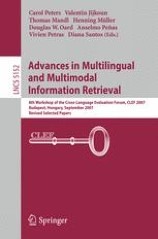
Advances in Multilingual and Multimodal Information Retrieval ; 8th Workshop of the Cross-Language Evaluation Forum, CLEF 2007, Budapest, Hungary, September 19-21, 2007, Revised Selected Papers
This book constitutes the thoroughly refereed proceedings of the 8th Workshop of the Cross-Language Evaluation Forum, CLEF 2007, held in Budapest, Hungary, September 2007.

Advanced Man-Machine Interaction : Fundamentals and Implementation
Man-machine interaction is the gateway providing access to functions and services, which, due to the ever increasing complexity of smart systems, threatens to become a bottleneck. This book therefore introduces not only advanced interfacing concepts, but also gives insight into the related theoretical background.This refers mainly to the realization of video-based multimodal interaction via gesture, mimics, and speech, but also to interacting with virtual object in virtual environments, cooperating with local or remote robots, and user assistance. this book puts special emphasis on implementation aspects. To this end it is accompanied by software development environments for image processing, classification, and virtual environment implementation. In addition a test data base is included for gestures, head pose, facial expressions, full-body person recognition, and people tracking.

A History of Radionuclide Studies in the UK : 50th Anniversary of the British Nuclear Medicine Society
The British Nuclear Medicine Society celebrates its 50th Anniversary with this booklet, which reflects the research of many of the pioneers in the use of radionuclides for the diagnosis and therapy of human disease. Since 1949 there have been remarkable advances in radionuclide techniques and imaging equipment: from the first devices “home-made” in the many physics departments throughout the UK, to the sophisticated multimodality imagers now in everyday use in Nuclear Medicine. The BNMS has been instrumental in promoting the use of radionuclide techniques in the investigation of pathology by supporting and providing education, research and guidelines on the optimum use of radiation to help patients.
