



الصفحة 24
الصفحة 24
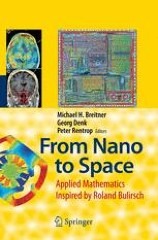
From Nano to Space : Applied Mathematics Inspired by Roland Bulirsch
Graduate students and postgraduates in Mathematics, Engineering and the Natural Sciences want to understand Applied Mathematics for the solution of everyday problems. Scholars of Roland Bulirsch working at universities, at research institutions and in industry combine research and review papers in this anthology. Their work is summed up under the title "From Nano to Space – Applied Mathematics Inspired by Roland Bulirsch". More than 20 contributions are divided into scales: nano, micro, macro, space and real life. The contributions survey current research and present case studies very interesting and informative for both graduate students and postgraduates. The contributions show how modern Applied Mathematics influences our everyday lives. Several contributions include complex graphics and illustrations, many of them in color.
From Hyperbolic Systems to Kinetic Theory : A Personalized Quest
Equations of state are not always effective in continuum mechanics. Maxwell and Boltzmann created a kinetic theory of gases, using classical mechanics. How could they derive the irreversible Boltzmann equation from a reversible Hamiltonian framework? By using probabilities, which destroy physical reality! Forces at distance are non-physical as we know from Poincaré's theory of relativity. Yet Maxwell and Boltzmann only used trajectories like hyperbolas, reasonable for rarefied gases, but wrong without bound trajectories if the "mean free path between collisions" tends to 0. Tartar relies on his H-measures, a tool created for homogenization, to explain some of the weaknesses, e.g. from quantum mechanics: there are no "particles", so the Boltzmann equation and the second principle, can not apply. He examines modes used by energy, proves which equation governs each mode, and conjectures that the result will not look like the Boltzmann equation, and there will be more modes than those indexed by velocity!

From Geometry to quantum mechanics : In Honor of Hideki Omori
This volume is composed of invited expository articles by well-known mathematicians in differential geometry and mathematical physics that have been arranged in celebration of Hideki Omori's recent retirement from Tokyo University of Science and in honor of his fundamental contributions to these areas.The papers focus on recent trends and future directions in symplectic and Poisson geometry, global analysis, infinite-dimensional Lie group theory, quantizations and noncommutative geometry, as well as applications of partial differential equations and variational methods to geometry.

From Energetics to Ecosystems : the Dynamics and Structure of Ecological Systems
Ecosystems are complex and enigmatic entities that are ultimately our life support systems. Understanding these systems to the point of being able to predict their behaviour in the face of perturbations requires that researchers adopt a number of strategies that vary in both approach and scale. This book, in a sense, is representative of some of the developments that have unfolded when math and physics met ecology. Here, some of the world’s leading ecologists examine ecosystems from theoretical, experimental, and empirical viewpoints, from energetics to ecosystems. The book begins with simplifying and synthesizing nature’s complex relationships. It then moves on to explore the mapping between food web structure and function and ends with the role of theory in integrating different research areas. From the breadth of systems analyzed to the rigor of approaches taken, this book is not only a useful resource for students and researchers in ecology, but also serves as a fitting tribute to the life and work of Peter Yodzis.
From Data and Information Analysis to Knowledge Engineering ; Proceedings of the 29th Annual Conference of the Gesellschaft für Klassifikation e.V., University of Magdeburg, March 9-11, 2005
The volume contains revised versions of selected papers presented during the 29th Annual Conference of the Gesellschaft für Klassifikation (GfKl), the German Classification Society, held at the Otto-von-Guericke-University of Magdeburg, Germany, in March 2005. In addition to papers on the traditional subjects Classification, Clustering, and Data Analysis, there are many papers on a wide range of topics with a strong relation to Computer Science. Examples are Text Mining, Web Mining, Fuzzy Data Analysis, IT Security, Adaptivity and Personalization, and Visualization. Application-oriented topics include Economics, Marketing, Banking and Finance, Medicine, Bioinformatics, Biostatistics, and Music Analysis.

From Bulk to Nano : The Many Sides of Magnetism
The field of magnetism is rapidly advancing in this new millennium, revealing an ever-wider diversity of magnetic phenomena on more than one scale. With the emergence of countless applications particularly on a nanoscale, and their unpredictable implications mostly on a macroscale, it may seem that different aspects of magnetism are unrelated. Quite often, the overwhelming amount of topics discussed in the professional literature views only parts of a field, ignoring a broader context. Therefore, the present book aims at addressing the relationship between apparently unconnected topics in magnetism. Less obvious relationships are revealed among individual fields on various scales, making them better understandable.

From Assessing to Conserving Biodiversity : Conceptual and Practical Challenges
This book despite increasing communication, accelerating policy and management responses, and notwithstanding improving ecosystem assessment and endangered species knowledge, conserving biodiversity continues to be more a concern than an accomplished task. Why is it so? The overexploitation of natural resources by our species is a frequently recognised factor, while the short-term economic interests of governments and stakeholders typically clash with the burdens that implementing conservation actions imply. But this is not the whole story. This book develops a different perspective on the problem by exploring the conceptual challenges and practical defiance posed by conserving biodiversity, namely: on the one hand, the difficulties in defining what biodiversity is and characterizing that “thing” to which the word ‘biodiversity’ refers to; on the other hand, the reasons why assessing biodiversity and putting in place effective conservation actions is arduous.

Freshwater Animal Diversity Assessment
The Freshwater Animal Diversity Assessment gives a state of the art assessment of the diversity and distribution of Metazoa in the continental waters of the world. The project deals with all major animal groups plus the macrophytes, and encompasses the complete array of terrestrial aquatic ecosystems. It is the most comprehensive study of species- and genus-level diversity and chorology of the global freshwater fauna to date, and is the first to present comparable data on the different faunal groups concerned. The project draws from the collected expertise of numerous world-renowned taxonomic experts that have bundled efforts to produce this outstanding volume. The result is invaluable to all scientists, managers and conservationists interested in non-marine aquatic animals.

Free Boundary Problems : Theory and Applications
This book gathersa collection of refereed articles containing original result srepo- ing the recent originalcontributions of the lectures and communications presented at the Free Boundary Problems (FBP2005) Conference that took place at the University of Coimbra, Portugal, from 7 to 12 of June 2005. They deal with the Mathematics of a broad class of models and problems involving nonlinear partial diferentialequationsarising inPhysics, Engineering, Biology and Finance. Among the main topics, the talks considered free boundary problems in biomedicine, in porous media, in thermodynamic modeling.

Fragility fracture nursing : Holistic care and management of the orthogeriatric patient
Aims to provide a comprehensive but practical overview of the knowledge required for the assessment and management of the older adult with or at risk of fragility fracture. It considers this from the perspectives of all of the settings in which this group of patients receive nursing care.

Fracture Mechanics of Ceramics ; Active Materials, Nanoscale Materials, Composites, Glass, and Fundamentals
The 8th International Symposium on fracture mechanics of ceramics was held in on the campus of the University of Houston, Houston, TX, USA, on February 25-28, 2003. With the natural maturing of the fields of structural ceramics, this symposium focused on nano-scale materials, composites, thin films and coatings as well as glass. The symposium also addressed new issues on fundamentals of fracture mechanics and contact mechanics, and a session on reliability and standardization.

Fourier Transforms of Invariant Functions on Finite Reductive Lie Algebras
In this book the author studies Fourier transforms using Deligne-Lusztig induction and the Lie algebra version of Lusztig’s character sheaves theory. He conjectures a commutation formula between Deligne-Lusztig induction and Fourier transforms that he proves in many cases. As an application the computation of the values of the trigonometric sums (on reductive Lie algebras) is shown to reduce to the computation of the generalized Green functions and to the computation of some fourth roots of unity.

Foundations of Security Analysis and Design IV ; FOSAD 2006/2007 Turtorial Lectures
This book presents thoroughly revised versions of eight tutorial lectures given by leading researchers during two International Schools on Foundations of Security Analysis and Design, FOSAD 2006/2007, held in Bertinoro, Italy, in September 2006 and September 2007.

Foundations of Quantum Theory : From Classical Concepts to Operator Algebras
This book studies the foundations of quantum theory through its relationship to classical physics. This idea goes back to the Copenhagen Interpretation (in the original version due to Bohr and Heisenberg), which the author relates to the mathematical formalism of operator algebras originally created by von Neumann. The book therefore includes comprehensive appendices on functional analysis and C*-algebras, as well as a briefer one on logic, category theory, and topos theory. Matters of foundational as well as mathematical interest that are covered in detail include symmetry (and its "spontaneous" breaking), the measurement problem, the Kochen-Specker, Free Will, and Bell Theorems, the Kadison-Singer conjecture, quantization, indistinguishable particles, the quantum theory of large systems, and quantum logic, the latter in connection with the topos approach to quantum theory.
Foundations of Object-Oriented Programming Using .NET 2.0 Patterns
Foundations of Object-Oriented Programming Using .NET 2.0 Patterns solves the object-oriented and pattern-programming problem by mixing the two—the book teaches object-oriented concepts using patterns, or a solutions-based approach. The book's material is organized around tasks and patterns, and illustrated through development problems and solutions that include persistence, code efficiency, and good design. This book is of special interest to those who want to learn how to use .NET 2.0 Generics in conjunction with patterns. This unique book is based on the author's lectures, and the information unfolds in a practical manner.

Foundations of Intelligent Systems ; Vol. 3488 ; 15th International Symposium ISMIS 2005, Saratoga Springs, NY, USA, May 25-28, 2005, Proceedings
This volume contains the papers selected for presentation at the 15th International S- posiumonMethodologiesforIntelligentSystems, ISMIS2005, heldinSaratogaSprings, NewYork,25-28May,2005. ThesymposiumwasorganizedbySUNYatAlbany. Itwas sponsored by the Army Research Of?ce and by several units of the University at Albany including its Division for Research, College of Arts and Sciences, Department of C- puter Science, and Institute for Informatics, Logics, and Security Studies (formerly the Institute for Programming and Logics). The Program Committee selected the following major areas for ISMIS 2005: intelligent information systems, knowledge discovery and data mining, knowledge - formation and integration, knowledge representation, logic for arti?cial intelligence, soft computing, Web intelligence, Web services, and papers dealing with applications of intelligent systems in complex/novel domains. The contributed papers were selected from almost 200 full draft papers by the Program Committee members.
Foundations of Intelligent Systems ; 13th International Symposium, ISMIS 2002, Lyon, France, June 27-29, 2002. Proceedings
This volume contains the papers selected for presentation at the 13th International Symposium on Methodologies for Intelligent Systems ISMIS 2002, held in Lyon, France, 27-29 June, 2002. The symposium was organized by the UniversitØ ClaudThe program committee selected the following major areas for ISMIS 2002: Intelligent Multimedia, Intelligent Information Retrieval, Intelligent Information Systems, Knowledge Representation and Integration, Learning and Knowledge Discovery, Logic for Artificial Intelligence, Methodologies (modeling, design, validation, performance evaluation), and Soft Computing.

Foundations of genetic algorithms ; 8th International Workshop, FOGA 2005, Aizu-Wakamatsu City, Japan, January 5-9, 2005, Revised Selected Papers
The8thWorkshopontheFoundationsofGeneticAlgorithms,FOGA-8,washeld at the University of Aizu in Aizu-Wakamatsu City, Japan, January 5–9, 2005. This series of workshops was initiated in 1990 to encourage further research on the theoretical aspects of genetic algorithms, and the workshops have been held biennially ever since. The papers presented at these workshops are revised, edited and published as volumes during the year following each workshop. This series of (now eight) volumes provides an outstanding source of reference for the theoretical work in this ?eld. At the same time this series of volumes provides a clear picture of how the theoretical research has grown and matured along with the ?eld to encompass many evolutionary computation paradigms including evolution strategies (ES), evolutionary programming (EP), and genetic programming (GP), as well as the continuing growthininteractionswith other ?elds suchas mathematics,physics, and biology.

Foundations in microeconomic theory : A volume in honor of Hugo F. Sonnenschein
What a wonderful occasion it is to be celebrating 65 years of Hugo Sonnenschein! Given his many contributions to economic research and academia more broadly, there is much to celebrate. This volume, presented to Hugo at a confer ence in his honor at the University of Chicago in October 2005, highlights one of his deepest contributions. It is perhaps the hardest to detect from reading his bios and vita; but something that he is famous for among economists in general and economic theorists in particular. It is his incredible record as a mentor and advisor of students. In putting this volume together, we have collected papers from Hugo's students with the aim of demonstrating his tremendous impact as an advisor. The papers span decades, with the earliest coming from his advisees in the first years of his career and the most recent coming in the last two years after his return to research and advising that followed his adventures as a university administrator.

Foundational texts in modern criminal law
Presents essays in which scholars from various countries and legal systems engage critically with formative texts in criminal legal thought since Hobbes. It examines the emergence of a transnational canon of criminal law by documenting its intellectual and disciplinary history and provides a snapshot of contemporary work on criminal law within that historical and comparative context.
