



الصفحة 22
الصفحة 22

Killer Cell Dynamics : Mathematical and Computational Approaches to Immunology
Reviews how mathematics can be used in combination with biological data in order to improve understanding of how the immune system works. This is illustrated largely in the context of viral infections. Mathematical models allow scientists to capture complex biological interactions in a clear mathematical language and to follow them to their precise logical conclusions. This can give rise to counter-intuitive insights which would not be attained by experiments alone, and can be used for the design of further experiments in order to address the mathematical results.

Junge Perspektiven der Türkeiforschung in Deutschland = Young perspectives of Turkey research in Germany
This volume creates an interdisciplinary forum for contemporary Turkey research in Germany. It presents research results from young scientists who are characterized by a fresh view of Turkey, methodological diversity and interdisciplinary approaches. The volume thus contributes to a better understanding of the society, politics, economy, history and culture of the country, which is playing an increasingly important role both regionally and in the European context.

IUTAM Symposium on Fluid-Structure Interaction in Ocean Engineering ; Proceedings of the IUTAM Symposium held in Hamburg, Germany, July 23-26, 2007
This book collects contributions from leading scientists working on the following topics: Ocean waves, probabilistic models of sea waves, fluid-loading on structures including pipes, cables, drill-strings etc., behavior of floating systems, stability and capsizing of ships, coupled structural behavior, sloshing in tanks, CFD validation and verification.

Iutam Symposium on Dynamics and Control of Nonlinear Systems with Uncertainty ; Proceedings of the IUTAM Symposium held in Nanjing, China, September 18-22, 2006
The last decade has witnessed an increasing interest towards the dynamics and control of nonlinear engineering systems from the scientists engaged in nonlinear dynamics and the control engineers. Both groups of people have recognized the importance of interaction between nonlinear dynamics and robust control during their efforts to improve the dynamic performance of engineering systems with uncertainty, which comes from either the random excitations, such as wind and earthquake, or the modelling errors of real systems including their sensors, controllers and actuators. The dynamics and control of nonlinear systems with uncertainty, therefore, is a vital interdisciplinary topic related to both stochastic systems and deterministic systems. This volume contains the papers presented at the IUTAM Symposium on Dynamics and Control of Nonlinear Systems with Uncertainty, which was sponsored by the International Union of Theoretical and Applied Mechanics (IUTAM)

Issues of Decapod Crustacean Biology
This volume presents the proceedings of the eighth Colloquium Crustacea Decapoda Mediterranea, which was held at the Ionian University on Corfu Island, Greece, from 2 to 6 September 2002, and reflects recent advancements in decapod crustacean research. The meeting is the oldest European carcinological event, organized regularly at 3-year intervals since 1972. Although focused on the Mediterranean Sea, worldwide contributions provided a forum for fruitful contact and scientific exchange. The book covers up-to-date issues in decapod crustacean research, including genetics, morphology, reproduction, ecology, behaviour and fisheries, and it is primarily aimed at scientists interested in decapod crustacean research, but other scientists and decision-makers working on marine ecology and fisheries will also find up-to-date information on relevant issues.

Comprehensive utilization of magnesium slag by pidgeon process
This book introduces the harmless handling/recycling of magnesium slag , the process of magnesium silicothermic reduction (Pidgeon process)which the slag was produced, and . the magnesium resources, layout of the industry of the world. Examples and experimental data in this book are from the author group’s research programs, as well as the rencent researches in China. The book could provide precious reference to scientists and engineers in the field of recycling and environment friendly use of the industrial solid wastes. It could also be used for researchers and students who are interested in relevant field.

Comprehensive mathematics for computer scientists 2 : Calculus and ODEs, splines, probability, fourier and wavelet theory, fractals and neural networks, categories and lambda calculus
This second volume of a comprehensive tour through mathematical core subjects for computer scientists completes the first volume in two - gards: Part III first adds topology, di?erential, and integral calculus to the t- ics of sets, graphs, algebra, formal logic, machines, and linear geometry, of volume 1. With this spectrum of fundamentals in mathematical e- cation, young professionals should be able to successfully attack more involved subjects, which may be relevant to the computational sciences. In a second regard, the end of part III and part IV add a selection of more advanced topics. In view of the overwhelming variety of mathematical approaches in the computational sciences, any selection, even the most empirical, requires a methodological justi?cation. Our primary criterion has been the search for harmonization and optimization of thematic - versity and logical coherence. This is why we have, for instance, bundled such seemingly distant subjects as recursive constructions, ordinary d- ferential equations, and fractals under the unifying perspective of c- traction theory.

Comprehensive mathematics for computer scientists 1 : Sets and numbers, graphs and algebra, logic and machines, linear geometry
This two-volume textbook Comprehensive Mathematics for Computer Scientists is a self-contained comprehensive presentation of mathematics including sets, numbers, graphs, algebra, logic, grammars, machines, linear geometry, calculus, ODEs, and special themes such as neural networks, Fourier theory, wavelets, numerical issues, statistics, categories, and manifolds. The concept framework is streamlined but defining and proving virtually everything.

Complex Systems Science in Biomedicine
Complex Systems Science in Biomedicine covers the emerging field of systems science involving the application of physics, mathematics, engineering and computational methods and techniques to the study of biomedicine including nonlinear dynamics at the molecular, cellular, multi-cellular tissue, and organismic level. With all chapters helmed by leading scientists in the field, Complex Systems Science in Biomedicine's goal is to offer its audience a timely compendium of the ongoing research directed to the understanding of biological processes as whole systems instead of as isolated component parts.

Complex Medical Engineering
In the twenty-first century, applications in medicine and engineering must acquire greater safety and flexibility if they are to yield better products at higher efficiency. To this end, complex science and technology must be integrated in medicine and engineering. Complex medical engineering (CME) is a new field that merges medical science and technology, and includes biomedical robotics and biomechatronics, complex virtual technology in medicine, information and communication technology in medicine, complex technology in rehabilitation, cognitive neuroscience and technology, and complex bioinformatics. Experts from academia, industry, and government research laboratories who have pioneered CME ideas and technologies describe its concept and research approach and discuss related hardware and software, science and technology, and medicine and engineering. This book will be invaluable to scientists, researchers, and graduates in the emerging field of CME.

Complex Dynamics in Communication Networks
Computer and communication networks are among society's most important infrastructures. The internet, in particular, is a giant global network of networks without central control or administration. It is a paradigm of a complex system, where complexity may arise from different sources: topological structure, network evolution, connection and node diversity, or dynamical evolution. The present volume is the first book entirely devoted to the new and emerging field of nonlinear dynamics of TCP/IP networks. It addresses both scientists and engineers working in the general field of communication networks.

Comparative Skeletal Anatomy : A Photographic Atlas for Medical Examiners, Coroners, Forensic Anthropologists, and Archaeologists
The goal of this guide is to help experienced archaeologists and forensic scientists distinguish human remains from common animal species, including horses, cows, goats, rabbits, chickens, ducks, sheep, and pigs, among others. Comprehensive and timely, Comparative Skeletal Anatomy.

Comparative Hepatitis
This volume reviews today’s knowledge about hepatitis with emphasis on comparative aspects between hepatitis in humans and animals, but also between different etiological agents. This particular viewpoint makes the book relevant for scientists from both human and veterinary medicine, gastroenterologists, pathologists, virologists and students of human and veterinary medicine.

Communities and Technologies 2005 ; Proceedings of the Second Communities and Technologies Conference, Milano 2005
This book includes 23 papers dealing with the impact of modern information and communication technologies that support a wide variety of communities: local communities, virtual communities, and communities of practice, such as knowledge communities and scientific communities. The volume is the result of the second multidisciplinary "Communities and Technologies Conference", a major event in this emerging research field. The various chapters discuss how communities are affected by technologies, and how understanding of the way that communities function can be used in improving information systems design. This state of the art overview will be of interest to computer and information scientists, social scientists and practitioners alike.

Communications and Multimedia Security ; Vol.4237 ; 10th IFIP TC-6 TC 11 International Conference, CMS 2006, Heraklion Crete, Greece, October 19-21, 2006, Proceedings
Scientists, managers, and politicians all over the world havedesignedandarecurrently implementing systematicapproachesto network and information security, most of which are underlined by the principle: there is much more room for improvement and research. Along the lines of encouraging and catalyzing research in the area of c- munications and multimedia security, it is our great pleasure to present the proceedings of the 10th IFIP TC-6 TC-11 Conference on Communications and MultimediaSecurity(CMS2006), we sought a balanced program containing presentations on various aspects of secure c- munication and multimedia systems.
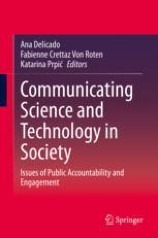
Communicating science and technology in society
Addresses the engagement between science and society from multiple viewpoints. At a time when trust in experts is being questioned, misinformation is rife and scientific and technological development show growing social impact, the volume examines the challenges in involving the public in scientific debates and decisions. It takes into account societal needs and concerns in research, and analyses the interface between the roles of institutions and individuals. From environmental challenges to science communication, participatory technological design to animal experimentation, and transdisciplinarity to norms and values in science, the volume brings together research on areas in which scientists and citizens interact, across diverse, often understudied, socio-cultural contexts in Europe.

Communicating European Research 2005 ; Proceedings of the Conference, Brussels, 14-15 November 2005
The book covers the main aspects of science and technology communication today and addresses topical questions such as: Is science journalism necessary at all? Should communication become one of the basic skills of scientists, as compulsory as thinking, testing and experimenting? Should our schools of the future put scientific literacy at the top of the science curriculum? Do we need science critics? Does the coverage of science in the media reflect the choice of the editors or does it accurately mirror the public’s interest? How does one capture the public’s attention when promoting science on local, commercial or entertainment radio? Why would we need standards in science communication? How can we remove any obstacles to communication among researchers and between researchers?

Climate-Smart Forestry in Mountain Regions
This book offers a cross-sectoral reference for both managers and scientists interested in climate-smart forestry, focusing on mountain regions. It provides a comprehensive analysis on forest issues, facilitating the implementation of climate objectives. CLIMO has provided scientific analysis on issues including criteria and indicators, growth dynamics, management prescriptions, long-term perspectives, monitoring technologies, economic impacts, and governance tools.

Civil and Environmental Engineering for the Sustainable Development Goals : Emerging Issues
This volume collects emerging issues in Environmental and Civil Engineering, originating from outstanding doctoral dissertations discussed at Politecnico di Milano in 2021. The advanced innovative insights provided are presented with reference to the relevant sustainable development goals (SDGs), hoping that scientists, technicians and decision makers will find them as a valid support to face future sustainability challenges.

Citation Analysis in Research Evaluation
This book is written for members of the scholarly research community, and for persons involved in research evaluation and research policy. More specifically, it is directed towards the following four main groups of readers: – All scientists and scholars who have been or will be subjected to a quantitative assessment of research performance using citation analysis. – Research policy makers and managers who wish to become conversant with the basic features of citation analysis, and about its potentialities and limitations. – Members of peer review committees and other evaluators, who consider the use of citation analysis as a tool in their assessments. – Practitioners and students in the field of quantitative science and technology studies, informetrics, and library and information science. Citation analysis involves the construction and application of a series of indicators of the ‘impact’, ‘influence’ or ‘quality’ of scholarly work, derived from citation data, i.e. data on references cited in footnotes or bibliographies of scholarly research publications. Such indicators are applied both in the study of scholarly communication and in the assessment of research performance. The term ‘scholarly’ comprises all domains of science and scholarship, including not only those fields that are normally denoted as science – the natural and life sciences, mathematical and technical sciences – but also social sciences and humanities.
