



الصفحة 22
الصفحة 22

Modern IoT onboarding platforms for advanced applications: a practitioner’s guide to KIS.ME
There is no doubt that digitalization solutions from Industry 4.0 and the Internet of Things (IoT) can be perceived as excellent candidate strategies capable of handling the above-stated issues concerning measurements and transparency. However, IoT tools themselves can provide appropriate data only, while their efficient integration and application are possible using a dedicated onboarding platform only. To settle this issue, the book undertakes the problem of modern IoT onboarding platforms for the advanced applications pertaining to manufacturing and logistics. In particular, instead of deliberating about a possible hypothetic platforms, an existing and efficient one is employed, which is called KIS.ME. KIS.ME (Keep It Simple. Manage Everything) is a complete IoT solution for a simple integration in manufacturing and logistics.

Modern hospice design : The architecture of palliative and social care
Takes cognisance of the new conditions of social care in the 21st century, principally in the UK, Europe and North America. It does so with regard to the development of new building types, but also in response to new philosophies of palliative care and the status of the elderly and the dying. At its core is a public discussion of a philosophy of design for providing care for the elderly and the vulnerable, taking the importance of architectural aesthetics, the use of quality materials, the porousness of design to the wider world, and the integration of indoor and outdoor spaces as part of the overall care environment.

Modern Hematology : Biology and Clinical Management
The first chapters of this book contain a self-contained introduction to path integrals in Euclidean quantum mechanics and statistical mechanics. The resulting high-dimensional integrals can be estimated with the help of Monte Carlo simulations based on Markov processes. The most commonly used algorithms are presented in detail so as to prepare the reader for the use of high-performance computers as an “experimental” tool for this burgeoning field of theoretical physics. Several chapters are then devoted to an introduction to simple lattice field theories and a variety of spin systems with discrete and continuous spins, where the ubiquitous Ising model serves as an ideal guide for introducing the fascinating area of phase transitions. As an alternative to the lattice formulation of quantum field theories, variants of the flexible renormalization group methods are discussed in detail. Since, according to our present-day knowledge, all fundamental interactions in nature are described by gauge theories, the remaining chapters of the book deal with gauge theories without and with matter.

Modern Ferrite Technology
odern Ferrite Technology ; 2nd ed. offers the readers an expert overview of the latest ferrite advances as well as their applications in electronic components. This volume develops the interplay among material properties, component specification and device requirements using ferrites. Throughout, emphasis is placed on practical technological concerns as opposed to mathematical and physical aspects of the subject. The book traces the origin of the magnetic effect in ferrites from the level of the simplest particle and then increases the scope to include larger hierarchies. From the desired magnetic properties, the author deduces the physical and chemical material parameters, taking into consideration major chemistry, impurity levels, ceramic microstructures and grain boundary effects. He then discusses the processing conditions and associated conditions required for implementation. In addition to conventional ceramic techniques, he describes non-conventional methods such as co-precipitation, co-spray roasting and single crystal growth.

Modern Differential Geometry in Gauge Theories : Maxwell Fields ; Vol. I
Differential geometry, in the classical sense, is developed through the theory of smooth manifolds. Modern differential geometry from the author’s perspective is used in this work to describe physical theories of a geometric character without using any notion of calculus (smoothness). Instead, an axiomatic treatment of differential geometry is presented via sheaf theory (geometry) and sheaf cohomology (analysis). Using vector sheaves, in place of bundles, based on arbitrary topological spaces, this unique approach in general furthers new perspectives and calculations that generate unexpected potential applications .Volume 1, the focus is on Maxwell fields. All the basic concepts of this mathematical approach are formulated and used thereafter to describe elementary particles, electromagnetism, and geometric prequantization. Maxwell fields are fully examined and classified in the language of sheaf theory and sheaf cohomology.

Modern deep learning for tabular data : Novel approaches to common modeling problems
Synthesizes and presents novel deep learning approaches to a seemingly unlikely domain - tabular data. Whether for finance, business, security, medicine, or countless other domain, deep learning can help mine and model complex patterns in tabular data - an incredibly ubiquitous form of structured data. Part I of the book offers a rigorous overview of machine learning principles, algorithms, and implementation skills relevant to holistically modeling and manipulating tabular data. Part II studies five dominant deep learning model designs - Artificial Neural Networks, Convolutional Neural Networks, Recurrent Neural Networks, Attention and Transformers, and Tree-Rooted Networks - through both their 'default' usage and their application to tabular data. Part III compounds the power of the previously covered methods by surveying strategies and techniques to supercharge deep learning systems: autoencoders, deep data generation, meta-optimization, multi-model arrangement, and neural network interpretability.

Modern Computational Intelligence Methods for the Interpretation of Medical Images
A detailed description of up-to-date methods used for computer processing and interpretation of medical images is given. The scope of the book include images acquisition, storing with compression, processing, analysis, recognition and also its automatic understanding In introduction general overview of the computer vision methods designed for medical images is presented. Next sources of medical images are presented with their general characteristics. Both traditional (like X-ray) and very modern (like PET) sources of medical images are presented. The main emphasis is placed on such properties of medical images given by particular medical imaging methods which are important form the point of view of its computer processing, analysis and recognition.

Modern Circuit Placement : Best Practices and Results
This book has four unique characteristics. First, it focuses on the most recent highly scalable placement techniques used for multi-million gate circuit designs, with consideration of many practical aspects of modern circuit placement, such as density and routability control, mixed-size placement support, and area I/O support. Second the book addresses dominant techniques being used in the field. Although these tools are developed by academia, many core techniques in these tools are being used extensively in industry and represent today’s advanced placement techniques. Third, the book provides quantitative comparison among the various techniques on common benchmark circuits derived from real-life industrial designs. The book includes significant amounts of analysis on each technique, such as trade-offs between quality-of-results (QoR) and runtime. Finally, analysis of the optimality of the placement techniques is included.

Modern Aspects of Electrochemistry ; Vol. 38
Solid State Electrochemistry encompassing modern equilibria concepts, thermodymanics and kinetics of charge carriers in solids.,Electron transfer processes, with special sections devoted to hydration of the proton and its heterogeneous transfer.Electrosorption at electrodes and its relevance to electrocatalysis and electrodeposition of metals,The behavior of Pt and other alloy electrocatalyst crystallites used as the electrode materials for phosphoric acid electrolyte fuel-cells.Applications of reflexology and electron microscopy to the materials science aspect of metal electrodes.Electroplating of metal matrix composites by codeposition of suspended particles, a process that has improved physical and electrochemical properties.

Modern apartment design
Provides guidelines to the design of modern apartment buildings as well as a summation of current cutting-edge practice in engineered timber construction.The book covers a brief history of apartment buildings around the world, a broad outline of different types of apartment blocks, and a strong focus on the design and actual construction of apartment buildings, especially those utilising mass timber, such as cross laminated timber and laminated veneer lumber. It also features six Case Study chapters from industry-leading practitioners in the area, enabling best practice in architecture and engineering of these new apartment building types to be more widely understood and propagated worldwide.

Models, Methods and Tools for Product Service Design : The Manutelligence Project
This book summarizes research being pursued within the Manutelligence project, the goal of which is to help enterprises develop smart, social and flexible products with high value added services. Manutelligence has improved Product and Service Design by developing suitable models and methods, and connecting them through a modular, collaborative and secure ICT Platform. The use of real data collected in real time by Internet of Things (IoT) technologies underpins the design of product-service systems and makes it possible to monitor them throughout their life cycle. Available data allows costs and sustainability issues to be more accurately measured and simulated in the form of Life Cycle Cost (LCC) and Life Cycle Assessment (LCA). Analysing data from IoT systems and sharing LCC and LCA information via the ICT Platform can help to accelerate the design of product-service systems, reduce costs and better understand customer needs. Industrial partners involved in Manutelligence provide a clear overview of the project's outcomes, and demonstrate how its technological solutions can be used to improve the design of product-service systems and the management of product-service life cycles.

Models of the Atomic Nucleus
Models of the Atomic Nucleus is a largely non-technical introduction to nuclear theory – an attempt to explain the nucleus in a way that makes nuclear physics as comprehensible as chemistry or cell biology. Unlike many other scientific fields, the "popularization" of nuclear physics has not previously been successful because many fundamental issues remain controversial and a unified theory of nuclear structure has not yet been established. The theme developed in this book is that the many models of nuclear theory each provide a partial perspective on the nucleus and that the many models can in fact be integrated into a coherent whole and expressed in terms of a lattice of nucleons.

Models of Mechanics
This is a textbook on models and modeling in mechanics. It introduces a new unifying approach to applied mechanics: through the concept of the open scheme, a step-by-step approach to modeling evolves. The unifying approach enables a very large scope on relatively few pages: the book treats theories of mass points and rigid bodies, continuum models of solids and fluids, as well as traditional engineering mechanics of beams, cables, pipe flow and wave propagation.

Models in Cooperative Game Theory : Crisp, Fuzzy, and Multi-Choice Games
This book investigates the classical model of cooperative games with transfer able utility (TU-games) and models in which the players have the possibility to cooperate partially, namely fuzzy and multichoice games. In a crisp game the agents are either fully involved or not involved at all in cooperation with some other agents, while in a fuzzy game players are allowed to cooperate with infinitely many different participation levels, varying from non-cooperation to full cooperation. A multichoice game describes an intermediate case in which each player may have a fixed number of activity levels. Part I of the book is devoted to the most developed model in the theory of cooperative games, that of a classical TU-game with crisp coalitions, which we refer to as crisp game along the book. It presents basic notions, solutions concepts and classes of cooperative crisp games in such a way that allows the reader to use this part as a reference toolbox when studying the corresponding concepts from the theory of fuzzy games (Part II) and from the theory of multichoice games (Part III).

Models in Cooperative Game Theory
Cooperative game theory is a booming research area with many new developments in the last few years. So, our main purpose when prep- ing the second edition was to incorporate as much of these new dev- opments as possible without changing the structure of the book. First, this o?ered us the opportunity to enhance and expand the treatment of traditional cooperative games, called here crisp games, and, especially, that of multi-choice games, in the idea to make the three parts of the monograph more balanced. Second, we have used the opportunity of a second edition to update and enlarge the list of references regarding the three models of cooperative games. Finally, we have benefited from this opportunity by removing typos and a few less important results from the ?rst edition of the book, and by slightly polishing the English style and the punctuation, for the sake of consistency along the monograph.

Models for Polymeric and Anisotropic Liquids
Models should be as simple as possible, but no simpler. For the physics of polymeric liquids, whose relevant lengths and time scales are out of reach for first principles calculations, this means that we have to choose a minimum set of sufficiently detailed descriptors such as architecture (linear, ring, branched), connectivity, semiflexibility, stretchability, excluded volume, and hydrodynamic interaction. These 'universal' fluids allow the prediction of material properties under external flow- or electrodynamic fields, the results being expressed in terms of reference units, specific for any particular chosen material. This book provides an introduction to the kinetic theory and computer simulation methods needed to handle these models and to interpret the results. Also included are a number of sample applications and computer codes.
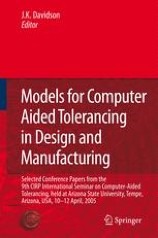
Models for computer aided tolerancing in design and manufacturing ; Selected conference papers from the 9th CIRP International Seminar on Computer-aided tolerancing, held at Arizona State University, Tempe, Arizona, USA, 10-12 April, 2005
Computer Aided Tolerancing (CAT) is an important topic in any field of design and production where parts move relative to one another and/or are assembled together. Geometric variations from specified dimensions and form always occur when parts are manufactured. Improvements in production systems can cause the amounts of the variations to become smaller, but their presence does not disappear. To shorten the time from concept to market of a product, it has been increasingly important to take clearances and the tolerancing of manufacturing variations into consideration right from the beginning, at the stage of design. Hence, geometric models are defined that represent both the complete array of geometric variations possible during manufacture and also the influence of geometry on the function of individual parts and on assemblies of them.

Modellistica numerica per problemi differenziali = Numerical modeling for differential problems
This text introduces the basic concepts for the numerical modeling of partial differential problems. We consider the classic elliptic, parabolic and hyperbolic linear equations, but also other equations, such as those of diffusion and transport, of Navier-Stokes, and the conservation laws, and we provide numerous physical examples underlying these equations. Then we analyze numerical resolution methods based on finite elements, finite differences, finite volumes, spectral methods and domain decomposition methods. In particular, the algorithmic and computer implementation aspects are discussed and various easy-to-use programs are provided.

Modellistica Numerica per Problemi Differenziali = Numerical Modeling for Differential Problems
This text introduces the fundamental concepts for the numerical modeling of partial differential problems. We consider the classic linear elliptic, parabolic and hyperbolic equations, but also other equations, such as those of diffusion and transport, of Navier-Stokes, and the conservation laws. Numerous physical examples underlying these equations are provided, their main mathematical properties are studied, then numerical resolution methods based on finite elements, finite differences, finite volumes and spectral methods are proposed and analyzed. In particular, the algorithmic and computer implementation aspects are discussed and some easy-to-use programs in C ++ language are provided. The text does not presuppose an advanced mathematical knowledge of partial differential equations: the strictly indispensable concepts in this regard are reported in the Appendix. The volume is therefore suitable for students of scientific degree courses (Engineering, Mathematics, Physics, Chemistry, Information Sciences) and recommended for researchers from the academic and extra-academic world who want to approach this interesting branch of applied mathematics.

Modelling, Monitoring and Diagnostic Techniques for Fluid Power Systems
Modelling, Monitoring and Diagnostic Techniques for Fluid Power Systems covers the background theory of fluid power and indicates the range of concepts necessary for a modern approach to condition monitoring and fault diagnosis in a readable and understandable fashion. The theory is constantly leavened by 15 years' worth of practical measurements by the author, working in association with major fluid power companies, and real industrial case studies – hot-strip-mill monitoring in conjunction with Corus p.l.c. being just one example. Comprising four parts, it provides: • an introduction to component behaviour. • a guide to the modelling methods employed for circuit analysis. • methods for doing condition monitoring. • common faults and breakdowns.
