



الصفحة 219
الصفحة 219
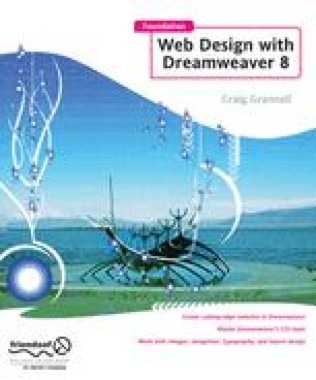
Foundation Web Design with Dreamweaver 8
Dreamweaver is Macromedia's bestselling web design/development environment. Dreamweaver has the capability to generate dynamic website code using server-side languages like ASP, PHP, and ASP.NET. We know that you don't always require a full database-driven site though, so this book focuses on using version 8 of Dreamweaver to design and create usable, standards-compliant websites using XHTML and CSS. One of the highlights of this version is much closer, tighter CSS/XHTML. This book will show you how to make the most of that feature. After a brief introduction to the latest version of Dreamweaver, and how CSS and XHTML fit into it, Craig Grannell looks at using the software for your web design projects in a hands-on, task based manner.
Foundation PHP5 for Flash
This latest, completely rewritten, edition again brings together three of the web's hottest technologies—Flash, the server-side language PHP, and the MySQL database system. We've brought things back up to date, using ActionScript 2.0, PHP 5.0, and MySQL 4.1, the book has been designed to be version-neutral. In other words, you can be confident that you're working with the latest standards, but that your applications won't break if deployed on an older server. The book also provides a brief introduction to an alternative database system, SQLite, which is now automatically bundled with PHP 5 and requires no installation.

Foundation PHP for Dreamweaver 8
In this book, we look specifically at using Dreamweaver's built-in server behaviors to build dynamic web sites using PHP and MySQL, the world's most popular open source server-side language and database server combination, which are both reliable, powerful, and open source (and therefore free to use). This version of Dreamweaver includes more powerful support for PHP and MySQL than ever before, and we'll show you how to make this work for you. No previous experience of PHP or MySQL is necessary to use this book. Examples built throughout the book include a content management system, and an online image gallery. All examples are designed to meet modern usability requirements and be web standards-compliant.
Foundation models for natural language processing : pre-trained language models integrating media
Covers basic natural language processing models, pre-trained language models BERT, GPT, and sequence-to-sequence converters, as well as the concepts of self-attention and context-sensitive embedding. Various approaches to improving these models are then discussed, such as expanding the pre-training parameters, increasing the length of input texts, or incorporating additional knowledge. An overview of the best performing models is then provided for about twenty application areas, e.g., question answering, translation, story generation, dialogue systems, image generation from text, etc. For each application area, the strengths and weaknesses of existing models are discussed, and an overview of further developments is provided. In addition, links to freely available code are provided. The concluding chapter summarizes the economic opportunities, risk mitigation, and potential developments of AI.

Foundation in construction and building services engineering - core (wales) : For city & guilds / EAL
Lay the foundation for a career in the Construction and Building Services Engineering industries with this comprehensive textbook published in association with City & Guilds.

Foundation Form Creation with Adobe LiveCycle Designer ES
Form creation is key to information processing and forms workflow is a key concept within Adobe LiveCycle Enterprise Suite. Adobe LiveCycle Forms ES is a stand-alone product that also comes bundled with Adobe LiveCycle Enterprise Suite. This is the first and only book about this new product specifically created for the design, creation, and processing of dynamically interactive forms. Foundation Form Creation with Adobe LiveCycle Designer ES is written for users of all abilities, with introductory material for beginners and advanced techniques for more experienced users. It discusses both the best-practices of designing forms that work and the specifics of implementing them efficiently for data collection—the full life cycle of working with forms.

Foundation Flex for Designers
All Flex applications look the same—a blue-gray background and silver-skinned components—right? That doesn't have to be the case, though. This book shows you how to ensure that your Flex 2 and 3 projects stand out from the crowd and provide your users with an application that is both visually stunning and beautifully functional. Flex Builder, coupled with the Adobe Creative Suite (CS3), is a powerful combination, providing all the tools you need to create compelling, vibrant interfaces. This book guides you through creating applications with Flex Builder, designing layouts in Fireworks, creating custom skins for your components in Photoshop and Illustrator, and using CSS to enhance the appearance of your rich Internet applications (RIAs).
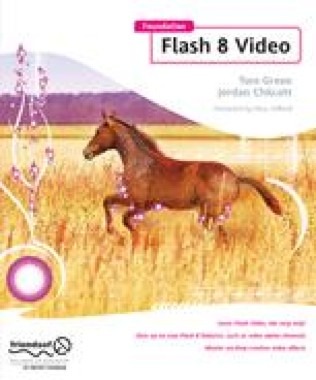
Foundation Flash 8 Video
This book is the ultimate guide to Flash 8 video it offers practical advice, technical guidance, and a full series of creative projects ranging from the dead simple to the complex in a manner that talks to you as an equal and makes only one assumption: basic familiarity with the Flash interface. We start with the basicshow to edit video in some of the most popular packages available (such as iMovie and Movie Maker 2) and create a Flash video file and import it into Flash.
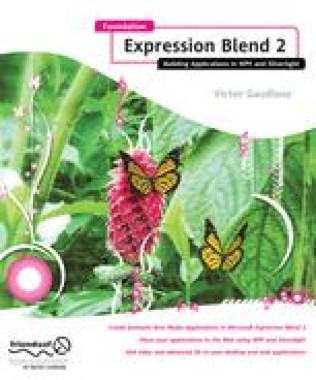
Foundation Expression Blend 2 : Building applications in WPF and silverlight
This book shows you how to take full advantage of Blend's interface, together with and Silverlight's vastly improved designer-developer workflow, guiding you through every step of development from downloading and installing of the development environment through creating finished, functional projects. You'll learn how to create simple drawing applications with the InkCanvas, make tabbed and scrollable interfaces, as well as build fully featured media players, photo galleries, and interactive 3D designs. Each chapter discusses major WPF and Silverlight features, provides a hands-on tutorial, and explains how that feature is implemented in the real world. In the end, you will have a collection of impressive WPF and Silverlight applications that can be added to your portfolio.
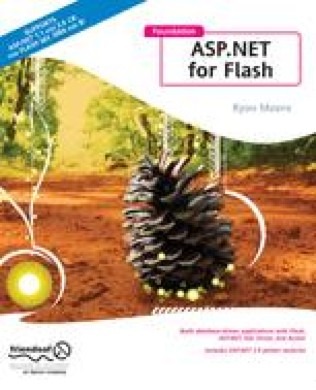
Foundation ASP.NET for Flash
If you're a reasonably experienced Flash user who has mastered the basics but wants to empower your SWFs, taking them further toward rich Internet applications, then you've come to the right place! Foundation ASP.NET for Flash will teach you everything you need to know to integrate two of the most exciting technologies used on the Web today. Using Flash and ASP.NET, it's possible to utilize the amazing user interface capabilities of Flash along with the extensive power of ASP.NET to create dynamic, data-driven web applications. In this book, advanced topics are made easy by providing intuitive step-by-step examples. This book covers Flash MX 2004 and Flash 8, ASP.NET 2.0, Visual Studio 2005, and Access and SQL Server 2005. It is an essential part of any Flash or ASP.NET web developer's arsenal.

Foundation ASP for Dreamweaver 8
Dreamweaver 8 takes a lot of the hard work out of performing tasks such as integrating a database into your website, but it can't do everything. That's why this book not only shows you how to use all of Dreamweaver's functions, but also shows you how the underlying code functions, so you can then work around Dreamweaver's shortcomings. There's no attempt to turn you into a code guru, but you'll come away with sufficient knowledge of basic ASP to have the confidence to dive into the Dreamweaver code and tweak it to your own requirements. The emphasis is exclusively on ASP, so you don't waste any time on information that's not relevant to what you want to do.
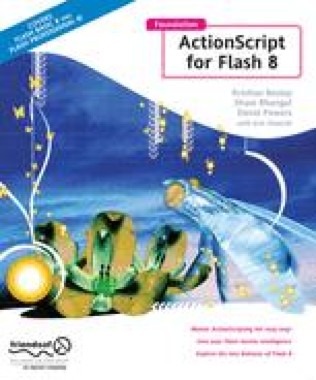
Foundation ActionScript for Flash 8
This book contains all you need to understand and make use of ActionScript, and to have some fun while learning. The Foundation series teaching style is ideal if you're a non-programmer who wants to learn Flash programming quickly and thoroughly. The authors teach the basics, and provide an all-around proficiency in ActionScript, as well as Flash components within Flash 8. You'll gain the practical skills to build ActionScript based Flash projects, including making initial design decisions, structuring code, and testing. An ongoing case study means that by the end of the book, you'll have constructed a cutting-edge Flash site to showcase your newly learned skills.
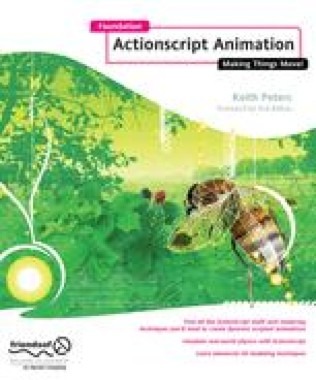
Foundation ActionScript animation : Making things move!
In this book Keith Peters guides you through some basic animation theory and then demystifies the math and physics behind creating realistic animation, looking at trigonometry, velocity and acceleration, and bouncing & friction. This book will teach you how to use Flash ActionScript to move the objects in your movies, rather than letting Flash's tween engine do it for you. The benefit of this is smaller, more realistic, more dynamic interactive movies that seem to come alive on your screen. Almost all of the code featured in this book will work fine in either Flash MX 2004 or Flash 8, and with a few minor adjustments, most of it can even be applied to Flash MX.
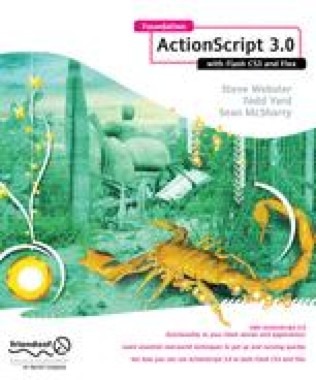
Foundation ActionScript 3.0 with Flash CS3 and Flex
If you want to create exciting dynamic web sites that will amaze your online audience, then the Flash platform is a great way to go, with it's many features, including powerful graphical and sound and video capabilities. To really harness the power of Flash though, you need to make use of ActionScript to provide dynamic effects, enable user interaction, and manipulate data. ActionScript 3.0, the Flash Platform's scripting language, offers a lot of new and powerful features. ActionScript is now a full-fledged programming language, with complete object-oriented capabilities, improved event handling, sound and video support, drawing capabilities, support for regular expressions, and much more. This book covers all the essential techniques from the ground up, allowing you to get up and running quickly and easily. Starting with the fundamentals, you'll learn about using ActionScript objects, manipulating sound and video, and harnessing the power of regular expressions and XML.

Fostering innovation : How to build an amazing IT team
In Fostering Innovation: How to Build an Amazing IT Team, accomplished technology strategist, executive, and leader Andrew Laudato delivers an eye-opening exploration of how to design, build, staff, and run a high-performing IT department. The book is filled with universally applicable strategies and techniques that can transform any IT team into an all-star cast perfectly aligned with your organization’s objectives.

Forward-backward stochastic differential equations and their applications
This volume is a survey/monograph on the recently developed theory of forward-backward stochastic differential equations (FBSDEs). Basic techniques such as the method of optimal control, the "Four Step Scheme", and the method of continuation are presented in full. Related topics such as backward stochastic PDEs and many applications of FBSDEs are also discussed in detail. The volume is suitable for readers with basic knowledge of stochastic differential equations, and some exposure to the stochastic control theory and PDEs. It can be used for researchers and/or senior graduate students in the areas of probability, control theory, mathematical finance, and other related fields.

Forty ways to think about architecture : Architectural history and theory today
How do we think about architecture historically and theoretically? Forty Ways to Think about Architecture provides an introduction to some of the wide-ranging ways in which architectural history and theory are being approached today.
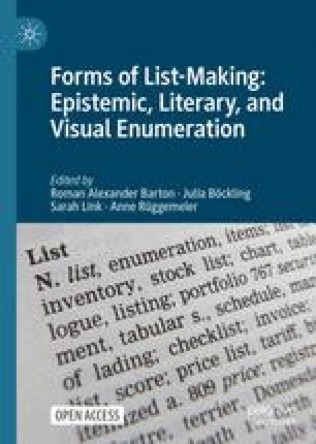
Forms of List-Making : Epistemic, Literary, and Visual Enumeration
This book attempts to show that an examination of the list’s formal features has the potential to produce genuine insights into the production of knowledge, the poetics of literature and the composition of visual art. Following a conceptual introduction, the twelve single-authored chapters place the list in a variety of well-researched contexts, including ancient Roman historiography, medieval painting, Enlightenment periodicals, nineteenth-century botanical geography, American Beat poetry and contemporary photobooks.

Forming the mind : Essays on the internal senses and the Mind/Body problem from avicenna to the medical enlightenment
The book collects essays from some of the foremost scholars in a relatively new and very promising field of research. It stresses how important and fruitful it is to see the time period between 1100 and 1700 as one continuous tradition, and brings together scholars working on the same issues in the Arabic, Jewish and Western philosophical traditions. In this respect, this collection opens up several new and interesting perspectives on the history of the philosophy of mind.

Formal Techniques for Networked and Distributed Systems - FORTE 2006 ; 26th IFIP WG 6.1 International Conference, Paris, France, September 26-29, 2006, Proceedings
This book constitutes the refereed proceedings of the 26th IFIP WG 6.1 International Conference on Formal Techniques for Networked and Distributed Systems, FORTE 2006, held in Paris, France, in September 2006. The 26 revised full papers and 4 short papers presented together with 3 invited lectures were carefully reviewed and selected from 177 submissions. The papers focus on the construction of middleware and services using formalised and verified approaches.
