



الصفحة 21
الصفحة 21

Corporate Sustainability as a Challenge for Comprehensive Management
Sustainability has become a topic of global relevance: Corporations and other economically acting organizations increasingly need to realize economic, environmental and social objectives in order to survive. Supplementary to "classical" environmental management, realizing corporate sustainability requires comprehensive approaches which allow the integration of social and economic aspects. Such concepts can be found e.g. in international excellence models mainly based on a TQM thinking but also in the field of human factors in organizational design and management. Understood as systems approaches, they include the interests of all relevant stakeholders with a mid- or long-term time perspective and are thus highly linked with the principles of sustainable development. In this book internationally leading scientists discuss the issue of sustainability from their perspective, resulting in an innovative view on different management approaches under the umbrella of corporate sustainability.

Corporate finance workbook : Economic foundations and financial modeling
Corporate Finance: Economic Foundations and Financial Modeling Workbook, will help you: Synthesize essential material from the main Corporate Finance text using real-world applications. Understand the key fundamentals of the corporate finance discipline. Work toward specific chapter objectives to internalize important information.

Coordination models and languages ; 23rd IFIP WG 6.1 International Conference, COORDINATION 2021, Held as Part of the 16th International Federated Conference on Distributed Computing Techniques, DisCoTec 2021, Valletta, Malta, June 14–18, 2021, Proceedings
This book constitutes the refereed proceedings of the 23rd IFIP WG 6.1 International Conference on Coordination Models and Language, COORDINATION 2021, held in Valletta, Malta, in June 2021, as part of the 16th International Federated Conference on Distributed Computing Techniques, DisCoTec 2021. The 15 regular papers, 2 short papers, and 1 tutorial paper presented in this book were carefully reviewed and selected from 31 submissions. COORDINATION provides a well-established forum for the growing community of researchers interested in coordination models and languages, architectures, verification and implementation techniques necessary to cope with the complexity induced by the demands of today's software development.
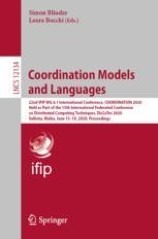
Coordination models and languages ; 22nd IFIP WG 6.1 International Conference, COORDINATION 2020, Held as Part of the 15th International Federated Conference on Distributed Computing Techniques, DisCoTec 2020, Valletta, Malta, June 15–19, 2020, Proceedings
This book constitutes the proceedings of the 22nd International Conference on Coordination Models and Languages, COORDINATION 2020, which was due to be held in Valletta, Malta, in June 2020, as part of the 15th International Federated Conference on Distributed Computing Techniques, DisCoTec 2020. The conference was held virtually due to the COVID-19 pandemic. The 12 full papers and 6 short papers included in this volume were carefully reviewed and selected from 30 submissions. They are presented in this volume together with 2 invited tutorials and 4 tool papers. The papers are organized in the following topical sections: tutorials; coordination languages; message-based communication; communications: types & implementations; service-oriented computing; large-scale decentralized systems; smart contracts; modelling; verification & analysis.

Contemporary Bioethics : Islamic Perspective
This book discusses the common principles of morality and ethics derived from divinely endowed intuitive reason through the creation of al-fitr' a (nature) and human intellect (al-‘aql). Biomedical topics are presented and ethical issues related to topics such as genetic testing, assisted reproduction and organ transplantation are discussed. Whereas these natural sources are God’s special gifts to human beings, God’s revelation as given to the prophets is the supernatural source of divine guidance through which human communities have been guided at all times through history. The second part of the book concentrates on the objectives of Islamic religious practice – the maqa' sid – which include: Preservation of Faith, Preservation of Life, Preservation of Mind (intellect and reason), Preservation of Progeny (al-nasl) and Preservation of Property. Lastly, the third part of the book discusses selected topical issues, including abortion, assisted reproduction devices, genetics, organ transplantation, brain death and end-of-life aspects.

Container terminals and cargo systems : Design, operations management, and logistics control issues
Significant gains in productivity can be achieved through advanced terminal layouts, more efficient IT-support and improved logistics control software systems. The primary objective of this book is to reflect these challenges and to present new insights and successful solutions to operational problems of automated container terminals and cargo systems.

Container Terminals and Automated Transport Systems : Logistics Control Issues and Quantitative Decision Support
Container transportation is the predominant mode of inter-continental cargo traffic. Since container ships and port terminals involve a huge capital investment and significant daily operating costs, it is of crucial importance to efficiently utilize the internal resources of container terminals and transportation systems. Today there is an ongoing trend to use automated container handling and transportation technology, in particular, in countries with high labour costs. This in turn requires highly sophisticated control strategies in order to meet the desired performance measures. The primary objective of this book is to reflect these recent developments and to present new insights and successful solutions to operational problems of automated container terminals and transportation systems. It comprises reports on the state of the art, applications of quantitative methods, as well as case studies and simulation results. Its contributions are written by leading experts from academia and business.

Consumer perception of food attributes
Objectives of this book is to summarize recent empirical findings from scholarly works on how consumers value food credence attributes. Such knowledge would benefit producers, processors, retailers, and policy makers. Another objective of this book is to discuss the effectiveness of the programs that have been introduced to strengthen the relationship between producers and consumers. Many programs have been developed to more effectively inform consumers regarding food production processes.

Constructal Theory of Social Dynamics
Constructal Theory of Social Dynamics brings together for the first time social scientists and engineers to develop a predictive theory of social organization, as a conglomerate of mating flows that morph in time to flow more easily (people, goods, money, energy, information). These flows have objectives (e.g., minimization of effort, travel time, cost), and the objectives clash with global constraints (space, time, resources). The result is organization (flow architecture) derived from one principle of configuration evolution in time (the constructal law): "for a flow system to persist in time, its configuration must morph such that it provides easier access to its streams."

Congenital torch infections : torch panel
TORCH is a group of infections that can be passed from the pregnant mother to her fetus through the placenta. TORCH, includes Toxoplasmosis, Other (syphilis, varicella-zoster, parvovirus B19, Hepatitis B), Rubella, Cytomegalovirus (CMV), and Herpes infections are some of the most common infections associated with congenital anomalies. Most of the TORCH infections have serious fetal consequences and there has no impact on fetal outcome. In the present article, we wanted to discuss about the causative agents/organism, mode of infection, symptoms, treatment, vaccination, available molecular biological techniques and public awareness regarding this infection, Our objective in this project is to assess the awareness of and knowledge about mother-to-child infections and prevention

Conditionals, Information, and Inference
Conditionals are fascinating and versatile objects of knowledge representation. On the one hand, they may express rules in a very general sense, representing, for example, plausible relationships, physical laws, and social norms. On the other hand, as default rules or general implications, they constitute a basic tool for reasoning, even in the presence of uncertainty. In this sense, conditionals are intimately connected both to information and inference. Due to their non-Boolean nature, however, conditionals are not easily dealt with. They are not simply true or false — rather, a conditional “if A then B” provides a context, A, for B to be plausible (or true) and must not be confused with “A entails B” or with the material implication “not A or B.” This ill- trates how conditionals represent information, understood in its strict sense as reduction of uncertainty. To learn that, in the context A, the proposition B is plausible, may reduce uncertainty about B and hence is information. The ab- ity to predict such conditioned propositions is knowledge and as such (earlier) acquired information. The ?rst work on conditional objects dates back to Boole in the 19th c- tury, and the interest in conditionals was revived in the second half of the 20th century, when the emerging Arti?cial Intelligence made claims for appropriate formaltoolstohandle“generalizedrules.”Sincethen,conditionalshavebeenthe topic of countless publications, each emphasizing their relevance for knowledge representation, plausible reasoning, nonmonotonic inference, and belief revision.
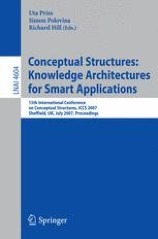
Conceptual Structures: Knowledge Architectures for Smart Applications ; 15th International Conference on Conceptual Structures, ICCS 2007, Sheffield, UK, July 22-27, 2007, Proceedings
Conceptual structures focus on the representation and analysis of concepts, events, actions and objects with applications in - search,softwareengineering,manufacturing and business.The book covers computer science, information technology,artificial int- ligence, philosophy and a variety of applied disciplines to explore novel ways that information technologies can be leveraged to assist human reasoning and interaction for tangible business or social benefits. Conceptual structures can be used to augment human intelligence by facilitating knowledge integration, desion making, the creation of intelligent software systems and the exploration of implicit structures.

Conceptual Modeling of Information Systems
When designing an information system, conceptual modeling is the activity that elicits and describes the general knowledge the system needs to know. This description, called the conceptual schema, is necessary in order to develop an information system.textbook explains in detail the principles of conceptual modeling independently from particular methods and languages and shows how to apply them in real-world projects. It covers all aspects of the engineering process from structural modeling over behavioral modeling to meta-modeling, and completes the presentation with an extensive case study based on the osCommerce system, an online store-management software program freely available under the GNU General Public License. His presentation is based on well-known industry standards like UML and OCL as a particular conceptual modeling language, yet also delivers the basics of the formal logical language background.

Conceptual Modeling for Traditional and Spatio-Temporal Applications : The MADS Approach
This book shows that a conceptual design approach for spatio-temporal databases is both feasible and easy to apprehend. While providing a firm basis through extensive discussion of traditional data modeling concepts, the major focus of the book is on modeling spatial and temporal information. Parent, Spaccapietra and Zimányi provide a detailed and comprehensive description of an approach that fills the gap between application conceptual requirements and system capabilities, covering both data modeling and data manipulation features.

Conceptual Modeling for New Information Systems Technologies ; ER 2001 Workshops, HUMACS, DASWIS, ECOMO, and DAMA, Yokohama Japan, November 27-30, 2001. Revised Papers
The objective of the workshops associated with ER 2001, the 20th International Con- rence on Conceptual Modeling, was to give participants the opportunity to present and discuss emerging hot topics, thus adding new perspectives to conceptual modeling.

Conceptual Modeling - ER 2006 ; 25th International Conference on Conceptual Modeling, Tucson, AZ, USA, November 6-9, 2006, Proceedings
The International Conference on Conceptual Modeling provides the premiere - rum for presenting and discussing current research and applications in which the - jor emphasis is on conceptual modeling. Topics of interest span the entire spectrum of conceptual modeling including research and practice in areas such as theories of c- cepts and ontologies underlying conceptual modeling, methods and tools for devel- ing and communicating conceptual models, and techniques for transforming conc- tual models into effective implementations.
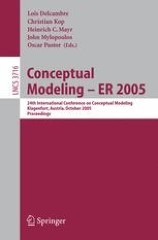
Conceptual Modeling - ER 2005
Conceptual modeling is fundamental to any domain where one must cope with complex real-world situations and systems because it fosters communication - tween technology experts and those who would bene?t from the application of those technologies. Conceptual modeling is the key mechanism for und- standing and representing the domains of information system and database - gineering but also increasingly for other domains including the new “virtual” e-environmentsandtheinformationsystemsthatsupportthem.Theimportance of conceptual modeling in software engineering is evidenced by recent interest in “model-drivenarchitecture”and“extremenon-programming”.Conceptualm- eling also plays a prominent rolein various technical disciplines and in the social sciences. The Annual International Conference on Conceptual Modeling (referred to as the ER Conference) provides a central forum for presenting and discussing current research and applications in which conceptual modeling is the major emphasis.

Concepts and Semantics of Programming Languages 2 : Modular and Object-oriented Constructs with OCaml, Python, C++, Ada and Java
Explores the syntactical constructs of the most common programming languages, and sheds a mathematical light on their semantics, providing also an accurate presentation of the material aspects that interfere with coding. Presents an original semantic model, collectively taking into account all of the constructs and operations of modules and classes: visibility, import, export, delayed definitions, parameterization by types and values, extensions, etc. The model serves for the study of Ada and OCaml modules, as well as C header files. It can be deployed to model object and class features, and is thus used to describe Java, C++, OCaml and Python classes.

Concepts and Semantics of Programming Languages 1 : A Semantical Approach with OCaml and Python
Explores the syntactical constructs of the most common programming languages, and sheds a mathematical light on their semantics, while also providing an accurate presentation of the material aspects that interfere with coding. It is dedicated to functional and imperative features. Included is the formal study of the semantics of typing and execution; their acquisition is facilitated by implementation into OCaml and Python, as well as by worked examples. Data representation is considered in detail: endianness, pointers, memory management, union types and pattern-matching, etc., with examples in OCaml, C and C++. The second volume introduces a specific model for studying modular and object features and uses this model to present Ada and OCaml modules, and subsequently Java, C++, OCaml and Python classes and objects.
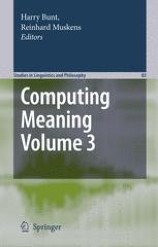
Computing Meaning : Vol.3
This book provides an in-depth view of the current issues, problems and approaches in the computation of meaning as expressed in language. Aimed at linguists, computer scientists, and logicians with an interest in the computation of meaning, this book focuses on two main topics in recent research in computational semantics. The first topic is the definition and use of underspecified semantic representations, i.e. formal structures that represent part of the meaning of a linguistic object while leaving other parts unspecified. The second topic discussed is semantic annotation. Annotated corpora have become an indispensable resource both for linguists and for developers of language and speech technology, especially when used in combination with machine learning methods. The annotation in corpora has only marginally addressed semantic information, however, since semantic annotation methodologies are still in their infancy. This book discusses the development and application of such methodologies.
