



الصفحة 2
الصفحة 2

Fundamentals of airplane flight mechanics
Airplane flight mechanics is the application of Newton's laws to the study of airplane trajectories (performance), stability, and aerodynamic control. This text is limited to flight in a vertical plane and is divided into two parts. The first part, trajectory analysis, is concerned primarily with the derivation of analytical solutions of trajectory problems associated with the sizing of commercial jets, that is, take-off, climb, cruise, descent, and landing, including trajectory optimization. The second part, stability and control, is further classified as static or dynamic. On each iteration of airplane sizing, the center of gravity is placed so that the airplane is statically stable. Dynamic stability and control is included to study the response of an airplane to control and gust inputs, which is needed for the design of automatic flight control systems. Algorithms are presented for estimating lift, drag, pitching moment, and stability derivatives.

Free Convection Film Flows and Heat Transfer
This book presents recent developments in systematic studies of hydrodynamics and heat and mass transfer in laminar free convection, accelerating film boiling and condensation of Newtonian fluids, as well as accelerating film flow of non-Newtonian power-law fluids (FFNF). A novel system of analysis models is provided with a developed velocity component method, instead of traditional Falkner-Skan type transformation, and a system of models for treatment of variable thermophysical properties is presented with an innovative temperature parameter method that makes it easier to similarly treat related governing differential equations for consideration of fluid variable thermophysical properties. A pseudo-similarity method is applied for dealing with thermal boundary layer of FFNF, furthermore, with an induced local Prandtl number, which greatly simplifies the heat-transfer analysis and numerical calculation.
Flowing Matter
This book presents an introduction to selected research topics in the broad field of flowing matter, including the dynamics of fluids with a complex internal structure -from nematic fluids to soft glasses- as well as active matter and turbulent phenomena. Flowing matter is a subject at the crossroads between physics, mathematics, chemistry, engineering, biology and earth sciences, and relies on a multidisciplinary approach to describe the emergence of the macroscopic behaviours in a system from the coordinated dynamics of its microscopic constituents. Depending on the microscopic interactions, an assembly of molecules or of mesoscopic particles can flow like a simple Newtonian fluid, deform elastically like a solid or behave in a complex manner. When the internal constituents are active, as for biological entities, one generally observes complex large-scale collective motions. Phenomenology is further complicated by the invariable tendency of fluids to display chaos at the large scales or when stirred strongly enough. This volume presents several research topics that address these phenomena encompassing the traditional micro-, meso-, and macro-scales descriptions, and contributes to our understanding of the fundamentals of flowing matter.

Essays in Constructive Mathematics
This book aims to promote constructive mathematics, not by defining it or formalizing it, but by practicing it, by basing all definitions and proofs on finite algorithms. The topics covered derive from classic works of nineteenth century mathematics---among them Galois' theory of algebraic equations, Gauss's theory of binary quadratic forms and Abel's theorem about integrals of rational differentials on algebraic curves. It is not surprising that the first two topics can be treated constructively---although the constructive treatments shed a surprising amount of light on them---but the last topic, involving integrals and differentials as it does, might seem to call for infinite processes. In this case too, however, finite algorithms suffice to define the genus of an algebraic curve, to prove that birationally equivalent curves have the same genus, and to prove the Riemann-Roch theorem. The main algorithm in this case is Newton's polygon, which is given a full treatment. Other topics covered include the fundamental theorem of algebra, the factorization of polynomials over an algebraic number field, and the spectral theorem for symmetric matrices.

Economics, Sustainability, and Natural Resources: Economics of Sustainable Forest Management
The economics of sustainability is much more complex than the neoclassical (Newtonian) economic approach to economic efficiency. Forest resources provide the ideal starting point for the economic analysis of sustainability. This book provides a systematic critique of neoclassical economic approaches and their limitations with respect to sustainability. Leading economists from different streams of economics discuss key economic aspects of sustainability and sustainable forest management including complexity, ethical issues, consumer choice theory, intergenerational equity, non-convexities, and multiple equilibria. This is the book which integrates different streams of economics – complexity theory, behavioral economics, post-Keynesian consumer choice theory, social choice theory, and non-convexities – and suggests the main features of Post-Newtonian economics.

Dynamical Systems, Graphs, and Algorithms
Provides a taster for using symbolic analysis, graph theory, and set-oriented methods in a quest to understand the global structure of the dynamics in a continuous- or discrete-time system. In many ways, the techniques discussed here are complementary to more traditional ways of analysing a dynamical system and as such, this book can be viewed as a valuable entry into the theory and computational methods

Courbes algébriques planes = Plane Algebraic Curves
Resulting from a master's course at the University of Paris VII, this text is re-edited as it appeared in 1978. Various tools are introduced in connection with Bézout's theorem necessary for the development of the notion of the multiplicity of intersection of two algebraic curves in the complex projective plane. Starting from elementary notions on affine and projective algebraic subsets, we define the intersection multiplicities and interpret their sum in terms of the resultant of two polynomials. The local study is a pretext for the introduction of formal or convergent series rings; it culminates in Puiseux's theorem, the convergence of which is reduced by splits to that of the theorem of implicit functions. Various figures illuminate the text: we "see" in particular that the homogeneous equation x3 + y3 + z3 = 0 defines a torus in the complex projective plane.

Convergence and Applications of Newton-type Iterations
Recent results in local convergence and semi-local convergence analysis constitute a natural framework for the theoretical study of iterative methods. This monograph provides a comprehensive study of both basic theory and new results in the area. Each chapter contains new theoretical results and important applications in engineering, modeling dynamic economic systems, input-output systems, optimization problems, and nonlinear and linear differential equations. Several classes of operators are considered, including operators without Lipschitz continuous derivatives, operators with high order derivatives, and analytic operators. Each section is self-contained. Examples are used to illustrate the theory and exercises are included at the end of each chapter.

Continuous Optimization : Current Trends and Modern Applications
The search for the best possible performance is inherent in human nature. Individuals, enterprises and governments all seek optimal—that is, the best—possible solutions of problems that they meet. Evidently, continuous optimization plays an increasingly significant role in everyday management and technical decisions in science, engineering and commerce. The collection of 16 refereed papers in this book covers a diverse number of topics and provides a good picture of recent research in continuous optimization. The first part of the book presents substantive survey articles in a number of important topic areas of continuous optimization. Most of the papers in the second part present results on the theoretical aspects as well as numerical methods of continuous optimization. The papers in the third part are mainly concerned with applications of continuous optimization.
Computer Algebra in Scientific Computing ; Vol. 4194 ; 9th International Workshop, CASC 2006, Chisinau, Moldova, September 11-15, 2006, Proceedings
This volume contains revised versions of the papers submitted to the workshop by the participants and accepted by the program committee after a thorough reviewing process. The collection of papers included in the proceedings covers not only various expanding applications of computer algebra to scienti?c computing but also the computer algebra systems themselves and the CA algorithms.

Mathematical Masterpieces : Further Chronicles by the Explorers
Experience the discovery of mathematics by reading the original work of some of the greatest minds throughout history. Here are the stories of four mathematical adventures, including the Bernoulli numbers as the passage between discrete and continuous phenomena, the search for numerical solutions to equations throughout time, the discovery of curvature and geometric space, and the quest for patterns in prime numbers. Each story is told through the words of the pioneers of mathematical thought. Particular advantages of the historical approach include providing context to mathematical inquiry, perspective to proposed conceptual solutions, and a glimpse into the direction research has taken.

MacLaurins Physical Dissertations
The Scottish mathematician Colin MacLaurin (1698-1746) is best known for developing and extending Newton’s work in calculus, geometry and gravitation; his 2-volume work "Treatise of Fluxions" (1742) was the first systematic exposition of Newton’s methods. It is well known that MacLaurin was awarded prizes by the Royal Academy of Sciences, Paris, for his earlier work on the collision of bodies (1724) and the tides (1740); however, the contents of these essays are less familiar – although some of the material is discussed in the Treatise of Fluxions - and the essays themselves often hard to obtain.

Leonhard Euler
Euler was not only by far the most productive mathematician in the history of mankind, but also one of the greatest scholars of all time. He attained, like only a few scholars, a degree of popularity and fame which may well be compared with that of Galilei, Newton, or Einstei .This book is based in part on unpublished sources and comes right out of the current research on Euler. It is entirely free of formulae as it has been written for a broad audience with interests in the history of culture and science.
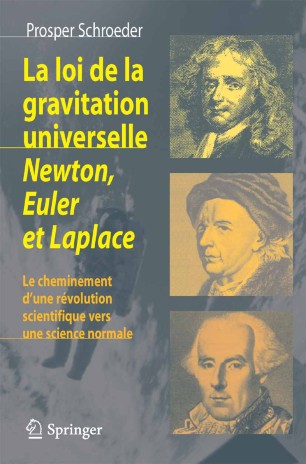
La loi de la gravitation universelle Newton, Euler et Laplace : Le cheminement d’une révolution scientifique vers une science normale = The law of universal gravitation Newton, Euler and Laplace : The progress of a scientific revolution towards a normal science
An analysis of Newton's ideas dismisses this hypothesis by the simple fact that the Principia sought to demonstrate the fallacy of earlier approaches. However, Newton suffered a failure in the application of his theory of gravitation to the explanation of the movement of the Moon, failure which marked the development of celestial mechanics throughout the 18th century. Clairaut, d'Alembert and Euler doubted the validity of Newtonian law almost at the same time and their ideas advanced celestial mechanics which reached the state of "normal science" with Laplace's treatise on celestial mechanics, a century after Newton.
Complexity in chemistry, biology, and ecology
This book, written by an international team of experts, introduces the reader to various aspects of complexity theory and its applications. It illustrates the latest trends in science to go beyond the mechanistic Newtonian view of the world by shifting the focus to self-organization, adaptation, and emergent phenomena. The authors discuss these properties of complex systems in biology, ecology and chemistry along with the structure and interconnectedness of the "layers" of complexity. The qualitative description is complemented by a discussion of methods for complexity quantification. Networks are covered in detail as a universal language of the complex world.
Biomimicry for Optimization, Control, and Automation
In this book, we focus onhowtousebiomimicryof the functionaloperationofthe “hardwareandso- ware” of biological systems for the development of optimization algorithms and feedbackcontrolsystemsthatextendourcapabilitiestoimplementsophisticated levels of automation. The primary focus is not on the modeling, emulation, or analysis of some biological system. The focus is on using “bio-inspiration” to inject new ideas, techniques, and perspective into the engineering of complex automation systems. There are many biological processes that, at some level of abstraction, can berepresentedasoptimizationprocesses,manyofwhichhaveasa basicpurpose automatic control, decision making, or automation.
Bernoulli potential in superconductors : How the electrostatic field helps to understand superconductivity
The motion of electrons in superconductors seems to defy our imagination based on daily experience with Newtonian mechanics. This book shows that the classical concepts, such as the balance of forces acting on electrons, are useful for understanding superconductivity. The electrostatic field plays a natural part in this balance as it mediates forces between electrons at long distances. Due to its classical interpretation, the theory presented in this book is suitable for introductory courses.
Automatic Differentiation : Applications, Theory, and Implementations
This collection covers the state of the art in automatic differentiation theory and practice. Practitioners and students will learn about advances in automatic differentiation techniques and strategies for the implementation of robust and powerful tools. Computational scientists and engineers will benefit from the discussion of applications, which provide insight into effective strategies for using automatic differentiation for design optimization, sensitivity analysis, and uncertainty quantification.

At the crossroads : The world trading system and the Doha Round
Since its foundation in 1995 the legitimacy of the WTO – and herewith the notion of organising global trade on the basis of herewith the notion of organising global trade on the basis of concepts like trade-liberalisation, treaty-based rule of law and concepts like trade-liberalisation, treaty-based rule of law and enforceability – is challenged for very different reasons this volume not only documents the proceedings of this conference but, against the backdrop of the ongoing efforts to revive the Doha Round wants to be understood as some sort of stocktaking: What did really go wrong in Cancún? Where does the WTO stand today? Has there been any progress made since? And, finally: Is there any chance left to reach the ambitions goals postulated by the Doha Development Agenda? These and other, related questions are being discussed in the volume at hand.
Associative and endophytic nitrogen-fixing bacteria and cyanobacterial associations
Associative and Endophytic Nitrogen-fixing Bacteria and Cyanobacterial Associations This book is part of the seven-volume series that was launched a few years ago with the ambitious objectives of reviewing the field of nitrogen fixation from its earliest beginnings through the millennium change and of consolidating the relevant information - from fundamental to agricultural and environmental aspects – all in one place. Volume 5 covers the biology of bacteria that associate with n- leguminous plants. The subject matter includes a wide range of associations; it covers the bacterial species that associate either with the surface or within the tissues of grasses (often referred as plant growth-promoting rhizobacteria) and also the symbiotic associations that cyanobacteria form with fungi, algae, and both lower and higher plants. This volume does not deal with the Frankia-actinorhizal plant associations, which is the topic of Volume 6
