



الصفحة 2
الصفحة 2

Cores to Clusters : Star Formation with Next Generation Telescopes
Toward the second half of this decade, several major telescope facilities operating in the infrared, sub-millimeter, and millimeter wave bands will become operational. These missions are expected to throw much light on our understanding of the star formation phenomenon, which is one of the primary science goals in these wave bands. This book contains the proceedings of the "Cores to Clusters" workshop held at Centro de Astrofisica da Universidade do Porto. The mission of the workshop was to discuss current and future issues in star formation physics in the light of these Next Generation Telescopes. This book is comprised of a mixture of articles that provide a comprehensive coverage of current topics including both low and high mass star formation. It serves as a practical compendium for graduate students and young researchers working in the field of star formation.

Clocks in the Sky : The Story of Pulsars
In this book, Geoff McNamara explores the history, subsequent discovery and contemporary research into pulsar astronomy. The story of pulsars is brought right up to date with the announcement in 2006 of a new breed of pulsar, Rotating Radio Transients (RRATs), which emit short bursts of radio signals separated by long pauses. These may outnumber conventional radio pulsars by a ratio of four to one. Geoff McNamara ends by pointing out that, despite the enormous success of pulsar research in the second half of the twentieth century, the real discoveries are yet to be made including, perhaps, the detection of the hypothetical pulsar black hole binary system by the proposed Square Kilometre Array - the largest single radio telescope in the world.
Lenses and Waves : Christiaan Huygens and the Mathematical Science of Optics in the Seventeenth Century
this book offers the first account of the development of Huygens’ mathematical analysis of lenses and telescopes and its significance for the origin of the wave theory of light. As Huygens applied his mathematical proficiency to practical issues pertaining to telescopes – including trying to design a perfect telescope by means of mathematical theory – his dioptrics is significant for our understanding of seventeenth-century relations between theory and practice. With this full account of Huygens’ optics, this book sheds new light on the history of seventeenth-century optics and the rise of the new mathematical sciences, as well as Huygens’ oeuvre as a whole. Students of the history of optics, of early mathematical physics, and the Scientific Revolution, will find this book enlightening.

L'astrofilo moderno = The modern amateur astronomer
In less than two decades, amateur astronomy has changed its face. The reason, of course, is technological progress. Cheap but high-quality telescopes, computer-controlled "go-to" mounts, autoguiders, CCD cameras, video cameras and (as always) computers and the Internet are just some of the elements that revolutionized 21st century astronomy. Not only have they made amateur astronomy more "friendly" and fun, but they have also greatly expanded the potential of the amateur astronomer. Martin Mobberley first tackles the basic issues and then analyzes in depth what tools are available on the market. From here he starts to review the revolutionary possibilities that open up for amateur astronomers, from imaging, to spectroscopy, to photometry, to the surveillance of Near-Earth objects - comets and asteroids that can come dangerously close to the Earth.
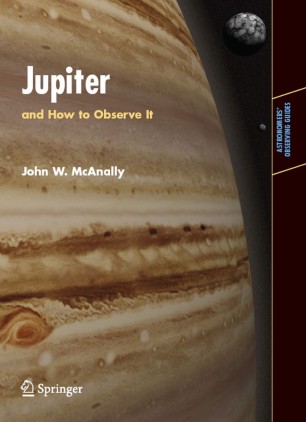
Jupiter : and How to Observe It
Jupiter is one of the most spectacular observing targets for amateur astronomers. There are various books about observing the planets, and several about Jupiter itself, but this is the only book to deal with the giant planet - its formation, structure, and incredible physics - as well as with the practical aspects of observation of the planet and its moons.
Jets from Young Stars II : Clues from High Angular Resolution Observations
This volume contains the edited lecture notes of the Second JETSET School on Jets from Young Stars: Clues from High Angular Resolution Observations organised by the Marie Curie Research Training Network JETSET: Jet Simulations, Experiments and Theory. After the opening two chapters on jet emission, readers can learn the fundamental background of modern high-spatial-resolution techniques, and how such methods have impacted on our understanding of young stars.
Care of Astronomical Telescopes and Accessories : A Manual for the Astronomical Observer and Amateur Telescope Maker
guide for anyone who wants to understand more than just the basics of astronomical telescopes and accessories, and how to maintain them in the peak of condition. The latest on safely adjusting, cleaning, and maintaining your equipment is combined with thoroughly updated methods from the old masters. Here, too, are details of choosing new and used optics and accessories, along with enhancements you can make to extend their versatility and useful lifetime. This book is for you. Really. Looking after an astronomical telescope isn’t only for the experts - although there are some things that only an expert should attempt - and every serious amateur astronomer will find invaluable information here, gleaned from Barlow Pepin's many years’ experience working with optical instruments.
Binocular astronomy
Anyone who has used a binocular telescope or even wide-field binoculars to look at the night sky will know just how breathtakingly beautiful the view can be when you observe with both eyes. Observing galaxies and nebulae with ‘regular’ prismatic binoculars is just a beginning. Binocular eyepieces and adapters can be added to almost any commercially-made astronomical telescope, and of course specialized astronomical binoculars can be assembled or purchased complete. These range from modest instruments to giants that are basically two large telescopes mounted together. Binocular Astronomy contains everything you’ll need to know about this exciting branch of astronomical observing.
Astronomy with a home computer
Here is a one-volume guide to just about everything computer-related for amateur astronomers!Today’s amateur astronomy is inextricably linked to personal computers. Computer-controlled "go-to" telescopes are inexpensive. CCD and webcam imaging make intensive use of the technology for capturing and processing images. Planetarium software provides information and an easy interface for telescopes. The Internet offers links to other astronomers, information, and software. The list goes on and on.
Astronomical sketching : A step-by-step introduction
At some time we have all gazed through the telescope eyepiece at the magnificent rings and banded globe of Saturn, or seen long shadows reaching across crater floors at the Moon’s terminator – and wondered at the sheer beauty of the sight. It seems almost anachronistic to think of sketching when CCD imaging is available, but astronomical sketching provides an entirely different and deeply personal experience. It means spending time at the eyepiece to really look at what you can see, training your eye to perceive ever greater detail to take the fullest advantage of your telescope's light grasp and resolution.
Astrobiology : Future perspectives
Astrobiology, a new exciting interdisciplinary research field, seeks to unravel the origin and evolution of life wherever it might exist in the Universe. The current view of the origin of life on Earth is that it is strongly connected to the origin and evolution of our planet and, indeed, of the Universe as a whole. We are fortunate to be living in an era where centuries of speculation about the two ancient and fundamental problems: the origin of life and its prevalence in the Universe are being replaced by experimental science. The subject of Astrobiology can be approached from many different perspectives. This book is focused on abiogenic organic matter from the viewpoint of astronomy and planetary science and considers its potential relevance to the origins of life on Earth and elsewhere. Guided by the review papers in this book, the concluding chapter aims to identify key questions to motivate future research and stimulate astrobiological applications of current and future research facilities and space missions. Today’s rich array of new spacecraft, telescopes and dedicated scientists promises a steady flow of discoveries and insights that will ultimately lead us to the answers we seek.
African Cultural Astronomy : Current Archaeoastronomy and Ethnoastronomy research in Africa
Astronomy is the science of studying the sky using telescopes and light collectors such as photographic plates or CCD detectors. However, people have always studied the sky and continue to study the sky without the aid of instruments this is the realm of cultural astronomy. This is the first scholarly collection of articles focused on the cultural astronomy of Africans. It weaves together astronomy, anthropology, and Africa. The volume includes African myths and legends about the sky, alignments to celestial bodies found at archaeological sites and at places of worship, rock art with celestial imagery, and scientific thinking revealed in local astronomy traditions including ethnomathematics and the creation of calendars. Authors include astronomers Kim Malville, Johnson Urama, and Thebe Medupe; archaeologist Felix Chami, and geographer Michael Bonine, and many new authors.
A Practical Guide to Lightcurve Photometry and Analysis
A Practical Guide to Lightcurve Photometry and Analysis provides, for those with access to even a modest telescope and CCD camera, all the information needed to take part in the scientific study of asteroids and variable stars.A Practical Guide to Lightcurve Photometry and Analysis contains all the material needed for readers to understand the theory, and avoid the practical pitfalls of lightcurve photometry. Detailed examples are given for obtaining data, and of course for the exciting and rewarding task of analyzing the data to determine the physical properties of the object.

A buyers and users guide to astronomical telescopes & binoculars
Provides an extensive overview of astronomical binoculars and telescopes. It includes detailed up-to-date information on sources, selection and use of virtually every major type, brand, and model of such instruments on today’s market. A Buyer’s & User’s Guide to Astronomical Telescopes and Binoculars is written for amateur astronomers and would-be amateur astronomers. Anyone planning to purchase binoculars or telescopes for astronomy – whether as a first instrument or as an upgrade to the next level – will find this book a treasure-trove of information and advice. But that is just the first part of the book. The second part is crammed with hints and tips on using astronomical telescopes or binoculars – in effect, how to get the best possible results from your purchase.
