


تحسين النتائح
ترتيب حسب
من
الى

Braids and braid groups have been at the heart of mathematical development over the last two decades. Braids play an important role in diverse areas of mathematics and theoretical physics. The special beauty of the theory of braids stems from their attractive geometric nature and their close relations to other fundamental geometric objects, such as knots, links, mapping class groups of surfaces, and configuration spaces. In this presentation the authors thoroughly examine various aspects of the theory of braids, starting from basic definitions and then moving to more recent results. The advanced topics cover the Burau and the Lawrence--Krammer--Bigelow representations of the braid groups, the Alexander--Conway and Jones link polynomials, connections with the representation theory of the Iwahori--Hecke algebras, and the Garside structure and orderability of the braid groups.
Bayesian Reliability presents modern methods and techniques for analyzing reliability data from a Bayesian perspective. The adoption and application of Bayesian methods in virtually all branches of science and engineering have significantly increased over the past few decades. This increase is largely due to advances in simulation-based computational tools for implementing Bayesian methods. The authors extensively use such tools throughout this book, focusing on assessing the reliability of components and systems with particular attention to hierarchical models and models incorporating explanatory variables. Such models include failure time regression models, accelerated testing models, and degradation models. The authors pay special attention to Bayesian goodness-of-fit testing, model validation, reliability test design, and assurance test planning. Throughout the book, the authors use Markov chain Monte Carlo (MCMC) algorithms for implementing Bayesian analyses--algorithms that make the Bayesian approach to reliability computationally feasible and conceptually straightforward.
R's open source nature, free availability, and large number of contributor packages have made R the software of choice for many statisticians in education and industry. Bayesian Computation with R introduces Bayesian modeling by the use of computation using the R language.
This introductory chapter discusses such notions as determinism, chaos and randomness, p- dictibility and unpredictibility, some initial approaches to formalizing r- domness and it surveys certain problems that can be solved by probability theory. This will perhaps give one an idea to what extent the theory can - swer questions arising in speci?c random occurrences and the character of the answers provided by the theory. 1. 1 The Nature of Randomness The phrase “by chance” has no single meaning in ordinary language. For instance, it may mean unpremeditated, nonobligatory, unexpected, and so on. Its opposite sense is simpler: “not by chance” signi?es obliged to or bound to (happen). In philosophy, necessity counteracts randomness. Necessity signi?es conforming to law – it can be expressed by an exact law. The basic laws of mechanics, physics and astronomy can be formulated in terms of precise quantitativerelationswhichmustholdwithironcladnecessity.
In this volume the author further develops his philosophy of quantum interpolation between the real numbers and the p-adic numbers. The p-adic numbers contain the p-adic integers Zp which are the inverse limit of the finite rings Z/pn. This gives rise to a tree, and probability measures w on Zp correspond to Markov chains on this tree. From the tree structure one obtains special basis for the Hilbert space L2(Zp,w). The real analogue of the p-adic integers is the interval [-1,1], and a probability measure w on it gives rise to a special basis for L2([-1,1],w) - the orthogonal polynomials, and to a Markov chain on "finite approximations" of [-1,1]. For special (gamma and beta) measures there is a "quantum" or "q-analogue" Markov chain, and a special basis, that within certain limits yield the real and the p-adic theories. This idea can be generalized variously. In representation theory, it is the quantum general linear group GLn(q)that interpolates between the p-adic group GLn(Zp), and between its real (and complex) analogue -the orthogonal On (and unitary Un )groups. There is a similar quantum interpolation between the real and p-adic Fourier transform and between the real and p-adic (local unramified part of) Tate thesis, and Weil explicit sums.
Applied Stochastic Processes uses a distinctly applied framework to present the most important topics in the field of stochastic processes.
The book presents homogeneous and non-homogeneous semi-Markov processes, as well as Markov and semi-Markov rewards processes. These concepts are fundamental for many applications, but they are not as thoroughly presented in other books on the subject as they are here.This book is intended for graduate students and researchers in mathematics, operations research and engineering; it might also appeal to actuaries and financial managers, and anyone interested in its applications for banks, mechanical industries for reliability aspects, and insurance companies.
Applied Quantitative Finance (2nd edition) provides a comprehensive and state-of-the-art treatment of cutting-edge topics and methods. It provides solutions to and presents theoretical developments in many practical problems such as risk management, pricing of credit derivatives, quantification of volatility and copula modelling. The synthesis of theory and practice supported by computational tools is reflected in the selection of topics as well as in a finely tuned balance of scientific contributions on practical implementation and theoretical concepts. This linkage between theory and practice offers theoreticians insights into considerations of applicability and, vice versa, provides practitioners comfortable access to new techniques in quantitative finance.
The main goal of this book is to cover some of the latest application domains of pattern recognition while presenting novel techniques that have been developed or customized in those domains.
it focus on applications of demographic models, while extending its scope to matrix models for stage-classified populations.first introduce the life table to describe age-specific mortality, and then use it to develop theory for stable populations and the rate of population increase. This theory is then revisited in the context of matrix models, for stage-classified as well as age-classified populations. Reproductive value and the stable equivalent population are introduced in both contexts, and Markov chain methods are presented to describe the movement of individuals through the life cycle. Applications of mathematical demography to population projection and forecasting, kinship, microdemography, heterogeneity, and multi-state models are considered.
Analysis of Computer and Communication Networks presents the academic and research communities with mathematical theory and techniques necessary for analyzing and modeling high-performance global networks, such as the Internet.
This introductory textbook is designed for a one-semester course on queueing theory that does not require a course in stochastic processes as a prerequisite. By integrating the necessary background on stochastic processes with the analysis of models, the work provides a sound foundational introduction to the modeling and analysis of queueing systems for a broad interdisciplinary audience of students in mathematics, statistics, and applied disciplines such as computer science, operations research, and engineering.
Provides a more accessible introduction than other books on Markov processes by emphasizing the structure of the subject and avoiding sophisticated measure theoryLeads the reader to a rigorous understanding of basic theory
In this revised and extended version of his course notes from a 1-year course at Scuola Normale Superiore, Pisa, the author provides an introduction – for an audience knowing basic functional analysis and measure theory but not necessarily probability theory – to analysis in a separable Hilbert space of infinite dimension.Starting from the definition of Gaussian measures in Hilbert spaces, concepts such as the Cameron-Martin formula, Brownian motion and Wiener integral are introduced in a simple way. These concepts are then used to illustrate some basic stochastic dynamical systems (including dissipative nonlinearities) and Markov semi-groups, paying special attention to their long-time behavior: ergodicity, invariant measure. Here fundamental results like the theorems of Prokhorov, Von Neumann, Krylov-Bogoliubov and Khas'minski are proved. The last chapter is devoted to gradient systems and their asymptotic behavior.
Approximation methods are vital in many challenging applications of computational science and engineering. This is a collection of papers from world experts in a broad variety of relevant applications.
This carefully edited book brings together in one volume some of the most important topics of current research in probabilistic graphical modelling, learning from data and probabilistic inference. This includes topics such as the characterisation of conditional independence, the sensitivity of the underlying probability distribution of a Bayesian network to variation in its parameters, the learning of graphical models with latent variables and extensions to the influence diagram formalism. In addition, attention is given to important application fields of probabilistic graphical models, such as the control of vehicles, bioinformatics and medicine.
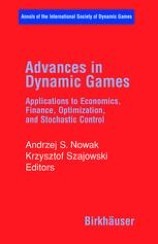
This book focuses on various aspects of dynamic game theory, presenting state-of-the-art research and serving as a guide to the vitality and growth of the field and its applications. The selected chapters, written by experts in their respective disciplines, are an outgrowth of presentations originally given at the 9th International Symposium of Dynamic Games and Applications. Featured throughout are useful tools for researchers and practitioners who use game theory for modeling in many disciplines.

سوريا - اتستراد درعا - غباغب
+963-15 2050 - 15 860 380 /1/2/3 - 11 662 3900