



الصفحة 2
الصفحة 2

Intelligent systems and applications ; Proceedings of the 2020 intelligent systems Conference (IntelliSys) Vol.2
The book Intelligent Systems and Applications - Proceedings of the 2020 Intelligent Systems Conference is a remarkable collection of chapters covering a wider range of topics in areas of intelligent systems and artificial intelligence and their applications to the real world. This book collects both theory and application based chapters on all aspects of artificial intelligence, from classical to intelligent scope.

Intelligent systems and applications ; Proceedings of the 2020 intelligent systems Conference (IntelliSys) Vol.1
The book Intelligent Systems and Applications - Proceedings of the 2020 Intelligent Systems Conference is a remarkable collection of chapters covering a wider range of topics in areas of intelligent systems and artificial intelligence and their applications to the real world. This book collects both theory and application based chapters on all aspects of artificial intelligence, from classical to intelligent scope.

Intelligent information processing and web mining ; Proceedings of the International IIS : IIPWM´06 Conference held in Ustron, Poland, June 19-22, 2006
This volume contains selected papers, presented at the international conference on Intelligent Information Processing and Web Mining Conference IIS:IIPWM'06, organized in Ustro« (Poland) on June 19-22nd, 2006. The submitted papers cover new computing paradigms, among others in biologically motivated methods, advanced data analysis, new machine learning paradigms, natural language processing, new optimization technologies, applied data mining using statistical and non-standard approaches.
Intelligent Computing ; Proceedings of the 2021 Computing Conference ; Vol.1
This book is a comprehensive collection of chapters focusing on the core areas of computing and their further applications in the real world. Each chapter is a paper presented at the Computing Conference 2021 held on 15-16 July 2021. Computing 2021 attracted a total of 638 submissions which underwent a double-blind peer review process. Of those 638 submissions, 235 submissions have been selected to be included in this book. The goal of this conference is to give a platform to researchers with fundamental contributions and to be a premier venue for academic and industry practitioners to share new ideas and development experiences.
Information Retrieval Technology ; Vol. 3689 ; 2nd Asia information retrieval symposium, AIRS 2005, Jeju Island, Korea, October 13-15, 2005, Proceedings
Asia Information Retrieval Symposium (AIRS) was established in 2004 by the Asian information retrieval community after the successful series of Information Retrieval with Asian Languages (IRAL) workshops held in six different locations in Asia, starting from 1996. The AIRS symposium aims to bring together international researchers and developers to exchange new ideas and the latest results in the field of information retrieval (IR). The scope of the symposium covers applications, systems, technologies and theoretical aspects of information retrieval in text, audio, image, video and multi-media data. We are very pleased to report that we saw a sharp and steady increase in the number of submissions and their qualities, compared with previous IRAL workshop series. We received 136 submissions from all over the world including Asia, North America, Europe, Australia, and even Africa, from which 32 papers (23%) were presented in oral sessions and 36 papers in poster sessions (26%). We also held a special session called “Digital Photo Albuming,” where 4 oral papers and 3 posters were presented. It was a great challenge and hard work for the program committee to select the best among the excellent papers. The high acceptance rates witness the success and stability of the AIRS series. All the papers and posters are included in this LNCS (Lecture Notes in Computer Science) proceedings volume, which is S- indexed. The technical program included two keynote talks by Prof. Walter Bender and Prof.
Information Management and Big Data ; 7th Annual International Conference, SIMBig 2020, Lima, Peru, October 1–3, 2020, Proceedings
This book constitutes the refereed proceedings of the 7th International Conference on Information Management and Big Data, SIMBig 2020, held in Lima, Peru, in October 2020.* The 32 revised full papers and 7 revised short papers presented were carefully reviewed and selected from 122 submissions. The papers address topics such as natural language processing and text mining; machine learning; image processing; social networks; data-driven software engineering; graph mining; and Semantic Web, repositories, and visualization.

Information Access through Search Engines and Digital Libraries
he Information Management Systems group at the University of Padua, led by Maristella Agosti, has been a major contributor to information retrieval (IR) and digital libraries for nearly twenty years. This group has gained an excellent reputation in the IR community and has produced some of the best-known IR researchers, whose work spans a broad range of topics.The papers in this book deal with e.g. automated text categorizations, web link analysis algorithms, retrieval in multimedia digital libraries, and multilingual information retrieval. The presentation of original research results built on the past work of the group which at the same time summarizes past .

Implementation and Application of Automata ; Vol. 4094 ; 11th International Conference, CIAA 2006, Taipei, Taiwan, August 21-23, 2006, Proceedings
This book constitutes the refereed proceedings of the 11th International Conference on Implementation and Application of Automata, CIAA 2006, held in Taipei, Taiwan, in August 2006.

High performance computing for drug discovery and biomedicine
Explores the application of high-performance computing (HPC) technologies to computational drug discovery (CDD) and biomedicine. Collects CDD approaches that, together with HPC, can revolutionize and automate drug discovery process, such as knowledge graphs, natural language processing (NLP), Bayesian optimization, automated virtual screening platforms, alchemical free energy workflows, fragment-molecular orbitals (FMO), HPC-adapted molecular dynamic simulation (MD-HPC), and the potential of cloud computing for drug discovery. And delves into computational algorithms and workflows for biomedicine, featuring an HPC framework to assess drug-induced arrhythmic risk, digital patient applications relevant to the clinic, virtual human simulations, cellular and whole-body blood flow modeling for stroke treatments, prediction of the femoral bone strength from CT data, and many more subjects.

Health Information Science ; 9th International Conference, HIS 2020, Amsterdam, The Netherlands, October 20–23, 2020, Proceedings
This book constitutes the proceedings of the 9th International Conference on Health Information Science, HIS 2020, which took place in Amsterdam, The Netherlands, during October 20-23, 2020. The 11 full papers and 6 short papers presented in this volume were carefully reviewed and selected from 62 submissions. They were organized in topical sections named: mental health; medical record processing; medical information systems; medical diagnosis with machine learning; and health behavior and medication.

Hands-on question answering systems with BERT : Applications in neural networks and natural language processing
Begins with an overview of the technology landscape behind BERT. It takes you through the basics of NLP, including natural language understanding with tokenization, stemming, and lemmatization, and bag of words. Next, you’ll look at neural networks for NLP starting with its variants such as recurrent neural networks, encoders and decoders, bi-directional encoders and decoders, and transformer models. Along the way, you’ll cover word embedding and their types along with the basics of BERT. After this solid foundation, you’ll be ready to take a deep dive into BERT algorithms such as masked language models and next sentence prediction. You’ll see different BERT variations followed by a hands-on example of a question answering system. You will: Examine the fundamentals of word embeddings / Apply neural networks and BERT for various NLP tasks / Develop a question-answering system from scratch / Train question-answering systems for your own data

Grammatical Inference ; Algorithms and Applications : 9th International Colloquium, ICGI 2008 Saint-Malo, France, September 22-24, 2008 Proceedings
This book constitutes the refereed proceedings of the 9th International Colloquium on Grammatical Inference, ICGI 2008, held in Saint-Malo, France, in September 2008.The 21 revised full papers and 8 revised short papers presented were carefully reviewed and selected from 36 submissions. The topics of the papers presented vary from theoretical results of learning algorithms to innovative applications of grammatical inference, and from learning several interesting classes of formal grammars to applications to natural language processing.
Grammatical Inference : Algorithms and Applications ; 8th International Colloquium, ICGI 2006, Tokyo, Japan, September 20-22, 2006, Proceedings
The topics discussed range from theoretical results of learning algorithms to innovative applications of grammatical inference and from learning several interesting classes of formal grammars to applications to natural language processing.
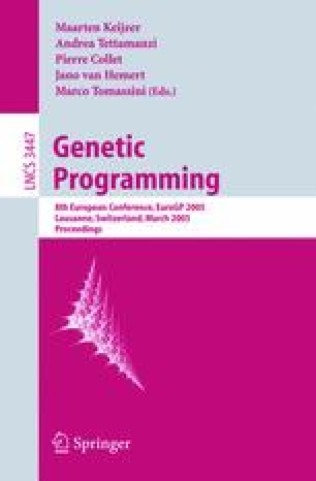
Genetic rogramming ; Vol. 3447 : 8th European conference, EuroGP 2005, Lausanne, Switzerland, March 30-April 1, 2005, Proceedings
In this volume we present the contributions for the 18th European Conference on Genetic Programming (EuroGP 2005). The conference took place from 30 March to 1 April in Lausanne, Switzerland. EuroGP is a well-established conf- ence and the only one exclusively devoted to genetic programming. All previous proceedings were published by Springer in the LNCS series. From the outset, EuroGP has been co-located with the EvoWorkshops focusing on applications of evolutionary computation. Since 2004, EvoCOP, the conference on evolutionary combinatorial optimization, has also been co-located with EuroGP, making this year’s combined events one of the largest dedicated to evolutionary computation in Europe. Genetic programming (GP) is evolutionary computation that solves complex problems or tasks by evolving and adapting a population of computer programs, using Darwinian evolution and Mendelian genetics as its sources of inspiration. Some of the 34 papers included in these proceedings address foundational and theoretical issues and there is also a wide variety of papers dealing with di?erent application areas, such as computer science, engineering, language processing, biology and computational design, demonstrating that GP is a powerful and practical problem-solving paradigm.
Fundamental approaches to software engineering ; 24th International Conference, FASE 2021, Held as Part of the European Joint Conferences on Theory and Practice of Software, ETAPS 2021, Luxembourg City, Luxembourg, March 27 – April 1, 2021, Proceedings
This book constitutes the proceedings of the 24th International Conference on Fundamental Approaches to Software Engineering, FASE 2021, which took place during March 27–April 1, 2021, and was held as part of the Joint Conferences on Theory and Practice of Software, ETAPS 2021.

From Opinion Mining to Financial Argument Mining
Financial opinion mining is a branch of traditional opinion mining and sentiment analysis which shares the basic notions of traditional approaches and adds its own domain-specific characteristics. In Sect. 1.1, we start with a common definition of general opinion mining after which we briefly overview traditional research directions.

From Data to Models and Back ; 9th International Symposium, DataMod 2020, Virtual Event, October 20, 2020, Revised Selected Papers
This book constitutes the refereed proceedings of the 9th International Symposium on From Data Models and Back, DataMod 2020, held virtually, in October 2020. The 11 full papers and 3 short papers presented in this book were selected from 19 submissions. The papers are grouped in these topical sections: machine learning; simulation-based approaches, and data mining and processing related approaches.
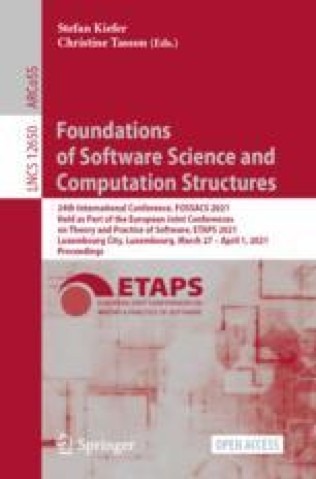
Foundations of software science and computation structures ; 24th International conference, FOSSACS 2021, Held as Part of the European joint conferences on theory and practice of software, ETAPS 2021, Luxembourg City, Luxembourg, March 27 – April 1, 2021, proceedings
This book constitutes the proceedings of the 24th International Conference on Foundations of Software Science and Computational Structures, FOSSACS 2021, which was held during March 27 until April 1, 2021, as part of the European Joint Conferences on Theory and Practice of Software, ETAPS 2021. The conference was planned to take place in Luxembourg and changed to an online format due to the COVID-19 pandemic.
Foundation models for natural language processing : pre-trained language models integrating media
Covers basic natural language processing models, pre-trained language models BERT, GPT, and sequence-to-sequence converters, as well as the concepts of self-attention and context-sensitive embedding. Various approaches to improving these models are then discussed, such as expanding the pre-training parameters, increasing the length of input texts, or incorporating additional knowledge. An overview of the best performing models is then provided for about twenty application areas, e.g., question answering, translation, story generation, dialogue systems, image generation from text, etc. For each application area, the strengths and weaknesses of existing models are discussed, and an overview of further developments is provided. In addition, links to freely available code are provided. The concluding chapter summarizes the economic opportunities, risk mitigation, and potential developments of AI.
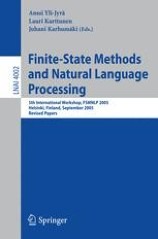
Finite-state methods and natural language processing ; 5th International Workshop, FSMNLP 2005, Helsinki, Finland, September 1-2, 2005, Revised Papers
This book constitutes the thoroughly refereed post-proceedings of the 5th International Workshop on Finite-State Methods in Natural Language Processing, FSMNLP 2005, held in Helsinki, Finland, September 2005. The book presents 24 revised full papers and seven revised poster papers together with two invited contributions and abstracts of six software demos. Topics include morphology, optimality theory, some special FSM families, weighted FSM algorithms, FSM representations, exploration, ordered structures, and surface parsing.
