



الصفحة 2
الصفحة 2

Improving Interagency Collaboration, Innovation and Learning in Criminal Justice Systems : Supporting Offender Rehabilitation
This book to improve collaboration between criminal justice and welfare services in order to help prepare offenders for life after serving a prison sentence. It examines the potential tensions between criminal justice agencies and other organisations which are involved in the rehabilitation and reintegration of offenders, most notably those engaged in mental health care or third sector organisations

Humanistic foundation of criminal law
Uses humanity-rationality and experience and the freedom of human will as a theoretical perspective to examine the basic framework of criminal law theories constructed by the criminal classic school and the criminal empirical school. The author puts forward the principle of the duality of rationality and experience of humanity and affirms the determinism of human behavior in the ontological sense and the freedom of will in the axiological sense. From this point of view, this book examines the humanistic foundations of crime and punishment, legislation and justice.

Hedonic Methods in Housing Markets : Pricing Environmental Amenities and Segregation
Cities are growing worldwide and their sprawl is increasingly challenged for its pressure on open spaces and environmental quality. Economic arguments can help to decide about the trade-off between preserving environmental quality and developing housing and business surfaces, provided the benefits of environmental quality are adequately quantified. To this end, this book focuses on the use and advancement of the "hedonic approach", an economic valuation technique that analyses and quantifies the sources of rent and property price differentials. Starting from theoretical foundations, the hedonic approach is applied to the valuation of natural land use preservation and noise abatement measures, as well as to residential segregation and discrimination, extending the analysis to the role of the buyers' and sellers' identity on housing market prices and to the issue of environmental justice.

Health of People, Health of Planet and Our Responsibility : Climate Change, Air Pollution and Health
This book not only describes the challenges of climate disruption, but also presents solutions. The challenges described include air pollution, climate change, extreme weather, and related health impacts that range from heat stress, vector-borne diseases, food and water insecurity and chronic diseases to malnutrition and mental well-being.

Harnessing the Power of the Criminal Corpse
This book is the culmination of many years of research on what happened to the bodies of executed criminals in the past. Focusing on the eighteenth and nineteenth centuries, it looks at the consequences of the 1752 Murder Act. These criminal bodies had a crucial role in the history of medicine, and the history of crime, and great symbolic resonance in literature and popular culture. Starting with a consideration of the criminal corpse in the medieval and early modern periods, chapters go on to review the histories of criminal justice, of medical history and of gibbeting under the Murder Act, and ends with some discussion of the afterlives of the corpse, in literature, folklore and in contemporary medical ethics. Using sophisticated insights from cultural history, archaeology, literature, philosophy and ethics as well as medical and crime history, this book is a uniquely interdisciplinary take on a fascinating historical phenomenon.

Guardians of public value : How public organisations become and remain institutions
This book presents case studies of twelve organisations which the public have come to view as institutions. From the BBC to Doctors Without Borders, from the Amsterdam Concertgebouw Orchestra to CERN, this volume examines how some organisations rise to prominence and remain in high public esteem through changing and challenging times

Governing Europe under a Constitution : The Hard Road from the European Treaties to a European Constitutional Treaty
At the summit in Laeken in December 2001 the European Council opened the debate on the reform of the supranational structures through its "Declaration on the Future of the European Union" and proposed a wide-ranging agenda. The European Convention, with the mandate of the European Council, has been forming proposals for a more democratic, transparent and efficient European Union and presented a draft of a Treaty establishing a Constitution for Europe on 20th of June 2003. On these fundaments the Intergovernmental Conference finally came to a compromise in summer 2004 after wrestling especially with the problem of qualified majority voting within the Council. On 29th of October 2004 the Heads of State and Governments of the 25 Member States signed the Treaty.
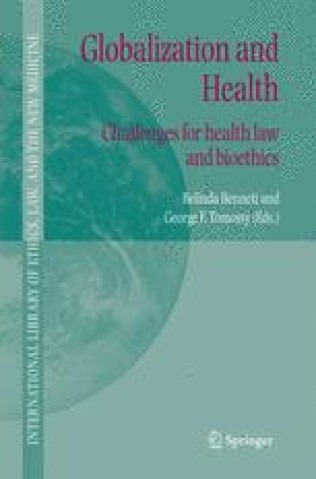
Globalization and Health : Challenges for health law and bioethics
This timely collection explores ethical and legal dilemmas in healthcare arising from globalization. Conflicts between public interests and individual rights, the challenge of regulating professionals and access to health services, and the effects of a global market all feature prominently in contemporary debates in this area. As a result of globalization, issues in health law and bioethics can no longer be understood solely within political boundaries that define traditional notions of individuals and communities. Rather, solutions for emerging problems require a global conception of rights and obligations, including the re-evaluation of ethical frameworks and legal regimes that currently govern exchanges in healthcare. Leading scholars in bioethics, law, medicine and philosophy from various jurisdictions engage these themes in this volume, and demonstrate the need for transnational solutions in a global age of healthcare.

Globalization and Environmental Challenges : Reconceptualizing Security in the 21st Century
This book contiants chapters address the theoretical, philosophical, ethical and religious and spatial context of security; discuss the relationship between security, peace, development and environment; review the reconceptualization of security in philosophy, international law, economics and political science and for the political, military, economic, social and environmental security dimension and the adaptation of the institutional security concepts of the UN, EU and NATO; analyze the reconceptualization of regional security and alternative security futures and draw conclusions for future research and action.

Global Citizenship Education : Critical and International Perspectives
This book takes a critical and international perspective to the mainstreaming of the Global Citizenship Concept and analyses the key issues regarding global citizenship education across the world. In that respect, it addresses a pressing need to provide further conceptual input and to open global citizenship agendas to diversity and indigeneity.

Geo-Spatial Technologies in Urban Environments : Policy, Practice, and Pixels
This book expands the current frame of reference of remote sensing and geographic information specialists to include an array of socio-economic and related planning issues.

Geo-spatial technologies in urban environments : Policy, practice, and pixels
The purpose of this book is to investigate and develop alternate methodological approaches to understand urban environments and urban change. In particular, the study demonstrates the application of remote-sensing data and geographic information systems to the exploration of issues often ignored by the mainstream community of geo-technical specialists such as urban forestry, urban traffic, migration or quality of life in urban areas. Case studies show how disciplines like environmental science and planning, sociology, landscape ecology and architecture, regional science and policy design, and assessment can benefit from employing remote-sensing data and GIS.

General principles of law : the role of the judiciary
Examines the role played by domestic and international judges in the “flexibilization” of legal systems through general principles. It features revised papers that were presented at the Annual Conference of the European-American Consortium for Legal Education, held at the University of Parma.The second section contains studies on the role of general principles in selected legal systems, including International Law, European Union Law as well as Common Law systems.

Gender and the judiciary in Africa: from obscurity to parity
Addresses the important issue of the increasing numbers and varied roles of women judges and justices, as judiciaries evolve across the continent.Scholars of law, gender politics and African politics provide overviews of recent developments in gender and the judiciary in nine African countries that represent north.

Fundamentals of Forensic Practice : Mental Health and Criminal Law
Forensic psychologists and psychiatrists are increasingly asked to provide expertise to courts and attorneys in the criminal justice system. To do so effectively, they must stay abreast of important advances in the understanding of legal standards as well as new developments in sophisticated measures and the methods for their assessment. Fundamentals of Forensic Practice is designed to address the critical issues that are faced by mental health experts in their role of conducting assessments, presenting findings, and preparing for challenges to admissibility and credibility.

Friedrich Nietzsche (1844-1900) : Economy and Society
Until now, Friedrich Nietzsche’s influence on the development of modern social sciences has not been well documented. This volume reconsiders some of Nietzsche’s writings on economics and the science of state and in doing so pioneers a line of research not previously available in English.

Freshwater Governance for the 21st Century
The objective of this book is to broadly illustrate the key aspects of water governance, mapping the spectrum of decision-making from techno-centric and eco-centric approaches, to hybrid concepts and people-centric approaches. Topics covered include the challenges for water-governance models, the polycentric model, the integration challenge, water in the decision-making hierarchy, and the rise of water-sensitive design, while also taking into account interdependencies between stakeholders, as well as the issue of scale.

Foundational texts in modern criminal law
Presents essays in which scholars from various countries and legal systems engage critically with formative texts in criminal legal thought since Hobbes. It examines the emergence of a transnational canon of criminal law by documenting its intellectual and disciplinary history and provides a snapshot of contemporary work on criminal law within that historical and comparative context.

Forensic psychology: crime, justice, law, interventions
Provides an introduction for more detailed postgraduate courses. Introduces forensic psychology to students and professionals who want to better understand psychology's expanding influence on the study of law, crime and criminality Forensic psychology is a constantly growing discipline, both in terms of student interest and as a profession for graduates. This book highlights the often sizeable gap between media myths surrounding forensic practice and reality. Editors Graham Davies and Anthony Beech present an exciting and broad range of topics within the field, including detailed treatments of the causes of crime, investigative methods, the trial process.

Forensic Genetics in the Governance of Crime
This book uses a critical sociological perspective to explore contemporary ways of reformulating the governance of crime through genetics. Through the lens of scientific knowledge and genetic technology, Machado and Granja offer a unique perspective on current trends in crime governance. They explore the place and role of genetics in criminal justice systems, and show how classical and contemporary social theory can help address challenges posed by social processes and interactions generated by the uses, meanings, and expectations attributed to genetics in the governance of crime
