



الصفحة 18
الصفحة 18

Earthquake disaster simulation of civil infrastructures : From tall buildings to urban areas
Covers a range of numerical modeling approaches, higher performance computation methods, and high fidelity visualization techniques for earthquake disaster simulation of tall buildings and urban areas. It also demonstrates successful engineering applications of the proposed methodologies to typical landmark projects (e.g., Shanghai Tower and CITIC Tower, two of the world's tallest buildings; Beijing CBD and San Francisco Bay Area).

Earth Structures : In Transport, Water and Environmental Engineering
This book describes the principles of working with soil as a construction material, including two basic ways of treating it: geosynthetics and stabilization. The book discusses the design logic and ways to control Earth Structures, which differ significantly from other construction materials. Building with Earth involves greater uncertainty and risk, which means that there is a need for better design detailing and improvement in the quality of financial calculations. The general part of the book gives a detailed description of the principles of limit states according to Eurocode 7, after which geotechnical design is also described. Subsequent chapters concentrate on earth structures for transport, water, and environmental projects. The chapter on Earth Structures in transport engineering presents detailed coverage of limit states of stability and deformation. Earth Structures in water engineering prioritizes the limit state of internal erosion. Earth Structures in environmental engineering describes new designs, in which part of the structure is created from non-standard materials which are usually susceptible to internal collapse, double porosity, unsaturation, etc. It also focuses on protecting the surrounding environment from contamination.

Earth reinforcement and soil structures
Provides a comprehensive explanation and illustration of earth reinforcement and soil structures, from the viewpoint of practising engineers involved in design and construction. This edition has been updated to reflect the latest changes in theory, materials and practice.

Dynamics of MEMS : Models, Methods, Experiments and Applications
This work presents a systematic view of the dynamics of MEMS (microelectromechanical systems), microstructures, and their responses. The focus is on the mecahnical/structural micro domain and the compliant nature of mechanical transmission. Features of this work include: An in-depth treatment of problems that involve reliable modeling, analysis and design, Analytical models with correct dependences on service dimensions, Cantilever based systems for nanofabrication researchers and designers, and Dynamics of complex spring and beam microsystems.

Dynamics of Freezing-Thawing Soil around Subway Shield Tunnels
Addresses development laws for axial strain and excess pore water pressure in silty clay around subway shield tunnels before and after freezing-thawing when subjected to subway loading, as well as the effect of freezing-thawing on the dynamic parameters of silty clay, including the dynamic modulus and damping ratio, introducing readers to the design and construction of bypasses in subway tunnels with the artificial freezing method. On this basis, it then studies the microstructures of silty clay before and after freezing-thawing cyclic loading by means of scanning electron microscope tests and mercury intrusion porosimetry tests. Lastly, the book presents a numerical simulation of the dynamics of silty clay around subway tunnels before and after thawing.

Dynamic Methods for Damage Detection in Structures
Presents an overview of dynamic methods for structural health monitoring and damage detection in structures. This book explains both theoretical and experimental aspects of dynamic non-destructive methods and their connection with inverse and identification problems in structural dynamics.

Dynamic brain : From neural spikes to behaviors ; 12th International Summer School on Neural Networks, Erice, Italy, December 5-12, 2007, Revised Lectures
The volume presents 12 thoroughly revised tutorial papers based on lectures given by leading researchers at the 12th International Summer School on Neural Networks in Erice, Italy, in December 2007.

Dynamic Analysis of Structures
Reflects the latest application of structural dynamics theory to produce more optimal and economical structural designs. The author includes carefully worked-out examples which are solved utilizing more recent numerical methods. These examples pave the way to more accurately simulate the behavior of various types of structures. The essential topics covered include principles of structural dynamics applied to particles, rigid and deformable bodies, thus enabling the formulation of equations for the motion of any structure.

Durability of reinforced concrete structures
Reinforced concrete structures corrode as they age, with significant financial implications, but it is not immediately clear why some are more durable than others. This book looks at the mechanisms for corrosion and how corrosion engineering can be used for these problems to be minimized in future projects. Several different examples of reinforced concrete structures with corrosion problems are described and the various life enhancement solutions considered and applied are discussed. The book includes a chapter on the effectiveness of corrosion monitoring techniques and questions why the reality is at odds with current theory and standards.

Drug discovery with privileged building Blocks : Tactics in medicinal chemistry
Drug Discovery with Privileged Building Blocks traces back PharmaBlock’s founding philosophy of designing privileged building blocks. High-quality building blocks are crucial not only to biological activities of different molecules but also to ADMET properties, which eventually will impact the success rate of drug discovery projects. A thorough study of how building blocks perform in drug molecules and a regular analysis of new building block structures in the latest researches have proven to be a fruitful strategy to generate novel building blocks. Using this strategy, PharmaBlock has supplied the drug industry with a great number of building blocks, which are increasingly being adopted by drug hunters, and these are identified in this book.

Distributed, High-Performance and Grid Computing in Computational Biology ; International Workshop, GCCB 2006, International Workshop, GCCB 2006, Eilat, Israel, January 21, 2007, Proceedings
Modern computational biology and bioinformatics are characterized by large and complex structured data and by applications requiring considerable computing resources, such as processing units, storage elements and software programs. In addition, these disciplines are intrinsically geographically distributed in terms of their instruments, communities and computing resources. Tackling the computational challenges in computational biology and bioinformatics increasingly requires high-end and distributed computing infrastructures, systems and tools.

Distributed Embedded Control Systems : Improving Dependability with Coherent Design
Distributed Embedded Control Systems handles the domains encountered when designing a distributed embedded computer control system as an integrated whole. First to be discussed are some basic issues about real-time systems and their properties, specifically safety. Then, system and hardware architectures are dealt.

Distributed Cooperative Laboratories : Networking, Instrumentation, and Measurements
This is a highly interdisciplinary topic, where various aspects converge: multimedia communications and networking, sensor networks, Grid technology, Quality of Service (QoS) provisioning and control, network management, measurement instrumentation and methodology, architecture of measurement systems. The material is organized into six parts: Technologies for Real-Time Interactive Multimedia Communications; Monitoring, Management and Configuration of Networks and Networking Devices; Data Acquisition and Aggregation in Sensor Networks; Grid Structures for Distributed Cooperative Laboratories; Architectures and Techniques for Tele-Measurements; Virtual Immersive Communications and Distance Learning. Each contribution presents a self-contained treatment, within a framework that provides the reader with an up-to-date picture of the most recent state-of-the-art developments.
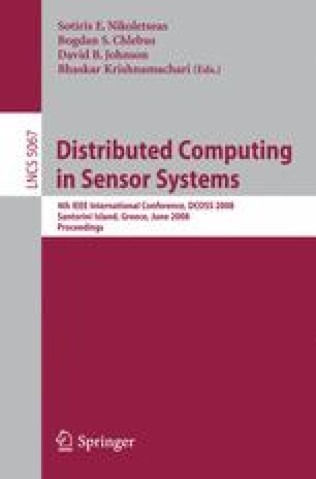
Distributed computing in sensor systems ; 4th IEEE International Conference, DCOSS 2008 Santorini Island, Greece, June 11-14, 2008 Proceedings
The book constitutes the refereed proceedings of the 4th International Conference on Distributed Computing in Sensor Systems, DCOSS 2008, held on Santorini Island, Greece, in June 2008.

Dissonant Heritages and Memories in Contemporary Europe
This book discusses political, economic, social, and humanitarian challenges that influence both how people deal with their past and how they build their identities in contemporary Europe. Ongoing debates on migration, on local, national, inter- and transnational levels, prove that it is a divisive issue with regards to understanding European integration and identity. At the same time, the European Union increasingly invests in projects related to European heritage, museums, and cultural memory networks, while having to take dissonant heritages into account. These processes in their combination offer an interesting dynamic and form the complex puzzle that poses challenging questions for anyone involved in academic research, heritage practices, and policy debates. With this puzzle at its core, this book explicitly focuses on slippery and transforming notions of Europe and critically discusses ongoing and transforming power structures of heritage and memory in today’s Europe.

Dissipative Solitons : From Optics to Biology and Medicine
The dissipative soliton concept is a fundamental extension of the concept of solitons in conservative and integrable systems. It includes ideas from three major sources, namely standard soliton theory developed since the 1960s, nonlinear dynamics theory, and Prigogine's ideas of systems far from equilibrium. These three sources also correspond to the three component parts of this novel paradigm. This book explains the above principles in detail and gives the reader various examples from optics, biology and medicine. These include laser systems, optical transmission lines, cortical networks, models of muscle contraction, localized vegetation structures and waves in brain tissues.

Disordered Materials : An Introduction
This self-contained text introduces the physics of structurally disordered condensed systems at the level of advanced undergraduate and graduate students. Among the topics are the geometry and symmetries of the structural units used as building blocks of extended structures, the various kinds of disorder, the phenomenology and the main theories of the glass transition, the structure of amorphous systems and the techniques to investigate it, the evolution of system's structure with its size (clusters) and the presence of orientational order in the absence of translational order (quasicrystals). In the second edition, the treatment of the mode coupling theory of the glass transition has been enlarged and connects now to a new section on collective excitations in disordered systems. Special attention has been devoted to nanometer-sized disordered systems, with emphasis on cluster-assembled materials. Questions of what governs the occurrence and stability of quasicrystals, the features of the amorphous to quasicrystal transformation and its reverse transition are discussed. The conditions leading to nano-quasicrystalline phases of technological interest are examined. Throughout the text relevant recent experimental and theoretical results are discussed so as to give readers insight into the currently most vibrant research topics.

Digital watermarking ; 6th International Workshop, IWDW 2007 Guangzhou, China, December 3-5, 2007 Proceedings
This book constitutes the refereed proceedings of the 6th International Workshop, IWDW 2007, held in Guangzhou, China, in December 2007.

Digital video and audio broadcasting technology : A practical engineering guide
"Digital Video and Audio Broadcasting Technology – A Practical Engineering Guide" deals with all the most important digital television, sound radio and multimedia standards such as MPEG, DVB, DVD, DAB, ATSC, T-DMB, DMB-T, DRM and ISDB-T. The book provides an in-depth look at these subjects in terms of practical experience.

Digital Technologies in Construction Engineering : Selected Papers
Includes the latest advances, innovations, and applications in the field of construction engineering, as presented by researchers and engineers at the Digital Technologies in Construction Engineering conference, held in Belgorod, Russia, on June 8-9, 2021. It covers highly diverse topics, including industrial and civil construction, building materials; environmental engineering and protection; sustainability; structure safety and special construction structures. The contributions, which were selected by means of a rigorous international peer-review process, highlight numerous exciting ideas that will spur novel research directions and foster multidisciplinary collaborations.
