



الصفحة 17
الصفحة 17
IUTAM symposium on computational approaches to multiphase flow ; Proceedings of an IUTAM Symposium held at Argonne National Laboratory, October 4-7, 2004
The book provides a broad overview of the full spectrum of state-of-the-art computational activities in multiphase flow as presented by top practitioners in the field. It starts with well-established approaches and builds up to newer methods. These methods are illustrated with applications to a broad spectrum of problems involving particle dispersion and deposition, turbulence modulation, environmental flows, fluidized beds, bubbly flows, and many others.
Iterated Function Systems for Real-Time Image Synthesis
Natural phenomena can be visually described with fractal-geometry methods, where iterative procedures rather than equations are used to model objects. With the development of better modelling algorithms, the efficiency of rendering, the realism of computer-generated scenes and the interactivity of visual stimuli are reaching astonishing levels. Iterated Function Systems for Real-Time Image Synthesis gives an explanation of iterated function systems and how to use them in generation of complex objects.
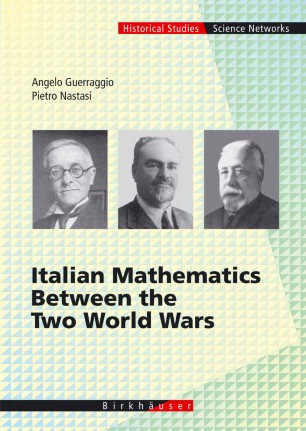
Italian Mathematics Between the Two World Wars
This book describes Italian mathematics in the period between the two World Wars. We analyze its development by focusing on both the interior and the external influences. Italian mathematics in that period was shaped by a colorful array of strong personalities who concentrated their efforts on a select number of fields and won international recognition and respect in an incredibly short time. Italy was also dominated by a fascist regime. This political situation and the social and academic structure of Italian society are included in the analysis as influences external to mathematics itself. The authors have provided a fascinating study of a most difficult time in the history of the world and of mathematics.
Comprehensive mathematics for computer scientists 2 : Calculus and ODEs, splines, probability, fourier and wavelet theory, fractals and neural networks, categories and lambda calculus
This second volume of a comprehensive tour through mathematical core subjects for computer scientists completes the first volume in two - gards: Part III first adds topology, di?erential, and integral calculus to the t- ics of sets, graphs, algebra, formal logic, machines, and linear geometry, of volume 1. With this spectrum of fundamentals in mathematical e- cation, young professionals should be able to successfully attack more involved subjects, which may be relevant to the computational sciences. In a second regard, the end of part III and part IV add a selection of more advanced topics. In view of the overwhelming variety of mathematical approaches in the computational sciences, any selection, even the most empirical, requires a methodological justi?cation. Our primary criterion has been the search for harmonization and optimization of thematic - versity and logical coherence. This is why we have, for instance, bundled such seemingly distant subjects as recursive constructions, ordinary d- ferential equations, and fractals under the unifying perspective of c- traction theory.

Comprehensive mathematics for computer scientists 1 : Sets and numbers, graphs and algebra, logic and machines, linear geometry
This two-volume textbook Comprehensive Mathematics for Computer Scientists is a self-contained comprehensive presentation of mathematics including sets, numbers, graphs, algebra, logic, grammars, machines, linear geometry, calculus, ODEs, and special themes such as neural networks, Fourier theory, wavelets, numerical issues, statistics, categories, and manifolds. The concept framework is streamlined but defining and proving virtually everything.
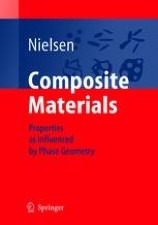
Composite Materials : Properties as Influenced by Phase Geometry
This book deals with the mechanical and physical behavior of composites as influenced by composite geometry. This monograph provides a comprehensive introduction for researchers and students to modern composite materials research with a special emphasis on the influence of geometry to materials properties. Composite Materials enables the reader to a better understanding of the behavior of natural composites, improvement of such materials, and design of new materials with prescribed properties.
Complex, Contact and Symmetric Manifolds : In Honor of L. Vanhecke
This volume contains introductory and contextual material, describe recent developments and research trends in spectral geometry, the theory of geodesics and curvature, contact and symplectic geometry, complex geometry, algebraic topology, homogeneous and symmetric spaces, and various applications of partial differential equations and differential systems to geometry. One of the key strengths of these articles is their appeal to non-specialists, as well as researchers and differential geometers.
Complex Variables with Applications
Complex numbers can be viewed in several ways: as an element in a field, as a point in the plane, and as a two-dimensional vector. Examined properly, each perspective provides crucial insight into the interrelations between the complex number system and its parent, the real number system. It explore these relationships by adopting both generalization and specialization methods to move from real variables to complex variables, and vice versa, while simultaneously examining their analytic and geometric characteristics, using geometry to illustrate analytic concepts and employing analysis to unravel geometric notions. The engaging exposition is replete with discussions, remarks, questions, and exercises, motivating not only understanding on the part of the reader, but also developing the tools needed to think critically about mathematical problems. This focus involves a careful examination of the methods and assumptions underlying various alternative routes that lead to the same destination.

Complex Systems in Biomedicine
Features contributions from several Italian research groups that are working on the field of biomedicine. Each chapter in this book deals with a specific subfield, with the aim of providing an overview of the subject and an account of the research results.
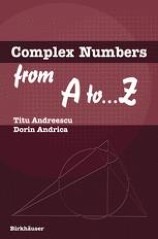
Complex Numbers from A to … Z
It is impossible to imagine modern mathematics without complex numbers. Complex Numbers from A to . . . Z introduces the reader to this fascinating subject that, from the time of L. Euler, has become one of the most utilized ideas in mathematics.The exposition concentrates on key concepts and then elementary results concerning these numbers. The reader learns how complex numbers can be used to solve algebraic equations and to understand the geometric interpretation of complex numbers and the operations involving them.The theoretical parts of the book are augmented with rich exercises and problems at various levels of difficulty. A special feature of the book is the last chapter, a selection of outstanding Olympiad and other important mathematical contest problems solved by employing the methods already presented.The book reflects the unique experience of the authors. It distills a vast mathematical literature, most of which is unknown to the western public, and captures the essence of an abundant problem culture.
Complex Nonlinearity : Chaos, Phase Transitions, Topology Change and Path Integrals
The book starts with a textbook-like expose on nonlinear dynamics, attractors and chaos, both temporal and spatio-temporal, including modern techniques of chaos–control. Chapter 2 turns to the edge of chaos, in the form of phase transitions (equilibrium and non-equilibrium, oscillatory, fractal and noise-induced), as well as the related field of synergetics. While the natural stage for linear dynamics comprises of flat, Euclidean geometry (with the corresponding calculation tools from linear algebra and analysis), the natural stage for nonlinear dynamics is curved, Riemannian geometry (with the corresponding tools from nonlinear, tensor algebra and analysis). The extreme nonlinearity – chaos – corresponds to the topology change of this curved geometrical stage, usually called configuration manifold. Chapter 3 elaborates on geometry and topology change in relation with complex nonlinearity and chaos. Chapter 4 develops general nonlinear dynamics, continuous and discrete, deterministic and stochastic, in the unique form of path integrals and their action-amplitude formalism.
Complex Geometry : An Introduction
Complex geometry studies (compact) complex manifolds. It discusses algebraic as well as metric aspects. The subject is on the crossroad of algebraic and differential geometry. Recent developments in string theory have made it an highly attractive area, both for mathematicians and theoretical physicists. The book contains detailed accounts of the basic concepts and the many exercises illustrate the theory. Appendices to various chapters allow an outlook to recent research directions.
Complex Effects in Large Eddy Simulations
This volume contains a collection of expert views on the state of the art in Large Eddy Simulation (LES) and its application to complex ?ows. Much of the material in this volume was inspired by contributions that were originally presented at the symposium on Complex E?ects in Large Eddy Simulation held in Lemesos (Limassol), Cyprus, between September 21st and 24th, 2005.
Complex Analysis with Applications to Number Theory
The book discusses major topics in complex analysis with applications to number theory.It 's including the theory of several finitely and infinitely complex variables, hyperbolic geometry, two- and three-manifolds, and number theory. In addition to solved examples and problems, the book covers most topics of current interest, such as Cauchy theorems, Picard’s theorems, Riemann–Zeta function, Dirichlet theorem, Gamma function, and harmonic functions.
Complex Analysis : In the Spirit of Lipman Bers
In this book, the main focus is the theory of complex-valued functions of a single complex variable. This theory is a prerequisite for the study of many current and rapidly developing areas of mathematics including the theory of several and infinitely many complex variables, the theory of groups, hyperbolic geometry and three-manifolds, and number theory.
Competitive Programming in Python : 128 Algorithms to Develop your Coding Skills
Learn all the algorithmic techniques and programming skills you need from two experienced coaches, problem setters, and jurors for coding competitions. The authors highlight the versatility of each algorithm by considering a variety of problems and show how to implement algorithms in simple and efficient code. What to expect: * Master 128 algorithms in Python. * Discover the right way to tackle a problem and quickly implement a solution of low complexity.
Compactifying Moduli Spaces for Abelian Varieties
This volume presents the construction of canonical modular compactifications of moduli spaces for polarized Abelian varieties (possibly with level structure), building on the earlier work of Alexeev, Nakamura, and Namikawa. This provides a different approach to compactifying these spaces than the more classical approach using toroical embeddings, which are not canonical. There are two main new contributions in this monograph: (1) The introduction of logarithmic geometry as understood by Fontaine, Illusie, and Kato to the study of degenerating Abelian varieties; and (2) the construction of canonical compactifications for moduli spaces with higher degree polarizations based on stack-theoretic techniques and a study of the theta group.
Compactifications of Symmetric and Locally Symmetric Spaces
Noncompact symmetric and locally symmetric spaces naturally appear in many mathematical theories, including analysis (representation theory, nonabelian harmonic analysis), number theory (automorphic forms), algebraic geometry (modulae) and algebraic topology (cohomology of discrete groups). In most applications it is necessary to form an appropriate compactification of the space. The literature dealing with such compactifications is vast. The main purpose of this book is to introduce uniform constructions of most of the known compactifications with emphasis on their geometric and topological structures. The book is divided into three parts. Part I studies compactifications of Riemannian symmetric spaces and their arithmetic quotients. Part II is a study of compact smooth manifolds. Part III studies the compactification of locally symmetric spaces.
Compact Riemann Surfaces : An Introduction to Contemporary Mathematics
Although Riemann surfaces are a time-honoured field, this book is novel in its broad perspective that systematically explores the connection with other fields of mathematics. It can serve as an introduction to contemporary mathematics as a whole as it develops background material from algebraic topology, differential geometry, the calculus of variations, elliptic PDE, and algebraic geometry. It is unique among textbooks on Riemann surfaces in including an introduction to Teichmüller theory.
Compact Lie Groups
This book covers the structure and representation theory of compact Lie groups. The necessary Lie algebra theory is also developed in the text with a streamlined approach focusing on linear Lie groups.
