



الصفحة 17
الصفحة 17

Computer Supported Cooperative Work in Design III ; 10th International Conference, CSCWD 2006, Nanjing, China, May 3-5, 2006, Revised Selected Papers
The design of complex artifacts and systems requires the cooperation of multidiscip- nary design teams using multiple commercial and proprietary engineering software tools (e.g., CAD, modeling, simulation, visualization, and optimization), engineering databases, and knowledge-based systems. Individuals or individual groups of mult- isciplinary design teams usually work in parallel and separately with various en- neering software tools which are located at different sites. In addition, individual members may be working on different versions of a design or viewing the design from different perspectives, at different levels of detail. In order to accomplish the work, it is necessary to have effective and efficient c- laborative design environments. Such environments should not only automate in- vidual tasks, in the manner of traditional computer-aided engineering tools, but also enable individual members to share information, collaborate, and coordinate their activities within the context of a design project. CSCW (computer-supported coope- tive work) in design is concerned with the development of such environments.

Computer Supported Cooperative Work in Design I
The design of complex artifacts and systems requires the cooperation of multidisciplinary design teams using multiple commercial and non-commercial engineering tools such as CAD tools, modeling, simulation and optimization software, engineering databases, and knowledge-based systems. Individuals or individual groups of multidisciplinary design teams usually work in parallel and separately with various engineering tools, which are located on different sites, often for quite a long time. At any moment, individual members may be working on different versions of a design or viewing the design from various perspectives, at different levels of detail. In order to meet these requirements, it is necessary to have effective and efficient collaborative design environments. These environments should not only automate individual tasks, in the manner of traditional computer-aided engineering tools, but also enable individual members to share information, collaborate and coordinate their activities within the context of a design project. CSCW (computer-supported cooperative work) in design is concerned with the development of such environments.

Computer science logic ; Vol. 4207 ; 20th International Workshop, CSL 2006, 15th Annual Conference of the EACSL, Szeged, Hungary, September 25-29, 2006, Proceedings
Coverage includes automated deduction and interactive theorem proving, constructive mathematics and type theory, equational logic and term rewriting, automata and formal logics, modal and temporal logic, model checking, finite model theory, and more.

Computer Science : Theory and Applications ; 2nd International Symposium on Computer Science in Russia, CSR 2007, Ekaterinburg, Russia, September 3-7, 2007, Proceedings
This book covers theory track deals with algorithms, protocols, and data structures; complexity and cryptography; formal languages, automata and their applications to computer science; computational models and concepts; proof theory; and applications of logic to computer science. Many applications are presented.

Computer science : Theory and applications ; 1st International symposium on computer science in Russia, CSR 2006, St. Petersburg, Russia, June 8-12, 2006, Proceedings
This book constitutes the refereed proceedings of the First International Symposium on Computer Science in Russia, CSR 2006. The 35 revised full theory papers and 29 revised application papers together with 3 invited talks address all major areas in computer science are addressed.

Computer science : Theory and applications ; 15th International computer science symposium in Russia, CSR 2020, Yekaterinburg, Russia, June 29 – July 3, 2020, Proceedings
This book constitutes the proceedings of the 15th International Computer Science Symposium in Russia, CSR 2020, held in Yekaterinburg, Russia, in June 2020. The 25 full papers and 6 invited papers were carefully reviewed and selected from 49 submissions. The papers cover a broad range of topics, such as: algorithms and data structures; computational complexity, including hardness of approximation and parameterized complexity; randomness in computing, approximation algorithms, fixed-parameter algorithms; combinatorial optimization, constraint satisfaction, operations research; computational geometry; string algorithms; formal languages and automata, including applications to computational linguistics; codes and cryptography; combinatorics in computer science; computational biology; applications of logic to computer science, proof complexity; database theory; distributed computing; fundamentals of machine learning, including learning theory, grammatical inference and neural computing; computational social choice; quantum computing and quantum cryptography; theoretical aspects of big data.

Computer Network Security ; Vol. 3685
This volume contains papers presented at the 3rd International Workshop on Mathematical Methods, Models and Architectures for Computer Network - curity (MMM-ACNS 2005) held in St. Petersburg, Russia, 2005. The 1st and the 2nd International Workshops on Mathematical Methods, Models and Architectures for Computer Network Security (MMM-ACNS 2001 and MMM-ACNS 2003), hosted by the St. Petersburg Institute for Informatics and Automation, demonstrated the keen interest of the international research community in the subject area. It was recognized that conducting a biannual series of such workshops in St. Petersburg stimulates fruitful exchanges between the di?erent schools of thought, facilitates the dissemination of new ideas and promotesthespirit of cooperationbetweenresearchersontheinternationalscale. MMM-ACNS 2005 provided an international forum for sharing original - search results and application experiences among specialists in fundamental and applied problems of computer network security. An important distinction of the workshop was its focus on mathematical aspects of information and computer network security addressing the ever-increasing demands for secure computing and highly dependable computer networks.

Computer Mathematics ; 8th Asian Symposium, ASCM 2007, Singapore, December 15-17, 2007. Revised and Invited Papers
This book constitutes thoroughly refereed post-conference proceedings of the 8th Asian Symposium on Computer Mathematics, ASCM 2007, held in Singapore in December 2007.
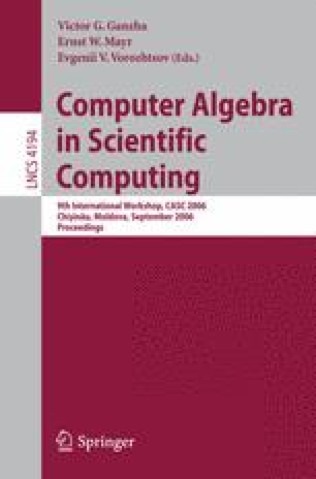
Computer Algebra in Scientific Computing ; Vol. 4194 ; 9th International Workshop, CASC 2006, Chisinau, Moldova, September 11-15, 2006, Proceedings
This volume contains revised versions of the papers submitted to the workshop by the participants and accepted by the program committee after a thorough reviewing process. The collection of papers included in the proceedings covers not only various expanding applications of computer algebra to scienti?c computing but also the computer algebra systems themselves and the CA algorithms.

Computer algebra in scientific computing ; Vol. 3718 ; 8th International workshop, CASC 2005, Kalamata, Greece, September 12-16, 2005, Proceedings
This volume contains the proceedings of the CASC 2005 continued a tradition — started in 1998 — of international con-ferences on the latest advances in the application of computer algebra systems(CASs) and methods to the solution of various problems in scientific computing.The methods of scientific computing play an important role in research andengineering applications in the natural and the engineering sciences. The signif-icance and impact of computer algebra methods and computer algebra systemsfor scientific computing has increased considerably in recent times. Nowadays,such general-purpose computer algebra systems as Maple, Magma, Mathematica,MuPAD, Singular, CoCoA and others enable their users to solve the followingthree important tasks within a uniform framework:(a) symbolic manipulation;(b) numerical computation;(c) visualization. The result of this job is reflected in this volume, which contains revised versionsof the accepted papers. The collection of papers included in the proceedingscovers various topics of computer algebra methods, algorithms, and softwareapplied to scientific computing:
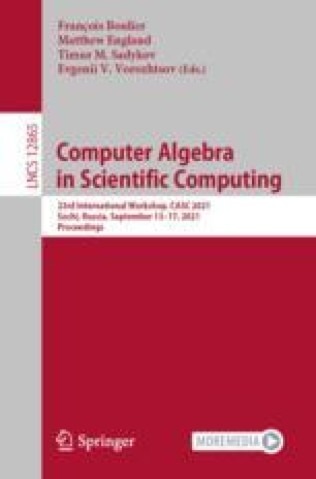
Computer algebra in scientific computing ; 23rd International Workshop, CASC 2021, Sochi, Russia, September 13–17, 2021, Proceedings
This book constitutes the proceedings of the 23rd International Workshop on Computer Algebra in Scientific Computing, CASC 2021, held in Sochi, Russia, in September 2021. The 24 full papers presented together with 1 invited talk were carefully reviewed and selected from 40 submissions. The papers cover theoretical computer algebra and its applications in scientific computing.

Computer Algebra in Scientific Computing ; 10th International Workshop, CASC 2007, Bonn, Germany, September 16-20, 2007, Proceedings
The book covers not only various expanding applications of computer algebra to scientific computing but also the computer algebra systems themselves and the CA algorithms. Topics addressed are studies in polynomial and matrix algebra, quantifier elimination, and Gröbner bases, as well as stability investigation of both differential equations and difference methods for them. Several papers are devoted to the application of computer algebra methods and algorithms to the derivation of new mathematical models in biology and in mathematical physics.

Computer algebra and geometric algebra with applications ; 6th International Workshop, IWMM 2004, Shanghai, China, May 19-21, 2004 and International Workshop, GIAE 2004, Xian, China, May 24-28, 2004.Revised Selected Papers
MathematicsMechanization consistsoftheory,softwareandapplicationofc- puterized mathematical activities such as computing, reasoning and discovering. ItsuniquefeaturecanbesuccinctlydescribedasAAA(Algebraization,Algori- mization, Application). The name “Mathematics Mechanization” has its origin in the work of Hao Wang (1960s), one of the pioneers in using computers to do research in mathematics, particularly in automated theorem proving. Since the 1970s, this research direction has been actively pursued and extensively dev- oped by Prof. Wen-tsun Wu and his followers. It di?ers from the closely related disciplines like Computer Mathematics, Symbolic Computation and Automated Reasoning in that its goal is to make algorithmic studies and applications of mathematics the major trend of mathematics development in the information age.

Computer Aided Verification ; Vol. 4144 ; 18th International Conference, CAV 2006, Seattle, WA, USA, August 17-20, 2006, Proceedings
Presents 35 revised full papers together with 10 tool papers and 4 invited papers adressing all current issues in computer aided verification and model checking - from foundational and methodological issues ranging to the evaluation of major tools and systems.

Computer Aided Verification ; Vol. 3576 ; 17th International Conference, CAV 2005, Edinburgh, Scotland, UK, July 6-10, 2005, Proceedings
This volume contains the proceedings of the International Conference on Computer Aided Veri?cation (CAV), held in Edinburgh, Scotland, 2005. CAV 2005 was the seventeenth in a series of conferences dedicated to the advancement of the theory and practice of computer-assisted formal an- ysis methods for software and hardware systems. The conference covered the spectrum from theoretical results to concrete applications, with an emphasis on practical veri?cation tools and the algorithms and techniques that are needed for their implementation.

Computer Aided Verification ; 33rd International Conference, CAV 2021, Virtual Event, July 20–23, 2021, Proceedings, Part I
This two-volume set LNCS 12759 and 12760 constitutes the refereed proceedings of the 33rd International Conference on Computer Aided Verification, CAV 2021, held virtually in July 2021. The 63 full papers presented together with 16 tool papers and 5 invited papers were carefully reviewed and selected from 290 submissions. The papers were organized in the following topical sections: Part I: invited papers; AI verification; concurrency and blockchain; hybrid and cyber-physical systems; security; and synthesis. Part II: complexity and termination; decision procedures and solvers; hardware and model checking; logical foundations; and software verification.

Computer Aided Verification ; 32nd International Conference, CAV 2020, Los Angeles, CA, USA, July 21–24, 2020, Proceedings, Part II
The two-volume set LNCS 12224 and 12225 constitutes the refereed proceedings of the 32st International Conference on Computer Aided Verification, CAV 2020, held in Los Angeles, CA, USA, in July 2020.*

Computer Aided Verification ; 31st International Conference, CAV 2019, New York City, NY, USA, July 15-18, 2019, Proceedings, Part I
This volume presented automata and timed systems; security and hyperproperties; synthesis; model checking; cyber-physical systems and machine learning; probabilistic systems, runtime techniques; dynamical, hybrid, and reactive systems.

Computer Aided Verification ; 20th International Conference, CAV 2008 Princeton, NJ, USA, July 7-14, 2008 Proceedings
This book constitutes the refereed proceedings of the 20th International Conference on Computer Aided Verification, CAV 2008, held in Princeton, NJ, USA, in July 2008.

Computer Aided Verification ; 19th International Conference, CAV 2007, Berlin, Germany, July 3-7, 2007, Proceedings
This volume contains advancement of the theory and practice of computer-assisted formal analysis methods for software and hardware systems. covers the spectrum from theoretical - sults to concrete applications, with an emphasis on practical verification tools and the algorithms and techniques that are needed for their implementation.
